
Recruitment guide
RRB NTPC 2026: Complete Preparation Roadmap — Explained
Complete preparation roadmap for RRB NTPC 2026 exam with syllabus, study plan, and expert strategies.
The RRB NTPC (Railway Recruitment Board Non-Technical Popular Categories) exam opens doors to various railway jobs across India. With competitive salaries, excellent benefits, and the coveted job security that comes with a government position, railway jobs remain highly popular among Indian job seekers. Lakhs of aspirants from diverse educational backgrounds vie for these coveted positions each recruitment cycle, making it one of the most competitive government exams. This comprehensive guide provides a detailed preparation roadmap for the RRB NTPC 2026 exam, helping you navigate the challenges and emerge successful through a structured and strategic approach.
Indian Railways, a colossal organization and one of the world's largest employers, offers a unique opportunity to contribute to the nation's infrastructure while securing a stable and rewarding career.
Understanding the Appeal of Railway Jobs in India
Before delving into the preparation strategy, it's crucial to understand why so many Indians aspire to work for the Indian Railways. The allure extends beyond just a paycheck, encompassing a holistic sense of security, significant social standing, and a direct contribution to national development.
- Job Security: Government jobs, especially in sectors like railways, offer unparalleled job security, a significant factor in India's competitive job market. This stability provides immense peace of mind, protecting employees from economic downturns, market fluctuations, and corporate restructuring common in the private sector. Employees can plan their lives with confidence, knowing their employment is secure for the long term.
- Competitive Salaries & Allowances: RRB NTPC positions come with attractive salary packages, provident fund, gratuity, and various other allowances like House Rent Allowance (HRA), Dearness Allowance (DA), and travel allowances. These benefits significantly enhance the overall compensation package, ensuring a comfortable lifestyle and financial stability. The periodic pay commission revisions further ensure that salaries remain competitive with inflation.
- Career Growth: The Indian Railways, being one of the largest employers globally, offers ample opportunities for promotions and career progression based on performance, seniority, and departmental examinations. Employees can climb the ranks, taking on greater responsibilities and leadership roles over time, moving from entry-level positions to supervisory and managerial roles. Regular training programs also facilitate skill enhancement and professional development.
- Work-Life Balance: Compared to many private sector roles that often demand long and unpredictable hours, railway jobs typically provide a better work-life balance with fixed working hours and predictable schedules, which is highly valued. This allows employees to dedicate quality time to family, hobbies, personal development, and community engagement, fostering overall well-being.
- Pan-India Presence: Indian Railways is a vast organization with a presence in every corner of the country, offering opportunities to work in various regions, sometimes closer to one's hometown or preferred location. This geographical flexibility can be a major advantage for many aspirants, allowing them to stay connected with their roots or experience diverse cultures across India.
- Social Status: Government jobs, particularly those in prestigious organizations like the Railways, carry significant social prestige and respect in Indian society. Being a railway employee often signifies stability, reliability, and a direct contribution to national infrastructure and public service, earning respect from family, friends, and the wider community.
RRB NTPC Exam Overview
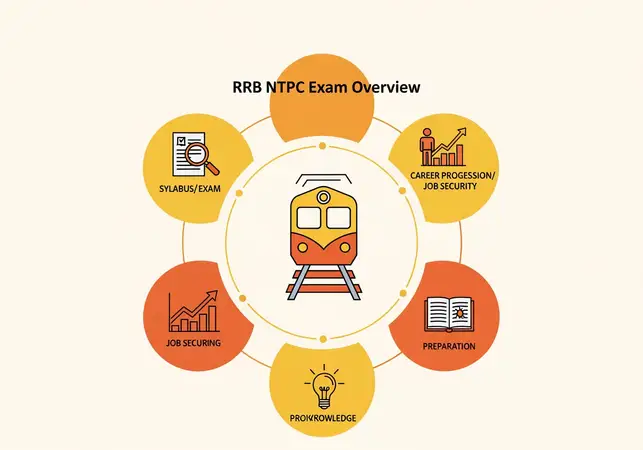
The RRB NTPC selection process typically involves multiple stages, designed to rigorously assess candidates' aptitude and suitability for various non-technical popular categories. Understanding the exam structure and its nuances is the foundational step towards effective preparation, allowing aspirants to strategize their study plan effectively.
- CBT Stage 1 (Prelims): This is a mandatory screening test designed to filter a large number of applicants. Its marks are usually not considered for the final merit list, but qualifying it with a score above the cut-off is absolutely essential to proceed to the next stage. It serves as the first hurdle in the selection process.
- Subjects: Mathematics, General Intelligence and Reasoning, and General Awareness. These three sections comprehensively test a candidate's basic aptitude and general knowledge.
- No. of Questions: 100 questions in total, distributed across the three subjects.
- Total Marks: 100 marks, with each question carrying one mark.
- Duration: 90 minutes (1 hour 30 minutes), requiring candidates to manage their time efficiently to attempt all questions.
- Negative Marking: 1/3rd of the marks allotted for each question is deducted for a wrong answer, emphasizing the importance of accuracy and discouraging random guessing. Unattempted questions do not incur negative marks.
- CBT Stage 2 (Mains): This stage is significantly more challenging and its marks are crucial for the final selection. The number of candidates called for CBT 2 is usually 20 times the total vacancies, ensuring a highly competitive environment where only the best performers advance. This stage is the primary determinant of a candidate's position in the merit list.
- Subjects: Mathematics, General Intelligence and Reasoning, and General Awareness. While the subjects remain the same as Stage 1, the depth and complexity of questions increase significantly.
- No. of Questions: 120 questions, indicating a higher volume of questions to be attempted within the same time frame.
- Total Marks: 120 marks, with each question carrying one mark.
- Duration: 90 minutes (1 hour 30 minutes), making time management even more critical due to the increased number of questions and higher difficulty.
- Negative Marking: 1/3rd of the marks allotted for each question is deducted for a wrong answer, making strategic attempts and a high level of accuracy vital for a good score.
- Difficulty Level: The questions here are generally at a higher difficulty level and require deeper conceptual understanding, advanced problem-solving skills, and quicker analytical abilities than Stage 1.
- Skill Test/Document Verification/Medical Examination: Depending on the specific post applied for, candidates might need to undergo a Computer Based Aptitude Test (CBAT) or a Typing Skill Test (TST). Subsequently, all shortlisted candidates undergo thorough document verification to confirm eligibility criteria such as age, educational qualifications, and caste certificates. Finally, a medical fitness test as per stringent railway standards is conducted to ensure candidates are physically capable of performing their duties.
Post-Specific Skill Tests
Certain posts under RRB NTPC require additional skill assessments to ensure candidates possess the necessary operational abilities for their specific roles. These tests are qualifying in nature or carry specific weightage for the final merit list.
- Computer Based Aptitude Test (CBAT): This test is mandatory for posts like Station Master and Traffic Assistant. It assesses a candidate's cognitive abilities, reaction time, perception, and decision-making skills through various psychological tests. Performance in CBAT is crucial as it carries significant weight (typically 30% of the final merit) in the final merit list for these specific posts, alongside CBT Stage 2 marks. Candidates must qualify in each test battery of CBAT.
- Typing Skill Test (TST): For posts such as Junior Clerk cum Typist, Accounts Clerk cum Typist, Junior Time Keeper, Trains Clerk, and Commercial cum Ticket Clerk, a Typing Skill Test is conducted. Candidates are typically required to type at a speed of 30 words per minute (WPM) in English or 25 WPM in Hindi on a computer. The focus is not just on speed but also on accuracy, with a permissible error limit (usually around 5%) to ensure practical utility in administrative roles. This test is generally qualifying in nature.
Subject-Wise Preparation Strategy
A well-rounded and targeted strategy covering all subjects is critical for excelling in both stages of the RRB NTPC exam. Each section demands a unique approach to master, focusing on both conceptual clarity and efficient problem-solving.
Mathematics (Quantitative Aptitude)
This section tests your numerical ability, logical reasoning, and problem-solving skills. It often proves to be a scoring section for those with strong fundamentals and consistent practice, but can be time-consuming if not approached strategically.
- Key Topics for CBT Stage 1 and Stage 2:
- Number System: LCM, HCF, fractions, decimals, divisibility rules, prime and composite numbers. This is the bedrock of quantitative aptitude; a strong grasp here simplifies many other topics.
- Percentage, Ratio and Proportion: Crucial for understanding relationships between quantities and forms the basis for many other topics like Profit & Loss, Simple & Compound Interest, and Data Interpretation.
- Time and Work, Time and Distance: Involves practical application of speed, efficiency, and rates. Problems often include scenarios with trains, boats and streams, and pipes and cisterns.
- Simple and Compound Interest, Profit and Loss: Focus on formulas and their practical applications in financial scenarios, including discounts, successive percentages, and partnership problems.
- Algebra: Basic algebraic identities, linear equations in one or two variables, polynomials, factorization, and basic inequalities. Requires understanding of fundamental algebraic operations and manipulation.
- Geometry: Properties of basic shapes (triangles, circles, quadrilaterals, polygons), theorems related to angles, lines, and areas.
- Mensuration: Calculating area, volume, and perimeter for 2D figures (squares, rectangles, circles, triangles) and 3D figures (cubes, cuboids, cylinders, cones, spheres).
- Trigonometry: Basic trigonometric ratios, identities, values for standard angles (0°, 30°, 45°, 60°, 90°), and simple problems on heights and distances. Focus on fundamental concepts.
- Statistics: Basic concepts of mean, median, mode, standard deviation, and frequency distribution. Basic understanding of data analysis.
- Data Interpretation: Analyzing and interpreting data presented in tables, bar graphs, line graphs, and pie charts. Requires quick calculation and analytical skills to answer questions based on the given data.
- Practical Advice:
- Master Basics First: Ensure your fundamentals are crystal clear. Don't jump to complex problems without understanding the core concepts. Revisit NCERT textbooks for classes 6-10, particularly for topics like Number System, Algebra, and Geometry, to solidify your foundation. Utilize online tutorials and basic concept books.
- Speed and Accuracy: This section is a major time-consumer. Practice mental calculations, learn Vedic math techniques, and use approximation strategies for faster computation. Regular timed practice of individual topics and mixed questions is non-negotiable. Aim to solve problems accurately within a minute.
- Formula Sheets: Maintain a dedicated notebook for all formulas, theorems, important identities, and shortcut tricks. Revise them daily to ensure quick recall during the exam. Understanding the derivation of formulas can also aid retention.
- Practice Diversely: Solve problems from various sources, including previous year's papers (PYQs) from RRB NTPC and other railway exams, and good quality mock tests. Focus on understanding different problem types and solution approaches. After solving, analyze your mistakes to identify weak areas.
- Real-World Example: For Time and Distance, understand the relationship between speed, distance, and time (D=S*T). Practice problems involving trains crossing platforms, relative speed of objects moving in the same or opposite directions, and boats in streams. For Percentage, relate it to discounts, growth, and depreciation problems to grasp its real-world application and solve problems quickly.
General Intelligence and Reasoning
This section evaluates your analytical, logical thinking, and problem-solving abilities. It's often considered a high-scoring section if approached systematically, as it relies more on logical deduction than rote memorization.
- Key Topics for CBT Stage 1 and Stage 2:
- Analogies: Word, number, and letter-based analogies. Identifying relationships between pairs of items.
- Alphabetical and Number Series: Identifying patterns in sequences, including missing or wrong terms. This requires keen observation and knowledge of number properties.
- Coding-Decoding: Understanding and applying specific rules to encode and decode messages or words. Various patterns can be used, such as letter shifting, number substitution, or mixed patterns.
- Mathematical Operations: Problems involving arithmetic signs and their interchanging to satisfy an equation, or problems based on logical operator symbols.
- Relationships (Blood Relations): Solving family tree-based problems, identifying relationships between individuals from given statements.
- Syllogism: Drawing conclusions from given statements using logical deduction, often involving 'all', 'some', 'no' relationships. Venn diagrams are highly effective for solving these.
- Jumbling: Arranging words or sentences in a meaningful or logical order to form a coherent statement or sequence.
- Venn Diagrams: Representing relationships between categories visually, and interpreting information presented in Venn diagrams.
- Data Interpretation and Sufficiency: Analyzing given data to answer questions or determine if the provided data is sufficient to answer a question. This often overlaps with quantitative aptitude.
- Conclusions and Decision Making: Evaluating statements and making logical judgments based on the information provided, avoiding external assumptions.
- Analytical Reasoning: Puzzles, seating arrangements (linear, circular, square), order and ranking, and complex logical deductions. These require systematic approach and careful tabulation of information.
- Classification: Identifying the odd one out from a group of words, numbers, or figures based on a common property.
- Directions: Problems based on cardinal directions, distances, and relative positions. Requires visualizing movement and calculating displacement.
- Statement-Arguments, Statement-Assumptions, Statement-Course of Action: Critical reasoning questions requiring logical evaluation of statements, identifying strong arguments, valid assumptions, or appropriate courses of action.
- Visual Reasoning: Mirror Images, Water Images, Figure completion, embedded figures, paper folding and cutting, cube and dice problems. These test spatial reasoning.
- Practical Advice:
- Daily Practice: Reasoning improves significantly with consistent practice. Dedicate at least one hour daily to solving a variety of reasoning problems to sharpen your skills and identify common patterns.
- Identify Patterns: For series and coding-decoding, focus on identifying underlying patterns (e.g., differences, squares, cubes, prime numbers, alphabetical positions, reverse order). Practice recognizing these patterns quickly.
- Diagrams for Clarity: Use Venn diagrams for syllogisms and flowcharts or family trees for blood relations to avoid confusion and ensure accuracy. For seating arrangements, draw the layout and fill in information systematically.
- Read Carefully: Especially for statement-based questions (arguments, assumptions, conclusions), understand the nuances of the statements and the question before drawing conclusions. Avoid making assumptions not explicitly stated in the problem.
- Real-World Example: For Blood Relations, practice by drawing family trees to visualize relationships clearly, using symbols for gender and generations. For Syllogisms, visualize the statements using Venn Diagrams to test the validity of conclusions. For Puzzles, break down the information into smaller, manageable chunks, create a table, and build a step-by-step solution, eliminating possibilities as you go.
General Awareness (GA)
This is a vast section covering Static GK, Current Affairs, and General Science. It requires consistent effort and smart study techniques due to its expansive nature. While it can be unpredictable, a structured approach can help cover most important areas.
- Key Topics for CBT Stage 1 and Stage 2:
- Current Affairs: National and International Events, Sports (major tournaments, winners), Awards (National Film Awards, Padma Awards, Nobel Prizes), Appointments (key government officials, international bodies), Books & Authors, Government Schemes (recent initiatives, objectives), Summits & Conferences (G20, BRICS, UN meetings) of the last 6-8 months. Focus on events of national and international significance, especially those impacting India.
- General Science (Physics, Chemistry, Biology): NCERT textbooks up to Class 10 are highly recommended. Focus on basic principles, laws (Newton's laws, Ohm's law), discoveries and inventions, common diseases and their causes, human body systems, elements and compounds, chemical reactions, and everyday science phenomena (e.g., why the sky is blue).
- Indian History: Ancient India (Indus Valley Civilization, Vedic Period, Mauryan, Gupta Empires), Medieval India (Delhi Sultanate, Mughal Empire), and Modern India, with a special focus on the Indian Freedom Struggle (1857 revolt, Gandhi's movements, partition). Understand the chronology of events, key personalities, and their significance.
- Indian Polity: Constitution of India, Preamble, Fundamental Rights & Duties, Directive Principles of State Policy, Parliament (Lok Sabha, Rajya Sabha), President, Prime Minister, Judiciary (Supreme Court, High Courts), Panchayati Raj, Constitutional Amendments. Focus on the structure and functioning of the Indian government and key articles.
- Indian Geography: Physical features (mountains, plateaus, plains, deserts), Rivers and Drainage Systems, Climate, Agriculture (major crops, types of farming), Minerals and Industries, Transport Systems (especially Railways, National Highways), Population. Understand the geographical diversity of India and its impact.
- Indian Economy: Basic economic terms (GDP, inflation, fiscal policy), Five-Year Plans, Banking in India (RBI, nationalized banks), budgets, key economic indicators, poverty and unemployment. Focus on current economic trends and government policies.
- Art & Culture: Famous historical sites (UNESCO World Heritage Sites), classical and folk music, dance forms, festivals, traditional crafts, prominent personalities in arts. Understand the rich cultural heritage of India.
- Computer Fundamentals: Basic knowledge of computer hardware (input/output devices, memory), software (operating systems, applications), networking, internet (protocols, web browsers), and common abbreviations (RAM, ROM, CPU, URL).
- Environmental Issues: Climate change, pollution (air, water, noise), conservation efforts, biodiversity, important environmental agreements and organizations (e.g., Paris Agreement, IPCC).
- Practical Advice:
- Newspaper Reading is Non-Negotiable: Read a national daily newspaper (e.g., The Hindu, The Indian Express) consistently. Focus on national news, economic policies, major international developments, and science & tech updates. Make concise notes of important facts, figures, and events.
- NCERTs for General Science: For a strong foundation in Physics, Chemistry, and Biology, revisit NCERT textbooks from class 6 to 10. These books provide accurate, concise, and easy-to-understand explanations that are often directly tested in government exams.
- Static GK: Create your own notes for historical dates, geographical facts, political articles, and cultural aspects. Use mnemonics, flashcards, or mind maps for effective memorization and regular revision. Categorize topics (e.g., "Rivers of India," "Important Battles") for systematic study.
- Monthly Current Affairs Compilations: Supplement your newspaper reading with monthly current affairs compilations from reputable sources (e.g., coaching institute magazines, online portals). These provide a consolidated overview and help in quick revision before the exam.
- Focus on Indian Railways: Dedicate some specific time to learn about the history, organizational structure, current projects, significant achievements, railway zones, important trains, and railway budget related to Indian Railways. Questions about these are common and specific to the exam.
- Real-World Example: While reading about a new government scheme in the newspaper, simultaneously research its objectives, target beneficiaries, implementing ministry, and budget allocation. When studying Indian history, relate events to their causes and effects rather than just memorizing dates to build a comprehensive understanding and better retention.
Recommended Study Plan for 2026
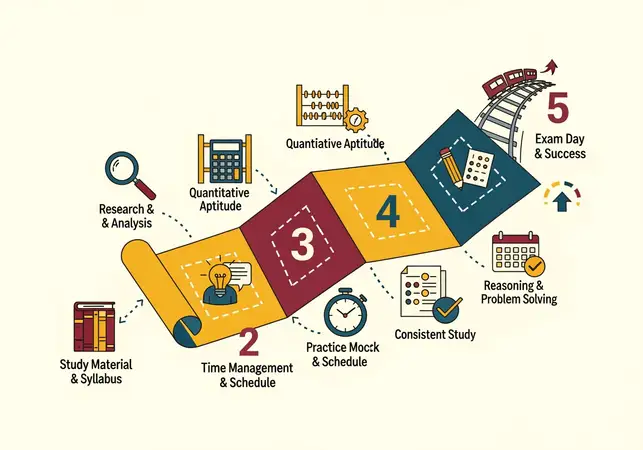
Effective time management and a structured study plan are paramount for success in RRB NTPC. This phased approach ensures comprehensive coverage, targeted practice, and effective revision, minimizing last-minute stress.
Phase 1: Foundation Building (Initial 3-4 Months)
This phase is crucial for building a strong conceptual base across all subjects. Do not rush through this phase; a solid foundation will make subsequent phases much easier.
- Subject Focus: Dedicate equal time to Mathematics, Reasoning, and General Awareness basics. Focus on understanding concepts thoroughly rather than just memorizing formulas or facts. For Mathematics, revisit NCERTs and solve basic problems. For Reasoning, understand different types of problems and their underlying logic. For General Awareness, start with General Science NCERTs and basic Indian History/Polity.
- Daily Schedule (Example):
- 1.5 hours: Mathematics (Concept learning + solving 20-30 basic problems per topic).
- 1.5 hours: General Intelligence and Reasoning (Understanding concepts + solving 20-30 problems per topic).
- 1.5 hours: General Awareness (Reading NCERTs for Science/History/Polity + 30 mins for current affairs from a newspaper).
- 0.5 hours: Revision of previous day's topics and formulas.
- Key Activities:
- Identify your strengths and weaknesses early on.
- Make short notes for each topic, highlighting key concepts and formulas.
- Solve examples and basic exercises from standard textbooks.
- Focus on understanding 'why' behind concepts, not just 'what'.
Phase 2: Intensive Practice & Application (Next 4-5 Months)
Once your foundation is strong, this phase focuses on applying your knowledge, improving speed, and tackling more complex problems. This is where you convert understanding into performance.
- Subject Focus: Continue daily practice for all subjects. For Mathematics, move to moderate to difficult problems. For Reasoning, practice complex puzzles and critical reasoning. For General Awareness, delve deeper into specific topics, current affairs of the last 6-8 months, and start memorizing static GK facts.
- Daily Schedule (Example):
- 1.5 hours: Mathematics (Solving 30-40 mixed problems, focusing on speed and accuracy).
- 1.5 hours: General Intelligence and Reasoning (Solving 30-40 mixed problems, including puzzles and analytical questions).
- 1.5 hours: General Awareness (In-depth study of specific topics + daily current affairs + revision of static GK notes).
- 1 hour: Topic-wise or sectional mock tests (alternating between subjects) and their analysis.
- 0.5 hours: Revision of formulas and difficult GA facts.
- Key Activities:
- Solve previous year's question papers (PYQs) topic-wise to understand exam patterns and question types.
- Start taking topic-wise and sectional mock tests to identify areas needing more practice.
- Work on improving calculation speed and shortcut techniques.
- Regularly revise your notes and current affairs compilations.
- Focus on accuracy while maintaining speed.
Phase 3: Revision & Mock Test Analysis (Last 2-3 Months)
This final phase is dedicated to consolidating your preparation, identifying and rectifying weaknesses, and perfecting your exam strategy through extensive mock test practice.
- Subject Focus: Primarily revision of all subjects. Focus on high-weightage topics and your identified weak areas. Stop learning new major topics in the last month.
- Daily Schedule (Example):
- 2-3 hours: Full-length Mock Test (every alternate day or 3-4 times a week).
- 2-3 hours: Detailed Analysis of the Mock Test (identifying mistakes, understanding solutions, revising related concepts).
- 1-2 hours: Targeted Revision of weak areas identified from mock tests and general revision of all subjects (formulas, GA facts, important concepts).
- RRB NTPC Official Notification
- Detailed RRB NTPC Syllabus
- RRB NTPC Previous Year Papers
- Latest Railway Job Openings
RRB NTPC 2026 Exam Preparation Guide
Related: Railway Job Benefits | Indian Railways Careers | Exam Prep Tips
RRB NTPC FAQs
...[FAQ content]... Related Resources
Reader questions: RRB NTPC
What is RRB NTPC exam?
Railway Recruitment Board Non-Technical Popular Categories exam
When will RRB NTPC 2026 be conducted?
Exact dates announced by RRB
What's the eligibility for RRB NTPC?
Graduation/12th pass depending on post
How many vacancies in RRB NTPC 2026?
Announced in official notification
What's the RRB NTPC selection process?
CBT-1, CBT-2, Typing Test/CBAT
Related Government Job Resources
Continue with active job hubs and related government job pages on TrueJobs.
Tools for this recruitment topic
Use only the tools relevant to the dates, eligibility or documents discussed above.
TrueJobs Editorial Team
TrueJobs editorial desk
This article is prepared from the sources referenced in the guide and reviewed for clarity, links and dated information. Read our editorial and corrections policy.
Continue This Topic
Follow the closest earlier and newer coverage so older archive posts keep real contextual crawl paths.
How Recruiters Actually Shortlist Candidates (Insider Secrets)
Unlock recruiter shortlisting secrets! Learn what makes candidates stand out and boost your job prospects with expert tips.
Gig Economy in India: Opportunities and Challenges
India's gig economy now includes 15M workers in flexible roles. Discover opportunities and challenges shaping this sector.
Read Next

How to Find Hidden Jobs That Are Never Posted Online

Best Job Portals in India Compared (Free vs Paid)

How Often Should You Apply for Jobs Daily?

How to Apply for Jobs Online Safely in India
Explore Topics
Perfect Your Resume
Use our AI-powered Resume Builder to create ATS-optimized resumes.
AI Resume Builder