
Career guide
Common Job Search Mistakes Freshers Make — Explained
Avoid the top mistakes freshers make in their job search. Learn how to present yourself professionally and land your first job faster.
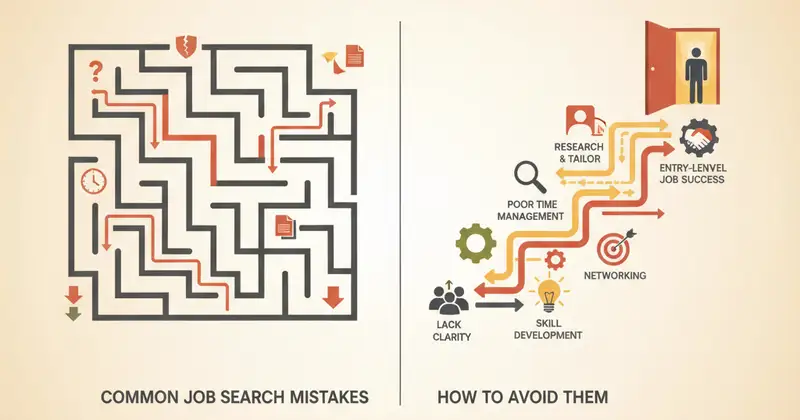
Starting your career journey in India's competitive job market can be daunting. As a fresher, you're full of potential, but a few common missteps can hinder your progress. This guide outlines the critical job search mistakes freshers often make and provides actionable strategies to avoid them, helping you land your first job faster.
Common Job Search Mistakes Freshers Make (And How to Avoid Them)
Mistake 1: Using a Generic Resume
Why It's a Problem:
Many freshers make the critical error of using a single, generic resume for every job application. This approach is highly ineffective in today's competitive job market, especially in India. The primary reason for its failure lies with Applicant Tracking Systems (ATS). Most medium to large companies, and increasingly even smaller ones, utilize ATS to screen resumes before they ever reach a human recruiter. An ATS is essentially a software program designed to scan resumes for specific keywords, phrases, and formatting. If your resume does not contain the keywords and phrases directly relevant to the job description, the ATS will likely filter it out, meaning your application never gets seen by a human.

Beyond the ATS, a generic resume is an instant red flag for human recruiters. When a recruiter sees a resume that clearly hasn't been tailored to the specific role, it signals a lack of effort, a misunderstanding of the position's requirements, and a general lack of attention to detail. Recruiters spend mere seconds scanning each resume, and a non-tailored document fails to highlight how your unique skills and experiences align with their specific needs. This can lead to your application being discarded, regardless of your actual potential or qualifications.
How to Avoid It:
To ensure your resume stands out and effectively communicates your suitability for a role, follow these strategic steps:
- Dissect the Job Description: This is the cornerstone of a tailored resume. Carefully read through the job description and highlight key skills (e.g., "Python," "Data Analysis," "Customer Service"), required qualifications (e.g., "B.Tech in CS," "Fluent in Hindi"), and responsibilities (e.g., "manage client relationships," "develop software modules"). Pay close attention to the action verbs used and the overall tone. This detailed analysis will give you a clear understanding of what the employer is truly looking for in a candidate and the specific language they use to describe it.
- Create a Master Resume: Before tailoring, build a comprehensive master resume. This document should be an exhaustive record of all your academic achievements, projects, internships, volunteer experiences, certifications, skills, and any other relevant accomplishments. Think of it as your personal career database. Having a master resume saves time and ensures you don't forget any valuable experience when customizing for specific roles. It will be your base document from which you selectively pull and adapt information for each application.
- Tailor Each Section: Customization goes beyond just a few keywords.
- Objective/Summary: For freshers, a compelling objective or summary statement should clearly articulate your career goals and how they align with the company's mission and the specific role. Make it unique for each application.
- Skills Section: Directly mirror the skills mentioned in the job description. If the job requires "SQL" and "Python," ensure these are prominently listed in your skills section.
- Experience/Projects Section: Rephrase bullet points from your internships or academic projects to emphasize the skills and outcomes most relevant to the target job. For example, if a job requires "problem-solving," highlight how you solved a specific technical challenge in a project.
- Education Highlights: Mention relevant coursework, academic projects, or thesis topics that directly relate to the job's requirements.

- Quantify Achievements: Wherever possible, use numbers and statistics to demonstrate the impact you made. This transforms vague statements into concrete evidence of your capabilities. For freshers, this might involve quantifying results from academic projects, internships, or even extracurricular activities.
For example, instead of just stating "participated in a college tech fest," you could say "Organized and managed a team of 5 volunteers for the annual college tech fest, resulting in a 20% increase in participant registrations compared to the previous year." Or, instead of "increased sales," say "Increased sales by 25% in 6 months through targeted outreach efforts during my internship." This gives the recruiter a clear, measurable idea of your accomplishments and makes your resume significantly more impactful.
Keywords and Action Verbs: Your Resume's Best Friends
Understanding the role of keywords and action verbs is crucial for ATS optimization and human readability. Keywords are the specific terms and phrases employers use to describe the skills, qualifications, and responsibilities of a job. Action verbs are powerful words that describe your accomplishments and contributions effectively. When tailoring your resume, ensure you integrate these naturally throughout your experience and skills sections. For instance, if a job description uses "developed," "implemented," or "analyzed," try to incorporate these verbs when describing your relevant experiences.
Resume Formatting Tips for ATS:
- Clean and Simple Layout: Avoid complex graphics, unusual fonts, or intricate designs that can confuse ATS. Stick to standard fonts like Arial, Calibri, or Times New Roman.
- Standard Headings: Use conventional headings like "Education," "Experience," "Skills," and "Projects."
- Keyword Placement: Strategically place relevant keywords throughout your resume, not just in a dedicated keyword section. Ensure they appear naturally within your bullet points and summary.
- PDF Format: Unless explicitly asked for a Word document, always submit your resume as a PDF to preserve formatting across different systems.
Mistake 2: Neglecting the Power of Networking
Why It's a Problem:
Many freshers underestimate or completely overlook the immense power of networking in their job search. They often rely solely on online applications, unaware that a significant portion of jobs, particularly in India's competitive market, are filled through referrals or internal recommendations before they are even posted publicly. This phenomenon is known as the "hidden job market." Companies often prefer to hire through referrals because it reduces hiring risk, as the referred candidate comes with an implicit endorsement from a trusted employee. It also speeds up the hiring process and can reduce recruitment costs.
In India, where personal connections and professional relationships (often referred to as "jugaad" in a positive sense of resourcefulness) play a significant role, networking can be a decisive factor in landing a job. Without networking, freshers isolate themselves from potential opportunities, valuable industry insights, and mentorship that could guide their career path. They miss out on learning about companies, roles, and industry trends directly from people working in those fields, which can be far more insightful than what's available online.
How to Avoid It:
To harness the power of networking and open doors to new opportunities, adopt these proactive strategies:
- Reach out to alumni from your college: Your college alumni network is a goldmine of connections. Alumni are often more willing to help fellow graduates. Use platforms like LinkedIn or your college's alumni portal to identify and connect with alumni working in your desired industry or companies. When reaching out, clearly state your connection (e.g., "fellow alumnus from XYZ College, batch of...") and express your admiration for their career path. Ask for advice, insights into their industry, or a brief informational chat, rather than directly asking for a job.
- Attend industry events and webinars: Actively seek out and participate in industry conferences, workshops, seminars, and webinars. Many of these are now available online, making them accessible regardless of your location. These events provide invaluable opportunities to meet professionals in your field, learn about new developments, and understand current industry challenges. Prepare a concise "elevator pitch" about yourself and your career aspirations, and be ready to engage in meaningful conversations.
- Engage meaningfully on LinkedIn: LinkedIn is the premier professional networking platform. Don't just create a profile; actively use it.
- Connect Strategically: Send personalized connection requests to people in your target companies or industries.
- Participate in Discussions: Join relevant industry groups and contribute thoughtful comments to posts.
- Share Relevant Content: Curate and share articles, news, or insights related to your field.
- Publish Your Own Content: Write short posts or articles about your projects, learnings, or career aspirations. This helps build your personal brand and showcases your expertise.
- Ask for informational interviews: An informational interview is a brief conversation with someone working in a field or company that interests you. The goal is not to ask for a job, but to gather information, advice, and insights. Prepare a list of thoughtful questions about their career path, daily responsibilities, industry trends, and advice for freshers. This is an excellent way to expand your network, gain valuable knowledge, and potentially uncover hidden opportunities. Always follow up with a thank-you note.
For instance, you can attend virtual job fairs hosted by platforms like Naukri or LinkedIn, industry-specific conferences (e.g., tech conferences, marketing summits), and networking events organized by professional organizations (e.g., IEEE, NASSCOM, FICCI). You can also join online communities and forums related to your field on platforms like Reddit or specific industry forums to connect with people who can offer guidance and support in your job search.
Building a Professional Brand Online (Beyond LinkedIn):
While LinkedIn is crucial, your professional brand extends to other platforms. Consider creating a personal website or an online portfolio to showcase your projects, skills, and achievements, especially if you are in creative or technical fields. Platforms like GitHub for developers, Behance for designers, or a simple blog can serve as powerful tools to demonstrate your capabilities and passion, making it easier for potential employers to discover your work.
Networking Etiquette:
- Be Respectful of Time: Professionals are busy. Keep your initial messages concise and to the point.
- Personalize Your Outreach: Generic messages are often ignored. Always mention how you know them or why you're reaching out specifically to them.
- Follow Up Thoughtfully: A polite follow-up after an initial interaction or informational interview is crucial.
- Offer Value (Even as a Fresher): While you're seeking advice, think about how you might offer value in return, even if it's just sharing a relevant article or offering to help with a small task if appropriate.
Mistake 3: Having an Unprofessional Online Presence
Why It's a Problem:
In today's hyper-connected digital age, your online presence is an extension of your professional identity. Recruiters, hiring managers, and even potential colleagues routinely search for candidates online as part of their due diligence. They do this to gain a more holistic understanding of your personality, interests, and professional conduct beyond what's presented on your resume. Inappropriate or unprofessional content found online can be a significant deterrent, costing you a job opportunity even if you are otherwise qualified.
What constitutes "inappropriate content"? This can range from overtly offensive posts, discriminatory comments, excessive partying photos, or negative rants about past employers or colleagues, to simply poor grammar and spelling in public posts. Such content can reflect poorly on your judgment, maturity, and potential cultural fit within a company. It can signal a lack of professionalism, discretion, or even ethical concerns, making employers hesitant to take a chance on you. Remember, once something is online, it's often there permanently, forming part of your digital footprint that can be easily accessed.
How to Avoid It:
Proactively manage your online presence to ensure it presents you in the best possible light. Follow these steps to cultivate a professional digital identity:
- Audit your social media profiles: Conduct a thorough review of all your social media accounts (Facebook, Instagram, Twitter, etc.). Search for your name on Google and other search engines to see what comes up.
- Privacy Settings: Set your personal social media profiles to private where possible.
- Content Review: Remove any posts, photos, or comments that could be perceived as unprofessional, offensive, controversial, or overly personal. This includes posts about illegal activities, excessive alcohol consumption, or strong political/religious views that might alienate potential employers.
- Grammar and Spelling: Ensure any public posts or comments are free of grammatical errors and typos, as this reflects on your attention to detail.
- Create a professional LinkedIn profile: LinkedIn is your digital resume and professional networking hub. A strong, professional LinkedIn profile is essential.
- Professional Photo: Use a clear, recent, and professional headshot.
- Compelling Headline and Summary: Craft a headline that highlights your aspirations and a summary that tells your professional story, showcasing your skills and career goals.
- Detailed Experience and Education: Fill out your education, internships, projects, and volunteer work with detailed descriptions, similar to your resume.
- Skills and Endorsements: List relevant skills and seek endorsements and recommendations from professors, mentors, or internship supervisors.
- Activity and Engagement: Regularly engage with industry content, share insights, and connect with professionals.
- Use a professional email address: Your email address is often the first point of contact with an employer. Avoid informal or quirky email addresses (e.g., "coolguy@example.com," "partyanimal@email.com"). Instead, use a professional format, typically your first name and last name (e.g., "firstname.lastname@example.com" or "initial.lastname@example.com").
- Consider what you post publicly: Develop a "think before you post" mindset. Before sharing anything online, ask yourself: "Would I be comfortable with a potential employer seeing this?" If the answer is no, don't post it. Be mindful of your digital footprint and how it contributes to your personal brand. This includes comments on news articles, forums, or even private messages that could potentially become public.
For example, you can dedicate an hour each week to review your online presence, ensuring it aligns with the professional image you want to project. Use LinkedIn to actively showcase your academic projects, certifications, and participation in workshops, demonstrating your commitment to continuous learning and professional development. This proactive management helps you leverage your online presence as an asset rather than a liability in your job search.
Digital Footprint Management:
Your digital footprint is the trail of data you leave online. It's not just about what you post, but also what others post about you. Regularly review tagged photos, comments, and mentions. If something inappropriate appears, politely request its removal or untag yourself. Building a positive digital footprint involves consistently sharing valuable content, engaging professionally, and showcasing your skills and accomplishments.
Leveraging Online Presence Positively:
Instead of just sanitizing your online presence, actively use it to your advantage. Create a professional website or blog if your field allows, showcasing your portfolio, projects, and insights. Participate in online forums or communities related to your industry, offering helpful advice and demonstrating your expertise. This proactive approach can turn your online presence into a powerful tool for attracting employers.
Mistake 4: Being Unprepared for Interviews
Why It's a Problem:
An interview is your golden opportunity to make a lasting impression and demonstrate your suitability for a role. However, many freshers walk into interviews with insufficient preparation, which is immediately evident to experienced interviewers. A lack of preparation signals a lack of genuine interest in the role, poor attention to detail, and potentially a lack of professionalism. This can create a negative impression that is hard to overcome, regardless of your academic achievements.
Signs of unpreparedness include fumbling for answers, giving generic responses, not knowing basic facts about the company, or having no questions to ask the interviewer. For freshers, who may have limited professional experience, preparation is even more critical. It's your chance to demonstrate your potential, enthusiasm, and willingness to learn. Failing to prepare suggests you haven't taken the opportunity seriously, which can significantly hurt your chances of getting hired.
How to Avoid It:
Thorough preparation is the key to a successful interview. Follow these steps to ensure you're ready to impress:
- Research the company thoroughly: Go beyond just their products or services.
- Mission, Vision, Values: Understand what drives the company and if their values align with yours.
- Recent News and Developments: Look for recent press releases, major projects, or industry awards. This shows you're up-to-date and genuinely interested.
- Company Culture: Explore their "Careers" page, employee testimonials, or sites like Glassdoor to get a sense of the work environment.
- Competitors and Industry Trends: Understand the company's position in the market and the broader industry landscape.
- Practice common interview questions: Prepare thoughtful answers to frequently asked interview questions. Don't memorize scripts, but internalize key points.
- "Tell me about yourself." (Craft a concise, professional summary of your background and aspirations.)
- "Why do you want to work for this company?" (Connect your research to your personal goals.)
- "Why are you interested in this role?" (Highlight specific aspects of the job description that excite you.)
- "What are your strengths and weaknesses?" (Be honest but frame weaknesses as areas for growth.)
- "Where do you see yourself in five years?" (Show ambition and alignment with the company's growth path.)
- Behavioral Questions (STAR Method): For questions like "Tell me about a time you faced a challenge," use the STAR method: Situation, Task, Action, Result. This provides a structured, impactful answer.
- Prepare questions to ask the interviewer: Having insightful questions demonstrates your engagement and critical thinking. Avoid asking questions whose answers are easily found on the company website.
- "What does a typical day look like for someone in this role?"
- "What are the biggest challenges facing this team/department right now?"
- "How does the company support employee growth and development?"
- "Can you tell me more about the team I'd be working with?"
- "What are the next steps in the hiring process?"
- Do mock interviews with friends or mentors: Practice makes perfect. Ask friends, family, career counselors, or mentors to conduct mock interviews. This helps you get comfortable articulating your answers, manage your body language, and receive constructive feedback. Record yourself if possible to identify areas for improvement.
For instance, you can use online platforms that offer interview simulation tools or practice with AI interview coaches. Additionally, review common technical questions if you're applying for a technical role, and be prepared to discuss your academic projects in detail, highlighting your contributions and the lessons learned. Remember to dress professionally, arrive on time (or log in early for virtual interviews), and maintain good eye contact.
Mastering Behavioral Questions (STAR Method):
Behavioral questions are designed to understand how you've handled past situations, as this often predicts future behavior. The STAR method is an excellent framework for answering these:
- Situation: Briefly describe the context or background of the situation.
- Task: Explain the goal you were trying to achieve or the problem you needed to solve.
- Action: Detail the specific steps you took to address the situation or complete the task. Use "I" statements to highlight your individual contribution.
- Result: Describe the outcome of your actions. Quantify the results whenever possible and highlight what you learned.
Post-Interview Etiquette (Thank You Notes):
Always send a personalized thank-you email within 24 hours of your interview. Reiterate your interest in the role, thank the interviewer for their time, and briefly mention something specific you discussed to remind them of your conversation. This shows professionalism and reinforces your positive impression.
Mistake 5: Having Unrealistic Expectations
Why It's a Problem:
It's natural for freshers to dream big – a high-paying job, a prestigious company, or a role perfectly aligned with their passions right out of college. However, having unrealistic expectations about starting salaries, job titles, or immediate career progression can lead to significant frustration and missed opportunities. The Indian job market, especially for freshers, is highly competitive, with a large pool of graduates vying for entry-level positions. Expecting top salaries or dream roles immediately without substantial prior experience or unique skills can prolong your job search and lead to disappointment.
When freshers hold onto these unrealistic expectations, they might reject perfectly good entry-level positions that offer valuable learning experiences, skill development, and a foot in the door. These initial roles, while perhaps not the "dream job," are crucial for building a foundational understanding of corporate culture, developing practical skills, and expanding professional networks. Overlooking these stepping stones can delay your career progression and prevent you from gaining the necessary experience to eventually land those coveted roles.
How to Avoid It:
To navigate the job market effectively and set yourself up for long-term success, cultivate realistic expectations and a strategic mindset:
- Research market salaries for freshers in your field: Before applying, understand the typical salary range for entry-level positions in your chosen industry and location. Use reliable online resources such as Glassdoor, Payscale, Naukri Salary, or LinkedIn Salary insights. Talk to career counselors or recent graduates in your network. This research will give you a realistic idea of what you can expect to earn and help you evaluate job offers without being swayed by inflated expectations. Remember that factors like company size, location (metro vs. tier-2 city), and specific skill sets can significantly influence starting salaries.
- Be open to entry-level positions: Don't be afraid to start at the bottom. Entry-level roles, internships, apprenticeships, or even contract positions are invaluable for gaining practical experience, learning industry best practices, and understanding the corporate environment. View these roles not as limitations, but as essential building blocks for your career. They provide a platform to apply theoretical knowledge, develop new skills, and demonstrate your work ethic to potential future employers.
- Focus on learning and growth opportunities: When evaluating job offers, look beyond just the salary. Prioritize companies that offer robust training and development programs, mentorship opportunities, exposure to diverse projects, and a clear path for career progression. A role that provides significant learning and growth, even with a modest starting salary, can be far more beneficial in the long run than a higher-paying job with stagnant growth potential. Ask about professional development budgets, internal training, and opportunities to take on new challenges during interviews.
- Build your career step by step: Understand that a successful career is a marathon, not a sprint. Don't expect to land your dream job immediately after graduation. Instead, focus on acquiring new skills, gaining diverse experiences, and building a strong professional network over time. Each role you take should be a strategic step that contributes to your overall career goals. Be patient, persistent, and adaptable, and your career will evolve organically.
For example, if you're a fresh engineering graduate, research typical starting salaries for junior engineers in Bangalore vs. Pune. Be open to roles like "Associate Software Engineer" or "Trainee Analyst" even if your ultimate goal is a senior leadership position. Focus on companies known for their strong learning culture and internal mobility, even if they are not the biggest names in the industry. This pragmatic approach will help you make informed decisions and avoid unnecessary frustration.
Understanding the Fresher Job Market in India:
The Indian job market for freshers is characterized by a high volume of graduates and intense competition. While there are numerous opportunities, employers often seek candidates who demonstrate not just academic prowess but also practical skills, adaptability, and a strong work ethic. Understanding this dynamic helps freshers temper their expectations and focus on what truly makes them employable.
The Value of Internships and Apprenticeships:
Internships and apprenticeships are powerful tools for freshers to gain real-world experience, build a professional network, and often lead to full-time employment. They provide a safe environment to learn, make mistakes, and contribute meaningfully. Even if unpaid or low-paying, the experience gained can be invaluable for future job prospects.
Mistake 6: Giving Up Too Soon
Why It's a Problem:
The job search process, especially for freshers, can be a long and arduous journey filled with rejections. It's common to apply to dozens, even hundreds, of jobs and receive little to no response, or face rejection after several interview rounds. This can be incredibly disheartening and lead many freshers to give up prematurely. However, it's crucial to understand that rejection is a normal, almost inevitable, part of the job search process and is rarely personal. The job market
Related: Resume Tips | Interview Prep | Job Strategies
Starting your career journey? Learn the top mistakes freshers make in job searches and how to avoid them. Navigate India's competitive market successfully.
Essential Job Search Tools for Freshers
Beyond avoiding mistakes, using the right tools can accelerate your job search. A well-crafted resume builder and a must-have for any fresher looking to create an ATS-friendly document.
Leveraging job portals like TrueJobs.co.in that specialize in government and public sector opportunities in India can provide a targeted approach, saving you time and effort.
Staying Motivated in Your Job Search
The process can be long and sometimes discouraging. It's important to set small, achievable goals, such as applying to a certain number of relevant jobs each week.
Celebrate small victories, like getting a callback or a positive response, to maintain a positive mindset throughout your journey.
FAQ
What's wrong with generic resumes?ATS rejects themHow to improve applications?Tailor resumesRelated Resources
- How to Write a Resume for Government Jobs
- Latest Government Jobs for Freshers
- Government Job Interview Preparation Guide
Put this advice into practice
Your first job search is a learning experience. By avoiding these common mistakes, you significantly increase your chances of success. Stay persistent, keep learning, and your efforts will pay off with a rewarding career start in India's dynamic job market.
TrueJobs Editorial Team
TrueJobs editorial desk
This article is prepared from the sources referenced in the guide and reviewed for clarity, links and dated information. Read our editorial and corrections policy.
Continue This Topic
Follow the closest earlier and newer coverage so older archive posts keep real contextual crawl paths.
Read Next

How to Build a Career Without Campus Placement
Best Career Options After 12th in India

Best Career Options After Graduation in India

Freelancing vs Full-Time Jobs: Pros and Cons
Explore Topics
Perfect Your Resume
Use our AI-powered Resume Builder to create ATS-optimized resumes.
AI Resume Builder