SSC CGL 2026 Preparation Guide: Syllabus, Strategy, and Tips

The SSC CGL (Combined Graduate Level) examination is a highly sought-after gateway to prestigious government posts in India. Annually, lakhs compete for a stable, respectable, and rewarding career in the public sector, offering financial security and growth. This comprehensive guide provides essential information, from exam structure to a winning preparation strategy for SSC CGL 2026.
Understanding the SSC CGL Exam Pattern
The SSC CGL exam is a multi-tiered process assessing aptitude, knowledge, and analytical skills. Understanding its pattern is crucial for tailoring an effective study plan.
Tier 1: Preliminary Examination (Computer Based Examination, CBT)
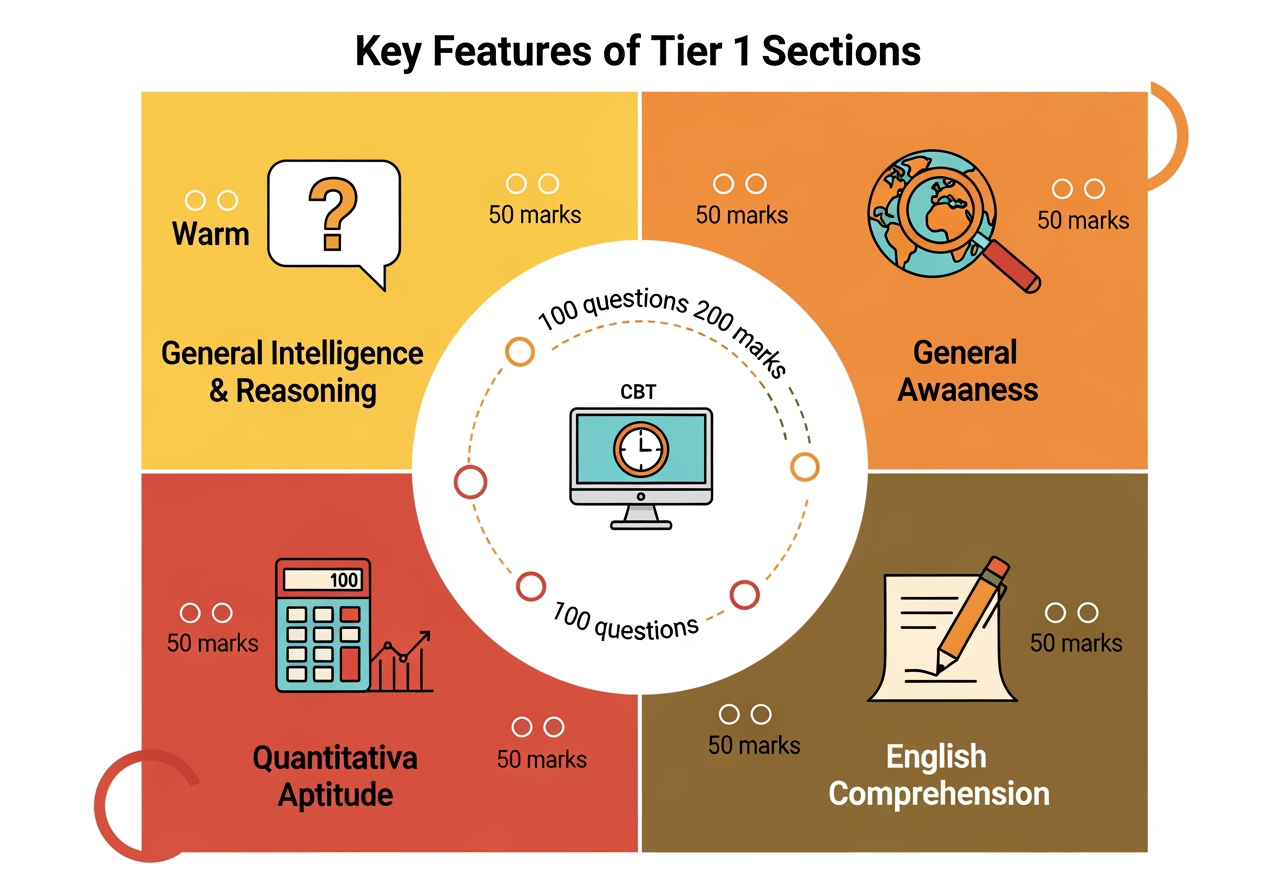
Tier 1 serves as an objective, online screening test (CBT) with four sections. Each section comprises 25 questions worth 50 marks, culminating in a total of 100 questions for 200 marks. Candidates are allotted 60 minutes (80 minutes for PWD candidates) to complete the exam, demanding both speed and accuracy. A negative marking of 0.50 for each incorrect answer underscores the importance of careful attempts.
Key Features of Tier 1 Sections
-
General Intelligence and Reasoning (25 questions, 50 marks): This section evaluates logical thinking, pattern identification, and analytical problem-solving. Topics include analogies, series, coding-decoding, syllogism, Venn diagrams, statement & conclusion, and non-verbal reasoning. Developing strong logical deduction skills and practicing a variety of question types are key to excelling here. Time management is critical, as some problems can be time-consuming.
-
General Awareness (25 questions, 50 marks): This section covers a broad spectrum of knowledge, including History, Geography, Polity, Economics, General Science, and Current Affairs. Unlike other sections, this relies heavily on rote learning and continuous updates. Regular reading of newspapers, magazines, and static GK books is essential. Focus on significant events, constitutional provisions, scientific discoveries, and economic principles. For current affairs, aim to cover at least 6-8 months prior to the examination date.
-
Quantitative Aptitude (25 questions, 50 marks): This section tests numerical ability and problem-solving skills. Topics range from arithmetic (percentages, ratio and proportion, profit and loss, time and work, speed, distance and time, simple and compound interest) to advanced mathematics (algebra, geometry, trigonometry, mensuration, data interpretation). A strong foundation in basic mathematical concepts and extensive practice with shortcuts and formulas are vital. Regular practice of previous year's questions is highly recommended to understand the pattern and difficulty level.
-
English Comprehension (25 questions, 50 marks): This section assesses a candidate's understanding of the English language. It includes questions on grammar (spotting errors, sentence improvement), vocabulary (synonyms, antonyms, idioms & phrases, one-word substitution), and comprehension (reading passages, cloze test, jumbled sentences). Building a strong vocabulary through daily reading and consistent practice of grammar rules are paramount. Reading English newspapers and novels can significantly improve comprehension and vocabulary.
Tier 2: Main Examination (Computer Based Examination, CBT)
Tier 2 is more intensive and comprises multiple papers, depending on the post applied for. It is also a Computer Based Examination (CBT).
-
Paper-I (Compulsory for all posts): This paper is divided into three sections, each with two modules.
- Section-I: Module-I (Mathematical Abilities) & Module-II (Reasoning and General Intelligence): This section is similar to Tier 1 Quantitative Aptitude and Reasoning but with a higher difficulty level. Each module has 30 questions, totaling 60 questions for 180 marks. Time allotted is 1 hour for each module.
- Section-II: Module-I (English Language and Comprehension) & Module-II (General Awareness): English Language and Comprehension has 45 questions for 135 marks, while General Awareness has 25 questions for 75 marks. Total 70 questions for 210 marks. Time allotted is 1 hour for each module.
- Section-III: Module-I (Computer Knowledge Test) & Module-II (Data Entry Speed Test): Computer Knowledge Test has 20 questions for 60 marks, and is qualifying in nature. Data Entry Speed Test requires candidates to type 2000 key depressions in 15 minutes, also qualifying.
-
Paper-II (For Junior Statistical Officer (JSO) posts): This paper focuses on Statistics, with 100 questions for 200 marks. Time allotted is 2 hours. Topics include Collection, Classification and Presentation of Statistical Data, Measures of Central Tendency, Correlation and Regression, Probability Theory, Sampling Theory, Statistical Inference, Variance Analysis, and Time Series Analysis.
-
Paper-III (For Assistant Audit Officer (AAO) and Assistant Accounts Officer (AAO) posts): This paper covers General Studies (Finance and Economics), with 100 questions for 200 marks. Time allotted is 2 hours. It delves into fundamental principles of economics, public finance, financial accounting, and auditing. Candidates should have a strong grasp of economic theories, budgeting, taxation, and basic accounting principles.
There is negative marking in Tier 2 as well. For Paper-I, there is a negative marking of 1 mark for each wrong answer. For Paper-II and Paper-III, there is a negative marking of 0.50 marks for each wrong answer.
SSC CGL 2026 Eligibility Criteria
Before embarking on your preparation journey, it's crucial to ensure you meet the fundamental eligibility requirements set by the Staff Selection Commission (SSC). These criteria typically cover nationality, age, and educational qualifications.
Nationality
A candidate must be either:
- A citizen of India, or
- A subject of Nepal, or
- A subject of Bhutan, or
- A Tibetan refugee who came over to India before 1st January 1962 with the intention of permanently settling in India, or
- A person of Indian origin who has migrated from Pakistan, Burma, Sri Lanka, East African Countries of Kenya, Uganda, the United Republic of Tanzania (formerly Tanganyika and Zanzibar), Zambia, Malawi, Zaire, Ethiopia and Vietnam with the intention of permanently settling in India.
Candidates belonging to categories other than Indian citizens must possess a certificate of eligibility issued by the Government of India.
Age Limit
The age limits vary depending on the specific post. Generally, the age criteria fall within the range of 18 to 32 years. However, some posts may have a minimum age of 20 or 21 years, and some may have an upper limit of 27 or 30 years. Crucially, there are age relaxations for reserved categories as per government rules:
- SC/ST: 5 years
- OBC: 3 years
- PwBD (Unreserved): 10 years
- PwBD (OBC): 13 years
- PwBD (SC/ST): 15 years
- Ex-Servicemen: 3 years after deduction of the military service rendered from the actual age as on the closing date.
- Other categories as specified in the official notification.
Candidates are strongly advised to refer to the official SSC CGL notification for 2026 once it is released to confirm the exact age limits and relaxation details for their desired posts.
Educational Qualification
The primary educational qualification for most SSC CGL posts is a Bachelor's Degree from a recognized University or equivalent. However, for certain specific posts, additional qualifications may be required:
- Junior Statistical Officer (JSO): Bachelor's Degree in any subject with at least 60% marks in Mathematics at 12th standard level; OR Bachelor's Degree in any subject with Statistics as one of the subjects at degree level.
- Assistant Audit Officer (AAO)/Assistant Accounts Officer (AAO): Bachelor's Degree from a recognized University or Institute. Desirable Qualification: Chartered Accountant or Cost & Management Accountant or Company Secretary or Masters in Commerce or Masters in Business Studies or Masters in Business Administration (Finance) or Masters in Business Economics.
Candidates appearing in the final year of their Bachelor's degree are generally eligible to apply, provided they possess the essential qualification on or before the cut-off date specified in the official notification. It is vital to ensure that your degree is from a university recognized by the University Grants Commission (UGC) or an equivalent body.
Comprehensive Preparation Strategy for SSC CGL 2026
A well-thought-out strategy is the cornerstone of success in the highly competitive SSC CGL examination. This involves a structured approach to syllabus coverage, effective study techniques, and consistent practice.
Phase 1: Understanding the Syllabus and Foundation Building (Months 1-3)
- Thorough Syllabus Analysis: Go through the detailed syllabus for both Tier 1 and Tier 2. Identify common topics and areas of overlap. This will help in integrated preparation.
- Gather Study Material: Collect reliable books, online resources, and previous year's question papers. Avoid accumulating too many resources; stick to a few high-quality ones.
- Strengthen Fundamentals: Dedicate this phase to building a strong foundation in all subjects. For Quantitative Aptitude, revise basic arithmetic and advanced math concepts. For English, focus on grammar rules and basic vocabulary. For Reasoning, understand different types of questions and their underlying logic. For General Awareness, start with static GK (History, Geography, Polity).
- Daily Current Affairs: Make it a habit to read a national daily newspaper and follow a reputable current affairs portal. Make concise notes of important events, awards, schemes, and appointments.
- Time Management Basics: Start practicing solving a few questions under timed conditions to get a feel for the exam pressure.
Phase 2: In-depth Study and Practice (Months 4-8)
- Topic-wise Mastery: Dive deep into each topic. Solve a wide variety of questions for each concept. For Quantitative Aptitude, focus on speed and accuracy using shortcuts. For English, practice cloze tests, reading comprehension, and error spotting regularly.
- Mock Tests (Tier 1): Begin taking full-length Tier 1 mock tests at least once a week. Analyze your performance meticulously. Identify weak areas and dedicate extra time to improve them. Don't just look at the score; understand why you got questions wrong or took too long.
- General Awareness Expansion: Expand your General Awareness knowledge to include General Science (Physics, Chemistry, Biology) and Economics. Focus on high-yield topics and frequently asked questions from previous years.
- Computer Knowledge (Tier 2): Start familiarizing yourself with basic computer concepts, MS Office, internet usage, and cyber security. This section is qualifying but essential.
- Specialized Papers (if applicable): If you are aiming for JSO or AAO posts, start studying for Paper-II (Statistics) or Paper-III (Finance & Economics) simultaneously. These papers require dedicated preparation from the outset.
Phase 3: Advanced Practice and Revision (Months 9-12)
- Intensive Mock Tests (Tier 1 & Tier 2): Increase the frequency of mock tests to 2-3 per week for Tier 1, and start taking full-length Tier 2 mocks. Simulate exam conditions as closely as possible.
- Performance Analysis: Continue detailed analysis of mock tests. Focus on improving accuracy, reducing time taken per question, and managing exam pressure. Maintain an error log to revisit mistakes.
- Revision of Weak Areas: Dedicate significant time to revise concepts and topics where you consistently make errors. Use your notes and marked questions for quick revision.
- Previous Year Papers: Solve as many previous year's SSC CGL question papers as possible. This gives invaluable insight into the actual exam pattern, question types, and difficulty levels. Aim to solve papers from the last 5-7 years.
- Speed and Accuracy Drills: Practice specific sections or topics under strict time limits to enhance speed and accuracy. For example, solve 25 quantitative aptitude questions in 15-20 minutes.
- Data Entry Speed Test Practice: For the Data Entry Speed Test, practice typing regularly to achieve the required speed and accuracy. Use online typing tutors or practice with passages from newspapers.
Essential Tips for Success
- Create a Realistic Study Schedule: Develop a daily and weekly study plan that is achievable and sustainable. Allocate specific time slots for each subject and stick to it.
- Quality over Quantity: It's better to thoroughly understand a few topics than to superficially cover many. Focus on conceptual clarity.
- Regular Revision: Consistent revision is key to retaining information. Use flashcards, self-quizzes, and summary notes.
- Stay Updated with Current Affairs: This is a dynamic section. Read newspapers, watch news, and follow reliable online sources daily.
- Maintain Health: A healthy mind resides in a healthy body. Ensure you get adequate sleep, eat nutritious food, and incorporate some physical activity into your routine.
- Stay Positive and Motivated: The journey is long and challenging. Believe in yourself, stay focused, and celebrate small milestones. Avoid negative influences.
- Join a Study Group (Optional): Discussing concepts and solving problems with peers can provide new perspectives and clarify doubts.
- Utilize Online Resources: Many platforms offer free quizzes, video lectures, and practice questions. Use them judiciously. TrueJobs.co.in also provides updates on admit cards and results.
- Analyze Mock Tests Thoroughly: This cannot be stressed enough. Understanding your mistakes is more important than just taking the test.
- Focus on English and Quant for Tier 2: These two sections carry significant weight in Tier 2. A strong performance here can significantly boost your overall score.
FAQ
What is the minimum educational qualification required for SSC CGL?
The minimum educational qualification for most SSC CGL posts is a Bachelor's Degree from a recognized University or equivalent. However, specific posts like Junior Statistical Officer (JSO) and Assistant Audit Officer (AAO) may have additional subject-specific requirements or desirable qualifications.
Is there negative marking in SSC CGL Tier 1 and Tier 2?
Yes, there is negative marking in both Tier 1 and Tier 2. In Tier 1, 0.50 marks are deducted for each incorrect answer. In Tier 2, for Paper-I, 1 mark is deducted for each wrong answer, while for Paper-II and Paper-III, 0.50 marks are deducted for each wrong answer. This emphasizes the importance of accuracy.
How important are previous year's question papers for SSC CGL preparation?
Previous year's question papers are extremely important. They provide invaluable insights into the exam pattern, the types of questions asked, the difficulty level, and the distribution of topics. Solving them helps in understanding the SSC's approach, identifying high-priority areas, and practicing time management under exam-like conditions. It's recommended to solve papers from at least the last 5-7 years.
Conclusion
The SSC CGL 2026 examination is a challenging yet rewarding path to a stable government career. By understanding the exam pattern, adhering to eligibility criteria, and implementing a disciplined, comprehensive preparation strategy, aspirants can significantly enhance their chances of success. Consistent effort, smart work, and unwavering dedication are the ultimate keys to cracking this prestigious examination.
SSC CGL 2026 Prep Guide
Frequently Asked Questions
Which books are recommended for SSC CGL preparation?
For Quantitative Aptitude, R.S. Aggarwal and M. Tyra are popular choices. For English, S.P. Bakshi and Wren & Martin are highly recommended. For General Awareness, Lucent's General Knowledge is a staple, and for Reasoning, R.S. Aggarwal can be useful.
How important are current affairs for SSC CGL?
Current affairs are extremely important, especially for the General Awareness section in Tier 1 and to some extent in Tier 2 (General Studies Paper-IV). Reading daily newspapers and monthly current affairs magazines is crucial for staying updated and scoring well in this dynamic section.
Is coaching necessary to clear the SSC CGL exam?
While coaching can provide structured guidance and resources, it is not strictly necessary. Many candidates successfully clear the exam through self-study, utilizing online resources, books, and mock tests. The key is disciplined self-preparation and access to quality study material.
How many hours should I study daily for SSC CGL?
The ideal study hours vary per individual, but a consistent 6-8 hours of focused study daily, spread across different subjects, is generally recommended for serious aspirants. Quality of study is more important than just the number of hours.
What's the best way to improve speed and accuracy?
The best way to improve both speed and accuracy is through consistent practice with mock tests and previous year papers. Analyze your mistakes, understand the concepts thoroughly, and learn time-saving tricks and shortcuts, especially for Quantitative Aptitude and Reasoning sections.
TrueJobs Editorial Team
Career & Employment Expert at TrueJobs
The TrueJobs Editorial Team consists of certified career counsellors, HR professionals, and industry experts dedicated to helping job seekers in India succeed. We provide research-backed advice on job search strategies, resume writing, interview preparation, and career development.
Read Next

Top Government Job Exams in India: Complete Calendar 2026
SBI PO 2026 Exam: How to Crack It on Your First Attempt

SSC CHSL 2026: Eligibility, Syllabus, and Study Plan
RRB NTPC 2026 Exam: Complete Preparation Roadmap
Explore Topics
Ready to Apply?
Browse thousands of verified job opportunities across India.

Perfect Your Resume
Use our AI-powered Resume Builder to create ATS-optimized resumes.