
Recruitment guide
SSC CHSL 2026 Eligibility: Syllabus & Study Plan Guide — Explained
Complete guide to SSC CHSL 2026 covering eligibility, syllabus, exam pattern, and a practical study plan.

SSC CHSL (Combined Higher Secondary Level) is an excellent opportunity for 12th pass candidates to secure government jobs within various ministries and departments of the Government of India. This highly competitive examination recruits for sought-after positions like Lower Division Clerk (LDC), Junior Secretariat Assistant (JSA), Postal Assistant (PA), Sorting Assistant (SA), and Data Entry Operator (DEO). For many Indian youth, an SSC CHSL role represents a stable career path with good benefits and opportunities for growth, making preparation for the 2026 examination crucial. The sheer volume of applicants underscores the aspirational value of these roles, making focused preparation paramount.
Securing a government job through CHSL is often seen as a gateway to a respectable and secure future, providing not just financial stability but also social standing and a chance to contribute to public service.
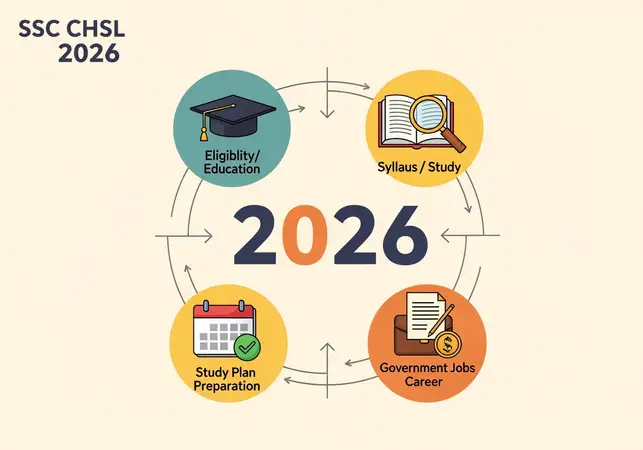
Understanding the SSC CHSL Opportunity
The Combined Higher Secondary Level (CHSL) examination is conducted annually by the Staff Selection Commission (SSC), one of India's largest recruiting agencies. It aims to fill Group 'C' and Group 'B' non-gazetted posts that require a foundational level of education, making it accessible to a wide demographic across the country. These roles typically involve administrative support, data management, and clerical duties, forming the backbone of government operations. The allure lies not just in job security, but also in the chance to serve the nation and contribute to public administration.
The SSC CHSL exam serves as a crucial stepping stone for individuals who have completed their 12th standard and are looking for a stable career without necessarily pursuing a full-fledged graduation degree first. It opens doors to a variety of central government departments, offering diverse work environments and experiences.
Why Choose SSC CHSL?
- Job Security: Government jobs are renowned for their stability and long-term security, a significant advantage in today's dynamic job market, often accompanied by lifelong pension benefits. Unlike the private sector, government roles are less susceptible to economic downturns or company restructuring, offering peace of mind. This stability extends to various benefits, including post-retirement provisions, which are a major draw for many aspirants.
- Attractive Pay & Benefits: Besides a competitive salary, employees often receive various allowances such as Dearness Allowance (DA), House Rent Allowance (HRA), and Travel Allowance (TA), along with pension schemes and comprehensive healthcare benefits. These allowances are revised periodically, ensuring that the compensation remains competitive. Additionally, government employees often have access to subsidized housing, medical facilities, and various types of leave, including casual leave, earned leave, and maternity/paternity leave, contributing to a holistic benefits package.
- Work-Life Balance: Generally, government jobs offer a better work-life balance compared to many private sector roles, allowing for personal growth and family time. Fixed working hours, adherence to public holidays, and a structured leave policy contribute significantly to this. This balance enables employees to pursue hobbies, spend quality time with family, and maintain overall well-being, which is often a challenge in demanding private sector jobs.
- Career Progression: Opportunities for promotion and career advancement are available through departmental exams and seniority, leading to higher positions and responsibilities. Employees can move up the hierarchy, taking on supervisory or managerial roles. Regular training programs and skill development initiatives are also often provided, helping employees enhance their capabilities and prepare for future challenges.
- Nationwide Presence: SSC CHSL recruits for offices across India, offering flexibility in potential postings and the chance to experience diverse work environments. Depending on the department and the candidate's preferences, one might get posted in metropolitan cities, state capitals, or even smaller towns, providing a unique opportunity to work and live in different parts of the country. Transfer policies are also in place, allowing for relocation under certain circumstances.
Key Roles and Responsibilities
Understanding the day-to-day responsibilities associated with each post can help candidates align their career aspirations with the roles offered through SSC CHSL:
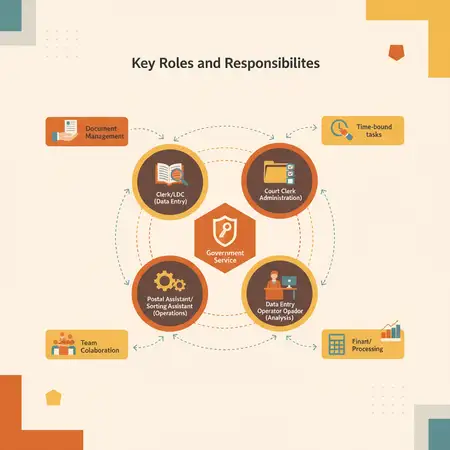
- Lower Division Clerk (LDC) / Junior Secretariat Assistant (JSA): These roles primarily involve clerical work, maintaining files and records, data entry, drafting letters and official documents, and assisting senior officials. They are the backbone of administrative functions in various government offices.
- Postal Assistant (PA) / Sorting Assistant (SA): These positions are within the Department of Posts. PAs handle customer service, mail booking, delivery, and financial transactions at post offices, while SAs are involved in sorting and dispatching mail in mail processing centers.
- Data Entry Operator (DEO): DEOs are responsible for entering data into computer systems, maintaining databases, and ensuring accuracy of information. This role requires good typing speed and attention to detail, especially in departments dealing with large volumes of data.
Each of these roles plays a vital part in the smooth functioning of government machinery, offering a sense of purpose and contribution to national development.
Growth and Promotion Prospects in SSC CHSL Roles
One of the significant advantages of securing a position through SSC CHSL is the clear path for career growth and promotion. While starting as a Group 'C' employee, dedicated individuals can ascend to higher positions through a combination of departmental examinations, seniority, and performance evaluations. For example, an LDC can aspire to become an Upper Division Clerk (UDC), then an Assistant Section Officer (ASO), and potentially even higher, depending on the department and their qualifications. Similarly, Postal Assistants can progress to roles like Supervisor or Inspector of Posts. These promotions often come with increased responsibilities, higher pay scales, and enhanced social standing. The government regularly conducts internal examinations to facilitate these promotions, providing a structured career trajectory for ambitious employees.
This aspect makes SSC CHSL not just a job, but a long-term career investment.
Eligibility Criteria
Meeting the eligibility requirements is the first step towards appearing for the SSC CHSL examination. It's crucial for aspiring candidates to carefully review these criteria to ensure they qualify, as any discrepancy can lead to disqualification. The Staff Selection Commission is very strict about these parameters, and candidates must ensure they meet all conditions as on the specified cut-off date.
Educational Qualification
Candidates must have passed the 12th standard or equivalent examination from a recognized Board or University. It's important to have your mark sheets and certificates ready for verification. A "recognized Board or University" typically refers to institutions approved by the Central or State Government, or bodies like AICTE, UGC, etc. Candidates with diplomas equivalent to 12th standard are also generally eligible, but it's always best to cross-check with the official notification for specific equivalency requirements.
- For Data Entry Operator (DEO) in the Office of Comptroller and Auditor General of India (CAG) and Department of Consumer Affairs, Food & Public Distribution and Ministry of Culture: Candidates must have passed 12th Standard in Science stream with Mathematics as a subject from a recognized Board or equivalent. This specific requirement ensures that DEOs in these departments possess a foundational understanding of numerical and analytical concepts, which might be crucial for the nature of data they handle.
- For LDC/JSA, PA/SA, DEO (except DEOs in CAG & Department of Consumer Affairs, Food & Public Distribution and Ministry of Culture): Candidates must have passed 12th Standard or equivalent examination from a recognized Board or University. For these posts, the stream of study in 12th standard is not a limiting factor, making it accessible to students from Arts, Commerce, and Science backgrounds.
Candidates awaiting their 12th-grade results may also apply provisionally, but must possess the required educational qualification on or before the cut-off date specified in the official notification. This cut-off date is non-negotiable, and failure to produce the necessary documents by this date will lead to disqualification, even if the candidate clears the examination.
Age Limit
The age limit for candidates is typically 18 to 27 years as on the prescribed crucial date (usually January 1st of the examination year, but always re-check the official notification for 2026). This crucial date is non-negotiable and determines a candidate's eligibility based on their date of birth. It means that a candidate must not be born before a certain date and not after another certain date, as specified in the official notification.
- Relaxation for Reserved Categories: The government provides age relaxations for various reserved categories to ensure equitable opportunities. Candidates belonging to these categories must possess valid certificates issued by competent authorities to claim these relaxations.
- SC/ST: 5 years (e.g., up to 32 years)
- OBC: 3 years (e.g., up to 30 years)
- PwBD (Unreserved): 10 years (e.g., up to 37 years)
- PwBD (OBC): 13 years (e.g., up to 40 years)
- PwBD (SC/ST): 15 years (e.g., up to 42 years)
- Ex-Servicemen (ESM): 3 years after deduction of the military service rendered from the actual age as on the closing date of receipt of online application. This relaxation is crucial for those who have dedicated years to serving the nation.
- Other categories like Central Government Civilian Employees, Widows, Divorced Women, etc., also have specific age relaxations. Always refer to the official notification for precise details, as these can vary slightly from year to year. For example, Central Government Civilian Employees who have rendered not less than 3 years of regular and continuous service as on the crucial date may have age relaxation up to 40 years (Unreserved), 43 years (OBC), and 45 years (SC/ST).
Nationality
The candidate must be:
- a citizen of India, or
- a subject of Nepal, or
- a subject of Bhutan, or
- a Tibetan refugee who came over to India before 1st January 1962 with the intention of permanently settling in India, or
- a person of Indian origin who has migrated from Pakistan, Burma, Sri Lanka, East African countries of Kenya, Uganda, the United Republic of Tanzania (formerly Tanganyika and Zanzibar), Zambia, Malawi, Zaire, Ethiopia and Vietnam with the intention of permanently settling in India.
Candidates falling under categories 2, 3, 4, and 5 must produce a certificate of eligibility issued by the Government of India. This is a crucial document for non-Indian citizens to prove their eligibility for government service in India.
Important Documents Required
Candidates must keep the following documents ready, both during the application process and for subsequent document verification:
- 10th Class Mark Sheet/Certificate (for Date of Birth proof)
- 12th Class Mark Sheet/Certificate (for Educational Qualification proof)
- Category Certificate (SC/ST/OBC/EWS) if applicable, issued by the competent authority in the prescribed format. OBC candidates must ensure their certificate is non-creamy layer.
- PwBD Certificate if applicable.
- Ex-Serviceman Discharge Certificate if applicable.
- Aadhaar Card or other valid Photo ID proof.
- Passport-sized photographs and signature as per specifications.
Practical Advice: Before applying, double-check your age against the crucial date mentioned in the official 2026 notification. Ensure all your educational documents are in order and match the details you will provide in the application form, as any mismatch can lead to rejection during document verification. It is advisable to keep scanned copies of all necessary documents readily accessible in the specified formats and sizes for online application.
Application Process Overview
The application process for SSC CHSL is entirely online and typically involves two main parts: One-Time Registration and Application for the CHSL Examination. Candidates who have previously registered for any SSC examination can use their existing registration details. New candidates need to complete the registration first.
- One-Time Registration: This involves providing basic details like name, father's name, mother's name, date of birth, educational board, roll number, year of passing 10th standard, gender, mobile number, email ID, and Aadhaar number (optional but recommended). After successful registration, a Registration Number and Password are generated, which should be kept safe.
- Online Application: Once registered, candidates can log in and apply for the CHSL examination. This step involves filling in detailed personal information, educational qualifications, choosing examination centers, and uploading scanned copies of a recent passport-sized photograph and signature as per the specifications mentioned in the official notification. The photograph should be clear, taken recently, and without spectacles or caps.
- Fee Payment: The application fee is usually nominal (e.g., Rs. 100/-) for General/OBC male candidates. Women candidates and candidates belonging to Scheduled Castes (SC), Scheduled Tribes (ST), Persons with Benchmark Disabilities (PwBD), and Ex-servicemen (ESM) eligible for reservation are exempted from payment of fee. The fee can be paid online through BHIM UPI, Net Banking, by using Visa, Mastercard, Maestro RuPay Credit or Debit cards or in cash at SBI Branches by generating SBI Challan.
- Submission and Printout: After successful payment and review of the application, candidates must submit it and take a printout of the completed application form for their records. It's crucial to ensure all details are correct before final submission, as editing options might be limited or unavailable after the deadline.
Candidates are strongly advised to apply well in advance of the closing date to avoid last-minute technical glitches or server overload. Always cross-verify all entered information with your original documents before final submission. For more details on applying for government jobs, visit Sarkari Naukri.
Exam Pattern and Syllabus
The SSC CHSL examination is a multi-tiered process designed to assess a candidate's aptitude and skill set across various domains. It typically comprises three tiers: Tier 1 (Computer Based Examination), Tier 2 (Descriptive Paper), and Tier 3 (Skill Test/Typing Test), each serving a distinct purpose in the selection process. Candidates must clear each tier to proceed to the next, with the final merit list being based on the combined scores of Tier 1 and Tier 2, provided Tier 3 is qualified.
Tier 1: Computer Based Examination
This is the first and most crucial stage, acting as a screening test. It's an objective-type test divided into four sections, designed to evaluate general intelligence, language proficiency, numerical ability, and general awareness. The examination is conducted online, requiring candidates to be familiar with computer-based testing environments. Each question has four options, and candidates must select the correct one.
- Total Questions: 100 (25 questions per section)
- Total Marks: 200 (50 marks per section, 2 marks for each correct answer)
- Time Duration: 60 minutes (80 minutes for candidates eligible for scribe). This means candidates have only 36 seconds per question on average, highlighting the importance of speed and accuracy.
- Negative Marking: 0.50 marks for each incorrect answer, making strategic attempts crucial. This penalty means that guessing wildly can significantly reduce your score. It's often better to leave a question unanswered if you are unsure, rather than risking a negative mark.
| Section | Number of Questions | Maximum Marks |
|---|---|---|
| General Intelligence | 25 | 50 |
| English Language | 25 | 50 |
| Quantitative Aptitude | 25 | 50 |
| General Awareness | 25 | 50 |
Detailed Tier 1 Syllabus
A thorough understanding of the syllabus for each section is vital for targeted preparation. Candidates should not only know the topics but also the depth required for each.
- General Intelligence (Reasoning): This section tests a candidate's ability to think logically and analyze patterns. It covers semantic analogy (e.g., 'Bird is to Nest as Dog is to Kennel'), symbolic operations (e.g., if '+' means '-', then solve '5+2'), symbolic/number analogy (e.g., 2:4::3:?), figural analogy (identifying similar patterns in figures), space orientation (visualizing 3D objects from 2D views), semantic classification (grouping words based on meaning), Venn diagrams (representing relationships between sets), symbolic/number classification (identifying the odd one out), figural classification, drawing inferences (deducing conclusions from given statements), coded-decoding (deciphering messages), numerical operations, problem-solving, word building, series (number, figural), embedded figures (finding a hidden figure), critical thinking, emotional intelligence (understanding and managing emotions), social intelligence (understanding social situations), etc. This section tests both verbal and non-verbal reasoning abilities, requiring a mix of analytical and visual skills.
- English Language: This section assesses a candidate's proficiency in the English language, including grammar, vocabulary, and comprehension skills. Topics include Spot the error (identifying grammatical mistakes in sentences), fill in the blanks (choosing appropriate words to complete sentences), synonyms (words with similar meanings), antonyms (words with opposite meanings), spelling/detecting misspelled words, idioms & phrases (understanding the meaning of idiomatic expressions), one-word substitution (replacing a phrase with a single word), improvement of sentences (correcting grammatical errors), active/passive voice of verbs, conversion into direct/indirect narration, shuffling of sentence parts (arranging jumbled sentences), cloze passage (filling blanks in a paragraph), comprehension passage (answering questions based on a given text). Daily reading of newspapers and books is highly recommended to improve vocabulary and comprehension, as well as to develop a natural feel for correct grammar and sentence structure.
- Quantitative Aptitude: This section evaluates a candidate's numerical ability and problem-solving skills.
- Number Systems: Whole numbers, decimals, fractions, relationships between numbers. Focus on concepts like divisibility rules, prime numbers, HCF, and LCM. Understanding the properties of numbers is foundational for many other topics.
- Fundamental Arithmetical Operations: Percentages, ratio & proportion, square roots, averages, interest (simple and compound), profit & loss, discount, partnership business, mixture and allegation, time & distance, time & work. These are core topics requiring strong conceptual understanding and quick calculation methods. Mastery of these topics is essential as they form the basis for many real-world problems and are frequently tested.
- Algebra: Basic algebraic identities of school algebra (e.g., (a+b)², (a-b)², a²-b²) and elementary surds, graphs of linear equations. Understanding basic equations and their graphical representation is key. Familiarity with solving linear equations and inequalities is also important.
- Geometry: Familiarity with elementary geometric figures and facts (lines, angles, triangles, quadrilaterals), congruence and similarity of triangles, circle and its chords, tangents, angles subtended by chords of a circle, common tangents to two or more circles. Basic theorems and properties are important. Revisiting 9th and 10th standard geometry textbooks can be very helpful.
- Mensuration: Triangle, quadrilaterals, regular polygons, circle, right prism, right circular cone, right circular cylinder, sphere, hemispheres, rectangular parallelepiped, regular right pyramid. This involves formulas for area, perimeter, volume, and surface area of various 2D and 3D shapes. Memorizing and understanding the derivation of these formulas can aid in problem-solving.
- Trigonometry: Trigonometric ratios (sin, cos, tan), complementary angles, height and distances. Basic identities and applications of trigonometry are covered. Understanding the relationship between angles and sides of a right-angled triangle is fundamental.
- Statistical Charts: Bar diagram, pie chart, histograms, frequency polygon, etc. Interpretation of data presented in various graphical forms is tested. This involves analyzing data, calculating percentages, averages, and ratios from given charts.
Focus on conceptual clarity and mastering formulas to solve problems accurately and quickly. Regular practice of a wide variety of problems is essential to build speed and confidence. It's also beneficial to categorize problems by type and practice them systematically.
- General Awareness: This section aims to test the candidate's general awareness of the environment around them and its application to society. It covers a broad spectrum of topics including general knowledge of India and its neighboring countries, history (ancient, medieval, modern Indian history, significant dates, movements, personalities), culture (arts, festivals, dance forms, music), geography (physical, Indian, world geography, climate, rivers, mountains), economic scene (basic economic terms, Indian economy, budgets, five-year plans, economic reforms), general policy (Indian Constitution, polity, governance, fundamental rights, duties, parliament, judiciary), scientific research (basic concepts from Physics, Chemistry, Biology, recent scientific and technological developments). Current affairs are a significant part of this section, requiring regular updates on national and international events, government schemes, awards, sports, and important personalities. Reading newspapers and current affairs magazines is indispensable. Developing a habit of watching news and current affairs discussions can also be beneficial.
Tier 2: Descriptive Paper (Offline)
This tier is a pen-and-paper mode examination designed to test the writing skills of the candidates in a conventional format. It assesses a candidate's ability to articulate thoughts clearly, structure arguments logically, and use correct grammar and vocabulary within specified word limits. This tier is crucial for assessing communication skills, which are vital for administrative roles.
- Total Marks: 100
- Time Duration: 60 minutes (80 minutes for candidates eligible for scribe). Time management is critical to complete both tasks effectively.
- Type: Descriptive paper, including Essay writing (200-250 words) and Letter/Application writing (150-200 words). The topics for essays can range from current affairs, social issues, economic topics, to general awareness. Letters can be formal (official letters, complaint letters) or informal (personal letters).
- Minimum Qualifying Marks: 33%. Candidates must score at least 33 marks out of 100 to qualify for this tier, irrespective of their score in Tier 1.
- Medium: English or Hindi. Candidates have the option to choose their preferred medium for writing. However, the entire paper must be written in one chosen language.
Practice structured writing, adhering to word limits, and maintaining grammatical accuracy to score well in this tier. Focus on clear expression, logical flow of ideas, and appropriate vocabulary. Reading editorials from newspapers can significantly help in developing a good writing style and providing content for essays. Regular practice of writing essays and letters on diverse topics is key to improving both content and structure.
Tier 3: Skill Test/Typing Test (Offline)
This tier is qualifying in nature and assesses the candidate's practical skills required for the jobs, specifically data entry and typing proficiency. The scores from this tier are not added to the final merit list, but qualifying it is mandatory for selection. This ensures that selected candidates possess the basic operational skills required for their roles.
- Skill Test for DEO: Data Entry Speed of 8,000 Key Depressions per hour on the computer. A passage of about 2000-2200 key-depressions will be given for 15 minutes. This test primarily measures the speed and accuracy of data entry. Key depressions include pressing any key on the keyboard, including spacebar, shift, etc. Accuracy is paramount, as errors can lead to disqualification. Candidates should aim for a higher speed than the minimum requirement to account for potential errors under exam pressure.
- Typing Test for LDC/JSA and Postal Assistant/Sorting Assistant: English typing speed of 35 words per minute (WPM) or Hindi typing speed of 30 WPM. The test duration is 10 minutes. For Hindi typing, candidates usually have a choice between Mangal Font and Kruti Dev Font. This test assesses general typing proficiency, which is essential for clerical and assistant roles. Regular practice with a focus on accuracy is more important than just speed, as a high error rate can lead to disqualification.
It is highly recommended to start practicing typing early and consistently, even before Tier 1 results are out, to build the necessary speed and accuracy. Many online typing tutors and software are available to help improve typing skills. Focus on proper finger placement, maintaining good posture, and practicing regularly to minimize errors and increase speed. Consistent practice for at least 30-60 minutes daily can significantly improve your performance in this tier.
Understanding the Cut-off and Merit List
The selection process is highly competitive, and understanding how the cut-off works is crucial. After Tier 1, candidates are shortlisted for Tier 2 based on a cut-off score. Similarly, after Tier 2, candidates are shortlisted for Tier 3 based on a combined score of Tier 1 and Tier 2. The final merit list is prepared based on the total marks obtained in Tier 1 and Tier 2, subject to qualifying Tier 3 and meeting all eligibility criteria. Higher scores in Tier 1 and Tier 2 increase the chances of final selection and getting a preferred post/department. Candidates can check their results on the official SSC website once released.
Practical Advice: Familiarize yourself with the exam pattern and a detailed syllabus from the official SSC website. Understanding the weightage of each section helps in prioritizing your study efforts and allocating time effectively. Regularly reviewing previous year's cut-offs can also give you a realistic target score to aim for.
Effective Study Plan
A well-structured and consistent study plan is the cornerstone of success for competitive exams like SSC CHSL. A personalized approach, tailored to your strengths and weaknesses, will yield the best results. It's not just about studying hard, but studying smart.
1. Understand the Syllabus and Exam Pattern Thoroughly
- Deep Dive: Don't just skim through the syllabus. Go through each topic under every section. For example, in Quantitative Aptitude, identify specific chapters like 'Time & Work' or 'Percentages.' For General Awareness, break down History into Ancient, Medieval, and Modern, and then further into specific events or periods. This granular understanding helps in focused preparation. Create a checklist of topics and mark them as you cover them.
- Weightage Analysis: Analyze previous year's papers to understand which topics are frequently asked and carry more weightage. This helps in strategic preparation. For instance, if 'Number Series' in Reasoning appears more often than 'Embedded Figures,' allocate more time to the former. Look for recurring themes in General Awareness. This analysis can guide your time allocation and focus areas.
- Tier-wise Preparation: Remember that Tier 1, Tier 2, and Tier 3 require distinct preparation strategies. Plan for all three from the outset. While Tier 1 is objective, Tier 2 requires subjective writing skills, and Tier 3 demands practical typing proficiency. Neglecting any tier can jeopardize your chances. Integrate typing practice and essay writing into your weekly schedule from the beginning.
- Official Notification: Always refer to the latest official notification for the most accurate and updated syllabus and exam pattern details. SSC sometimes makes minor changes, and relying on outdated information can be detrimental. The notification is your primary source of truth.
2. Create a Realistic and Consistent Study Schedule
- Daily Allocation: Allocate specific time slots for each subject based on your strengths and weaknesses. A general guideline:
- Mathematics (Quantitative Aptitude): 2-2.5 hours daily. Focus on concept clarity and problem-solving. Dedicate time to both learning new concepts and practicing problems. Start with foundational topics and gradually move to more complex ones.
- English Language: 1.5-2 hours daily. Include grammar rules, vocabulary building, and comprehension practice. Daily reading of newspapers, magazines, or English novels is a must to improve vocabulary and reading speed.
- General Intelligence (Reasoning): 1-1.5 hours daily. Practice various types of reasoning questions to improve speed and accuracy. Focus on pattern recognition and logical deduction. Solve puzzles and brain teasers to sharpen your mind.
- General Awareness: 1-1.5 hours daily. Divide this into Static GK (History, Geography, Polity, Science) and Current Affairs. Read newspapers daily and review monthly current affairs compilations. Make concise notes for quick revision.
Consider using techniques like the Pomodoro Technique (25 minutes study, 5 minutes break) to maintain focus and prevent burnout. Ensure you also schedule short breaks and a longer break to rejuvenate.
- Weekly & Monthly Goals: Set weekly targets (e.g., complete 3 topics in Maths, 2 in English, cover 1 month's current affairs). Review your progress at the end of each week. This helps in tracking your preparation and staying motivated. Adjust your goals if necessary, but try to stick to a routine.
- Flexibility: While consistency is key, allow for some flexibility. Adjust your schedule if certain topics require more attention or if you need to revisit weak areas. Life happens, so a rigid schedule that doesn't allow for adjustments is unsustainable. The goal is progress, not perfection.
- Self-Assessment: Regularly assess your progress and adapt your schedule to focus more on areas where you struggle. This could involve taking short quizzes, solving practice sets, or reviewing your notes. Don't shy away from spending extra time on difficult topics.
- Revision Slots: Dedicate specific time slots for revision. Regular revision of previously covered topics is crucial for long-term retention. Use flashcards, self-quizzing, or quick summaries for effective revision.
3. Subject-Specific Preparation Strategies
a. Quantitative Aptitude
- Concept Clarity: Start with understanding the fundamental concepts of each topic. Use good reference books like R.S. Aggarwal or Kiran Publication. Don't jump straight to shortcuts without understanding the basics. A strong foundation is critical.
- Practice, Practice, Practice: Solve a wide variety of problems, from basic to advanced. Don't just look at solutions; try solving them yourself. Practice at least 50-100 questions per topic. The more you practice, the faster and more accurate you become.
- Speed and Accuracy: Time yourself while solving problems. Learn shortcuts and Vedic Math techniques where applicable, but only after mastering the conventional methods. Avoid relying solely on calculators; practice mental math. Develop strategies for quickly identifying the right approach to a problem.
- Error Analysis: Maintain an error log. Revisit problems you got wrong and understand why. Was it a conceptual error, a calculation mistake, or a time management issue? Learning from your mistakes is a powerful way to improve.
- Formulas and Tables: Memorize important formulas, squares up to 30, cubes up to 20, and multiplication tables up to 20. This will save valuable time during the exam.
b. English Language
- Grammar: Master basic grammar rules (parts of speech, tenses, active/passive voice, direct/indirect speech, subject-verb agreement, prepositions). Use a good grammar book like Wren & Martin. Practice exercises from these books diligently.
- Vocabulary: Build your vocabulary daily. Read newspapers (especially editorials), magazines, and books. Note down new words, their meanings, synonyms, antonyms, and usage. Use flashcards or vocabulary apps. Regular revision of new words is essential.
- Comprehension: Practice reading comprehension passages regularly. Focus on understanding the main idea, identifying supporting details, and inferring meanings. Read different types of articles to improve your ability to grasp diverse content.
- Idioms & Phrases/One-Word Substitution: Dedicate time to learning common idioms, phrases, and one-word substitutions. There are many dedicated books and online resources for these topics.
- Previous Year Questions: Solve previous year's English sections to understand the pattern and types of questions asked. This helps in identifying your weak areas and focusing your preparation.
c. General Intelligence (Reasoning)
- Understand Concepts: For each type of reasoning question (e.g., coding-decoding, blood relations, series, analogy), understand the underlying logic and patterns.
- Practice Diverse Questions: Solve a wide variety of reasoning puzzles and questions. The more types you encounter, the better equipped you'll be to handle unexpected questions.
- Speed and Accuracy: Reasoning often involves tricky questions. Practice solving them under timed conditions to improve both speed and accuracy. Look for shortcuts or logical deductions that can save time.
- Visual Reasoning: Pay special attention to non-verbal reasoning topics like figural analogy, embedded figures, and paper folding/cutting, as these require strong visual interpretation skills.
- Mock Tests: Reasoning is a section where mock tests can significantly improve your performance by exposing you to a range of problems and helping you manage time effectively.
d. General Awareness
- Current Affairs: This is a dynamic section. Read at least one national newspaper daily (e.g., The Hindu, The Indian Express). Follow a reliable monthly current affairs magazine or online compilation. Focus on national and international events, government schemes, awards, sports, and important appointments.
- Static GK: Cover static general knowledge topics systematically.
- History: Focus on important dates, events, movements, and personalities from Ancient, Medieval, and Modern Indian History.
- Geography: Study Indian geography (rivers, mountains, climate, states, capitals) and basic world geography.
- Indian Polity & Constitution: Understand the basics of the Indian Constitution, fundamental rights, duties, Parliament, Judiciary, and Panchayati Raj.
- Economy: Basic economic terms, Indian economic planning (Five-Year Plans), budget, and reforms.
- General Science: Basic concepts from Physics, Chemistry, and Biology (up to 10th standard level). Focus on everyday science applications.
- Lucent's General Knowledge: This book is often recommended as a comprehensive resource for static GK. Read it thoroughly and make notes.
- Revision: Due to the vastness of this section, regular revision is paramount. Use mind maps, flashcards, or self-quizzing to retain information.
4. Practice with Previous Year Papers and Mock Tests
- Previous Year Papers: Solve as many previous year's question papers as possible. This gives you an idea of the exam pattern, difficulty level, and important topics. Aim to solve papers from the last 5-7 years. You can find these on the Admit Cards and results section of various government job portals.
- Mock Tests: Take full-length mock tests regularly, especially in the last few months leading up to the exam. Treat them as real exams – sit in a quiet environment, adhere to the time limits, and avoid distractions.
- Analyze Performance: After each mock test, thoroughly analyze your performance. Identify your strong and weak areas, time management issues, and types of questions you consistently get wrong. This analysis is more important than the score itself.
- Strategy Building: Use mock tests to develop your exam-day strategy. Experiment with the order of sections, time allocation per section, and guessing strategy (given negative marking).
5. Revision and Health
- Consistent Revision: Don't just study new topics; regularly revise what you've already covered. Spaced repetition is a highly effective revision technique.
- Short Notes: Make concise notes, formulas, and important facts for quick revision, especially in the last few days before the exam.
- Stay Healthy: A healthy mind resides in a healthy body. Ensure you get adequate sleep (7-8 hours), eat nutritious food, and incorporate some physical activity into your routine. Avoid excessive stress and burnout.
- Stay Positive: Maintain a positive attitude. The journey can be long and challenging, but belief in yourself and consistent effort will lead to success.
By following this comprehensive and adaptable study plan, candidates can systematically prepare for the SSC CHSL 2026 examination and significantly enhance their chances of securing a coveted government job. Remember, consistency, smart work, and self-belief are your greatest assets.
FAQ
Question: What is the minimum educational qualification required for SSC CHSL?
Answer: Candidates must have passed the 12th Standard or equivalent examination from a recognized Board or University. For Data Entry Operator (DEO) in specific departments (CAG, Department of Consumer Affairs, Food & Public Distribution, and Ministry of Culture), candidates must have passed 12th Standard in Science stream with Mathematics as a subject.
Question: Is there negative marking in the SSC CHSL Tier 1 examination?
Answer: Yes, there is negative marking in Tier 1. For each incorrect answer, 0.50 marks are deducted. This makes it crucial for candidates to attempt questions carefully and avoid wild guessing.
Question: Can I choose the language for the Tier 2 Descriptive Paper?
Answer: Yes, candidates have the option to write the Tier 2 Descriptive Paper in either English or Hindi. However, the entire paper must be written in one chosen language. You cannot switch between languages within the same paper.
Checks to complete before you apply
The SSC CHSL examination offers a significant pathway for 12th-pass candidates to embark on a stable and rewarding career in the Indian government. With a clear understanding of the eligibility criteria, a comprehensive grasp of the exam pattern and syllabus, and a diligently executed study plan, aspirants can significantly enhance their prospects of success. Consistent effort, strategic preparation, and a positive mindset are key to navigating this competitive landscape and securing a bright future in public service.
SSC CHSL 2026: Eligibility, Syllabus & Study Plan
Related: Preparation Tips | SSC Jobs | Exam Patterns
FAQs
What's SSC CHSL eligibility?12th pass, 18-27 yearsWhat's the syllabus?Tier-I: GK, Reasoning, Math, EnglishRelated Government Job Resources
Continue with active job hubs and related government job pages on TrueJobs.
Tools for this recruitment topic
Use only the tools relevant to the dates, eligibility or documents discussed above.
TrueJobs Editorial Team
TrueJobs editorial desk
This article is prepared from the sources referenced in the guide and reviewed for clarity, links and dated information. Read our editorial and corrections policy.
Continue This Topic
Follow the closest earlier and newer coverage so older archive posts keep real contextual crawl paths.
How Recruiters Actually Shortlist Candidates (Insider Secrets)
Unlock recruiter shortlisting secrets! Learn what makes candidates stand out and boost your job prospects with expert tips.
Gig Economy in India: Opportunities and Challenges
India's gig economy now includes 15M workers in flexible roles. Discover opportunities and challenges shaping this sector.
Read Next

How to Find Hidden Jobs That Are Never Posted Online

Best Job Portals in India Compared (Free vs Paid)

How Often Should You Apply for Jobs Daily?

How to Apply for Jobs Online Safely in India
Explore Topics
Perfect Your Resume
Use our AI-powered Resume Builder to create ATS-optimized resumes.
AI Resume Builder