
Recruitment guide
Resume for Government Jobs: Format & Tips — Explained
Expert guide on writing a resume for government jobs in India with the right format, sections, and tips.

Applying for government jobs in India requires a specific resume format, different from the private sector. This guide provides expert tips and a clear format to help your application stand out to public sector recruiters and pass through Applicant Tracking Systems (ATS).
Resume for Government Jobs: Format and Tips for India
Applying for government jobs in India requires a different resume approach compared to private sector applications. Government departments have specific expectations regarding format, content, and documentation. Understanding these nuances is crucial for any Indian job seeker aiming for a coveted position in the public sector. Unlike private companies that often seek innovation and unique personal branding, government recruitment prioritizes clarity, factual accuracy, adherence to established procedures, and a demonstrated commitment to public service. The selection process is often highly standardized, emphasizing merit, transparency, and compliance with extensive regulations.
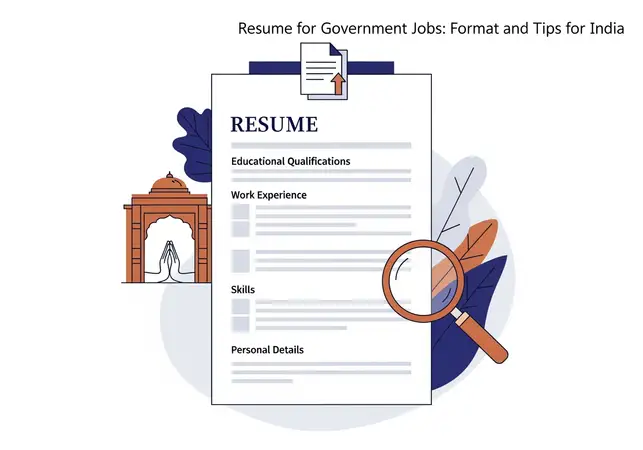
This comprehensive guide from TrueJobs will walk you through crafting a compelling resume that stands out for government jobs in India, ensuring your application gets the attention it deserves by meeting the stringent requirements of public sector recruitment agencies.
Government Resume Format
The foundational difference lies in the format itself. While creative and modern designs might work for the private sector, government resumes typically demand a more traditional, straightforward, and information-dense approach. The emphasis is on readability, ease of information extraction, and compatibility with Applicant Tracking Systems (ATS) that government bodies increasingly use. A clean, professional look ensures that your qualifications are the focal point, not distracting aesthetics.
Chronological Format, The Standard
Always use a chronological format, listing your most recent qualifications, work experience, and achievements first. This allows recruiters to quickly see your most up-to-date information and career progression. Dates are critical here, so ensure they are consistent, accurate, and presented in a uniform format (e.g., MM/YYYY or DD/MM/YYYY). This format is preferred because it provides a clear, linear progression of your professional and academic journey, which is easy for government evaluators to follow and verify.

Personal Details and Demographics
Government applications often require a more comprehensive set of personal details than private sector resumes. These details are crucial for determining eligibility, applying reservation policies, and conducting background checks.
- Full Name and Date of Birth: Must be exactly as per your official documents (Aadhar, PAN card, educational certificates). Discrepancies can lead to disqualification.
- Permanent Address: Your official residential address, often used for domicile verification and communication.
- Contact Information: A reliable email address and mobile number that you check regularly. Ensure they remain active throughout the recruitment process.
- Category: Explicitly mention your category (General, OBC, SC, ST, EWS) if applicable, as this impacts eligibility, age relaxation, and reservation policies crucial to India's government job landscape. You will typically need to provide a valid certificate.
- Nationality: Indian (usually implied but can be stated if the advertisement requires it).
- Gender: Sometimes required for specific demographic reporting or gender-specific roles.
- Marital Status: Occasionally requested, especially for certain administrative or uniformed services.
- Aadhar/PAN Number: While not always on the resume itself, be prepared to provide these during the online application as they are often linked for identity verification.
Educational Qualifications
This section is paramount. Government jobs place a high value on academic credentials and their authenticity. List all your educational qualifications in reverse chronological order, from your highest degree downwards. Ensure every detail is verifiable against your original certificates.
- Degree/Diploma Name: (e.g., M.Tech., B.E., B.Sc., 12th Standard, 10th Standard). Use the full, official name of the qualification.
- Specialization: (e.g., Computer Science, Mechanical Engineering, History). Be precise about your area of study.
- University/Board Name: Full name of the institution or examining body (e.g., University of Delhi, CBSE Board).
- Year of Passing: Accurate year of completion for each qualification.
- Percentage/CGPA: Provide the exact percentage or CGPA. Do not round up or down. If your university uses a different grading system, specify that, and if the notification requires conversion to a percentage, provide the converted value along with the original CGPA/grade.
- Division/Class: (e.g., First Class with Distinction, First Class).
Example:
- M.Tech. (Software Engineering), Indian Institute of Technology Bombay, 2022, 8.5 CGPA (First Class with Distinction)
- B.E. (Computer Science Engineering), Delhi College of Engineering, 2020, 78% (First Class)
- 12th Standard (Science Stream), CBSE Board, 2016, 92%
- 10th Standard, CBSE Board, 2014, 88%
Technical Formatting Considerations
While government resumes are traditional, paying attention to basic formatting ensures readability and professionalism.
- Font Choice: Stick to professional, easy-to-read fonts like Times New Roman, Calibri, or Arial. Font size should typically be 10-12 points for body text and 14-16 points for headings.
- Margins: Maintain standard 1-inch margins on all sides for a clean layout.
- Spacing: Use single spacing for paragraphs and lists, with a small space between sections for clarity.
- No Graphics: Avoid embedding photos, logos, or any graphical elements directly into the resume document unless explicitly requested.
Essential Sections
Beyond the basic format, certain sections are absolutely crucial for a government job resume. These sections help recruiters assess your suitability against specific eligibility criteria and demonstrate your commitment to public service, often acting as direct evidence against the job notification's requirements.
Clear Career Objective or Summary
While some modern resumes omit objectives, for government jobs, a concise career objective (1-2 sentences) or a brief summary (3-4 sentences) is highly beneficial. It should clearly state your intention and align with the specific government position you are applying for, often incorporating keywords from the job description. For freshers, an objective highlighting aspirations for public service is appropriate. For experienced professionals, a summary highlighting key achievements and relevance to government roles is more effective.
Example Career Objective (for freshers):
"To secure an entry-level position in the Indian Administrative Service, leveraging strong analytical skills and a commitment to public welfare, contributing effectively to national development and policy implementation."
Example Summary (for experienced professionals):
"A dedicated and results-oriented professional with 5 years of experience in project management within the public utility sector, seeking to apply specialized expertise in the Ministry of Power to enhance operational efficiency, streamline policy implementation, and contribute to national energy goals."
Competitive Exams Cleared
This is a standalone, critical section for government job applications, particularly for central and state government services. It directly demonstrates your ability to clear rigorous national-level examinations, a key indicator of merit and aptitude for public service.
- Exam Name: (e.g., UPSC Civil Services Exam, SSC CGL, IBPS PO, State PCS).
- Year: Year of examination/attempt.
- Roll Number/Rank: If applicable, your roll number and the final ranking.
- Score: Your score in each stage (Prelims, Mains, Interview) if listed on your admit card/result.
- Status: (e.g., Cleared Prelims, Qualified Mains, Qualified for Interview, Final Selection, Allotted Service/Department).
Example:
- UPSC Civil Services Exam, 2023: Qualified Mains, Roll No: 1234567, Interview Scheduled.
- SSC CGL (Combined Graduate Level) Exam, 2022: All Tiers Cleared, All India Rank: 500, Selected as Assistant Section Officer (Ministry of External Affairs).
Work Experience (if applicable)
List your work experience in reverse chronological order. For government jobs, focus on roles and responsibilities that demonstrate skills relevant to public administration, such as administration, policy implementation, public interaction, data management, compliance, and ethical conduct. Quantify your achievements whenever possible, even in a public sector context.
- Job Title: Your official designation.
- Organization Name: Full name of the organization. (Include department if applicable, e.g., "Software Engineer, Ministry of Electronics and Information Technology, Government of India").
- Duration: (From Month, Year to Month, Year). Be precise with dates.
- Key Responsibilities and Achievements: Use strong action verbs. Emphasize roles related to public service, data integrity, project management, adherence to regulations, stakeholder management, and problem-solving within a structured environment. For example, instead of "handled files," say "managed a portfolio of 500+ public grievances, ensuring resolution within stipulated timelines."
Example:
Assistant Manager, Canara Bank, Bengaluru
June 2020 – Present
- Managed a portfolio of over 500 retail and corporate accounts, ensuring strict compliance with RBI guidelines and internal banking protocols.
- Processed an average of 150 loan applications monthly and facilitated diverse financial services for customers, achieving a consistent 95% customer satisfaction rating.
- Trained junior staff on new banking software functionalities and updated internal operating procedures, improving team efficiency by 15%.
- Actively participated in community outreach programs, educating local residents on financial literacy and government-backed schemes.
Skills and Competencies
Categorize your skills for clarity, making it easy for recruiters to match your abilities with job requirements. Highlight skills that are particularly valuable in a government setting.
- Technical Skills: Relevant software proficiency (e.g., MS Office Suite - Word, Excel, PowerPoint, Outlook; specific statistical software like SPSS/R; GIS tools; programming languages if applicable to IT roles; experience with government-specific platforms like PFMS, GeM, or e-governance portals).
- Language Proficiency: A crucial section for Indian government jobs, especially for roles involving public interaction or postings in different linguistic regions.
- Hindi: Mother Tongue/Proficient/Working Knowledge (Read, Write, Speak).
- English: Proficient/Working Knowledge (Read, Write, Speak).
- Regional Languages: Specify other Indian languages you are proficient in (e.g., Marathi, Bengali, Tamil, Telugu, Kannada), and your level of proficiency. This is highly valued, especially for state government jobs and positions requiring outreach.
- Administrative/Soft Skills: Project management, data analysis, public speaking, teamwork, leadership, problem-solving, attention to detail, adherence to protocols, ethical decision-making, stakeholder management, policy analysis, and strong written and verbal communication. These skills are fundamental for effective public administration.
Training, Certifications, and Workshops
Mention any relevant training programs, government-specific certifications (e.g., Certified Public Accountant for finance roles, specific IT certifications for technical roles, e-governance certifications, public policy courses), or workshops attended. These demonstrate proactive learning, specialized knowledge, and a commitment to continuous professional development relevant to public service.
Example:
- Certified Public Procurement Professional (CPPP), Ministry of Finance, 2021
- Training on e-Governance Initiatives and Digital India Programs, National Institute of Smart Government, 2020
- Project Management Professional (PMP) Certification, Project Management Institute, 2019
Projects/Publications (if applicable)
For technical, research-oriented, or academic government roles, list relevant academic or professional projects, research papers, or publications. Briefly describe your role, the project's objective, methodologies used, and its impact or findings. This demonstrates your analytical capabilities and contribution to knowledge.
Awards and Honors
Mention any academic distinctions, scholarships, fellowships, or awards received. These reflect excellence, dedication, and recognition of your achievements, which are highly regarded in competitive government recruitment processes.
Common Mistakes to Avoid
A single error can sometimes lead to the rejection of an application in the rigorous government recruitment process. Attention to detail is paramount.
-
Exaggeration or False Information: Government verification processes are extremely thorough, often involving background checks, police verification, and cross-referencing with official databases. Any discrepancy, however small, can lead to immediate disqualification, blacklisting, or even legal action, even after selection. Always be truthful and ensure all claims can be substantiated with official documents.
-
Fancy Formatting and Irrelevant Graphics: Avoid elaborate designs, colorful fonts, unnecessary graphics, or personal photos (unless specifically requested for the resume itself). Government departments prefer clean, professional, and easy-to-read resumes. They are often scanned by ATS (Applicant Tracking Systems) that prefer plain text and standard layouts. A simple black-and-white font (like Times New Roman or Calibri, size 10-12) usually works best, ensuring compatibility and readability across different systems.
-
Inaccurate Dates and Figures: Double-check all dates of employment, education, exam years, percentages, CGPA, and certificate numbers. Discrepancies can raise significant red flags during verification and suggest a lack of meticulousness. Cross-reference every detail with your original certificates and official records.
-
Length: While comprehensive, aim to keep your resume within 2-3 pages for most positions. For entry-level roles, 1-2 pages are ideal. For senior positions with extensive experience, 3 pages might be acceptable, but prioritize relevance over exhaustive detail. Government recruiters review numerous applications, so conciseness without sacrificing essential information is key.
-
Typos and Grammatical Errors: Proofread your resume meticulously multiple times. Errors suggest a lack of attention to detail and professionalism, which are critical attributes for government roles. Use spell-checkers, but also get a friend, mentor, or professional editor to review it for clarity and accuracy.
-
Generic Resume: Never use a one-size-fits-all resume. Tailor your resume for each specific job advertisement. Highlight skills, experiences, and achievements most relevant to the stated requirements and responsibilities of the particular government position. Use keywords from the job description to optimize for ATS and human reviewers.
-
Missing Mandatory Information: Carefully read the entire job advertisement and application form. Ensure all requested information, such as father's name, mother's name, religion, identification numbers, or specific declarations, is included if asked for. Omitting mandatory details is a common reason for application rejection.
Practical Advice and Actionable Steps for Indian Job Seekers
-
Read the Notification Meticulously: Each government job notification (advertisement or 'Vigyapti') is your primary instruction manual. It outlines eligibility criteria, required documents, application format, specific resume requirements, age limits, reservation details, and selection procedures. Do not skip this step; it is the single most important piece of advice.
-
Refer to Previous Year’s Notifications/Resumes: If possible, look at the resume formats or application forms from previous years for similar positions. This can give you an idea of expected content, structure, and the level of detail required, helping you anticipate requirements.
-
Digital Submission Nuances: Many government applications are now online.
- PDF Format: Always submit your resume as a PDF unless explicitly asked for another format. This preserves formatting across different systems.
- File Naming: Name your file professionally and clearly (e.g., "Resume\_[YourName]\_[PostName].pdf" or "AadityaSharma\_AssistantSectionOfficer\_Resume.pdf").
- Photo and Signature: Be prepared to upload scanned copies of your recent passport-sized photograph and signature, adhering strictly to specified dimensions, file sizes, and background colors. Ensure clarity and proper resolution.
- Document Uploads: Have scanned copies of all educational certificates, caste certificates, experience letters, identity proofs (Aadhar, PAN), and any other relevant documents ready in the required formats (PDF, JPG) and sizes. Ensure high-quality scans that are legible.
-
Emphasize Language Skills: For roles involving public interaction, especially at the state level or in diverse linguistic regions, demonstrating proficiency in Hindi and relevant regional languages is a significant asset. Even if not explicitly asked, consider including it in your skills section.
-
Highlight Public Service Inclination: In your objective/summary and work experience, subtly convey your dedication to public service, ethical conduct, integrity, and alignment with government values. Use phrases like "committed to public welfare," "contributing to national development," or "adhering to ethical governance principles."
-
Seek Mentorship: Connect with individuals already working in the government sector or those who have successfully navigated the recruitment process. Their insights into resume preferences, interview processes, and career paths can be invaluable for tailoring your application effectively.
-
Keep Records: Maintain a systematic record of all applications submitted, including the job notification, your resume version, application IDs, payment receipts, and any correspondence. This is useful for future reference, follow-ups, and preparing for subsequent stages of the recruitment process.
-
Prepare for Verification: Understand that every claim in your resume will likely be verified. Keep original documents ready for inspection at every stage of the recruitment process. Be prepared for character and antecedents verification, which often includes police verification.
Crafting a government job resume in India is not just about listing qualifications; it's about presenting yourself as a reliable, honest, and capable individual ready to contribute to the nation's public services. By adhering to these guidelines, you significantly increase your chances of successfully navigating the competitive landscape of government recruitment. Good luck with your application!
Frequently Asked Questions
What is the ideal length for a government job resume in India?
For most entry-level to mid-level government positions, a resume of 1-2 pages is ideal. For senior roles or those requiring extensive research experience, a maximum of 3 pages might be acceptable. The key is to be comprehensive yet concise, focusing on relevant information.
Should I include a photograph on my government job resume?
Typically, government job applications require a separate upload of a passport-sized photograph during the online application process, rather than embedding it directly into the resume document itself. Always refer to the specific job notification for exact requirements regarding photo submission.
Is it mandatory to disclose my caste category on a government job resume?
Yes, it is often mandatory and beneficial to mention your caste category (General, OBC, SC, ST, EWS) if applicable, as government jobs have reservation policies and specific eligibility criteria tied to these categories. This information is crucial for recruiters to assess your eligibility correctly and ensure you benefit from any applicable relaxations or reservations. You will need to provide a valid certificate.
Should I include references on my government job resume?
It is generally not necessary to include references directly on your resume for government jobs. Instead, you can state "References available upon request." Government recruitment processes typically have their own verification procedures and may ask for references or contact details at a later stage, if required.
What if I have a career gap in my work history?
If you have a career gap, address it honestly and concisely. You can briefly explain the reason for the gap (e.g., "Family responsibilities," "Preparation for competitive exams," "Further studies," "Health reasons") in your resume or cover letter. Focus on any skills gained or activities undertaken during that period that are relevant to public service, such as volunteer work or skill development courses. Transparency is key, as government verification processes are thorough.
Resume for Government Jobs: India Format Guide
Explore more resources: Govt Job Prep | Resume Templates
Crack government job applications with the right resume format. Follow our India-specific guidelines for public sector success.
FAQs
What's the ideal length?1-2 pagesInclude hobbies?Only if relevantRelated Resources
- Sarkari Naukri
- UPSC Exam Preparation
- Government Job Interview Questions
Related Government Job Resources
Continue with active job hubs and related government job pages on TrueJobs.
Tools for this recruitment topic
Use only the tools relevant to the dates, eligibility or documents discussed above.
TrueJobs Editorial Team
TrueJobs editorial desk
This article is prepared from the sources referenced in the guide and reviewed for clarity, links and dated information. Read our editorial and corrections policy.
Continue This Topic
Follow the closest earlier and newer coverage so older archive posts keep real contextual crawl paths.
How Recruiters Actually Shortlist Candidates (Insider Secrets)
Unlock recruiter shortlisting secrets! Learn what makes candidates stand out and boost your job prospects with expert tips.
Gig Economy in India: Opportunities and Challenges
India's gig economy now includes 15M workers in flexible roles. Discover opportunities and challenges shaping this sector.
Read Next

Best Resume Format for Freshers in India

How Long Should a Resume Be? (A Practical Guide for Indian Job Seekers)

Resume Mistakes That Get You Rejected Instantly

Best Resume Format for Experienced Professionals
Explore Topics
Perfect Your Resume
Use our AI-powered Resume Builder to create ATS-optimized resumes.
AI Resume Builder