
Career guide
How Long Should a Resume Be? - Guide for Indian Job — Explained
Discover the ideal resume length for freshers, mid-level professionals, and senior executives in India. Learn how ATS systems affect resume sizing.

Crafting an effective resume is paramount for any job seeker, especially in India's dynamic and competitive employment landscape. This comprehensive guide will delve into the critical aspect of resume length, exploring how to tailor your document to your career stage, industry, and the specific roles you're targeting. You'll learn the strategic importance of conciseness, how to optimize your resume for both human recruiters and Applicant Tracking Systems (ATS), and practical tips to ensure your application stands out for all the right reasons.
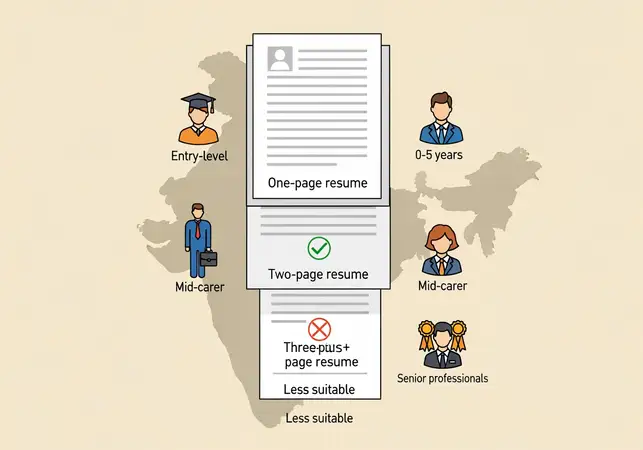
How Long Should a Resume Be? (A Practical Guide for Indian Job Seekers)
In India's competitive job market, recruiters face a deluge of applications daily. They quickly scan for keywords, career progression, and relevant skills. Your resume must capture attention in mere seconds, whether screened by a human or an Applicant Tracking System (ATS). For 2026 and beyond, a well-structured and appropriately-lengthed resume is crucial for making a strong first impression and securing an interview. Understanding the nuances of resume length is not just about fitting information; it's about strategic communication and respecting the hiring manager's time.
The Recruiter's Perspective: Time is Gold
Recruiters often sift through hundreds, even thousands, of applications for a single opening. They simply don't have the luxury of spending minutes on each resume. Industry studies suggest an average initial scan time of just 6-7 seconds. This rapid review aims to identify immediate red flags or compelling reasons to read further. Recruiters are under immense pressure to fill roles efficiently and effectively, making their initial screening highly critical. An overly long, dense, or poorly organized resume forces the recruiter to exert more effort, significantly increasing the chance of it being discarded, regardless of the candidate's actual qualifications. They are looking for quick validation of your suitability, not a comprehensive life story.
The Impact of Cognitive Load on Recruiters
Beyond the sheer volume, recruiters also experience significant cognitive load. They are constantly switching between applications, trying to match candidate profiles to job requirements, and making rapid decisions. A resume that is easy to read, well-organized, and concise reduces this cognitive burden. Conversely, a resume that requires excessive effort to decipher or locate key information will likely be passed over. Think of your resume as a user-friendly interface; the easier it is to navigate, the more positive the user experience (for the recruiter) will be.

Understanding Applicant Tracking Systems (ATS)
Many resumes are first processed by Applicant Tracking Systems (ATS). These sophisticated software programs filter applications based on keywords, skills, experience, and other criteria extracted directly from the job description. While modern ATS can handle multi-page documents, an excessively long resume can still be problematic. Too much irrelevant information can dilute the impact of crucial keywords, making it harder for the ATS to identify your core competencies and rank your application highly. Conversely, a resume that is too brief might lack the necessary keywords and details to pass the initial screening, leading to an automatic rejection.
Optimizing your resume for ATS involves using standard fonts, clear headings, and strategically placing relevant keywords throughout the document, ensuring it can be easily parsed and understood by the software.
How ATS Processes Resume Length
While an ATS can technically parse a longer document, its primary function is to identify and extract relevant information. If your resume is overly long with extraneous details, the ATS might struggle to pinpoint the most critical keywords and experiences that align with the job description. This can lead to a lower match score, even if you are a highly qualified candidate. A concise resume, strategically packed with keywords, makes it easier for the ATS to accurately assess your suitability and forward your application to a human recruiter. For more tips on optimizing your resume for these systems, you can explore our ATS-friendly resume tips.
Here's what determines the ideal length:
- A concise resume shows respect for the recruiter's time and demonstrates strong communication skills, highlighting your ability to distill complex information into its most impactful form. It signals professionalism and efficiency.
- An overlong, heavily detailed resume risks being skipped, as it appears daunting and time-consuming to review. Conversely, a too-brief one may lack credibility and fail to provide enough evidence of your capabilities. The goal is a balance that is compelling without overwhelming.
- ATS-powered systems scan for relevance; too much irrelevant information significantly reduces your chances of being shortlisted. Every piece of information must highlight your suitability for the specific role, aligning with the job description's requirements.
The Strategic Importance of Resume Length
Beyond mere page count, the length of your resume is a strategic choice that reflects your career stage, industry, and the specific role you're targeting. It's about presenting your professional narrative in the most impactful and accessible way. A well-judged resume length demonstrates your ability to prioritize information, understand the hiring process, and effectively market yourself. It's not just about fitting everything in, but about making every word count and ensuring the recruiter can quickly grasp your value proposition.
Tailoring Length for Different Industries
The "ideal" resume length can also vary slightly by industry. For instance, in creative fields, a portfolio link might be more crucial than extensive text, allowing for a shorter resume. In highly technical or research-oriented fields, more space might be needed for specific projects or publications. However, even within these variations, the principle of conciseness and relevance remains paramount. Always research industry norms and specific job requirements to fine-tune your approach.
The One-Page Resume: The Freshers' Gold Standard
Who Should Use It?
Freshers and College Graduates: If you have up to 2 years of work experience, a single page is crucial. This applies to recent graduates (B.Tech, MBA, B.Com, B.Sc., M.Sc., etc.) seeking their first or second professional role. Your academic achievements, internships, project work, and extracurricular involvement are your primary selling points, and they are best presented clearly and concisely on one page. For instance, a B.Tech graduate in Computer Science should focus on relevant projects, programming languages, and any hackathon wins, while an MBA graduate might highlight case study competitions, internships in finance or marketing, and leadership roles in student clubs.
Early-Career Switchers: Transitioning from campus to corporate, or making a significant career pivot early on? Use a single page to highlight education, internships, key transferable skills, and relevant volunteer work or certifications. Focus on potential and foundational skills that are applicable to your new desired path. For example, a candidate moving from a non-technical background to an entry-level IT support role should emphasize problem-solving skills, customer service experience, and any relevant IT certifications.
Candidates for Entry-Level Roles: Even with a year or two of experience, if the role is entry-level, a one-page resume often suffices. Recruiters for these positions seek foundational skills, enthusiasm, and a strong learning aptitude, which can be effectively conveyed on a single page. The focus should be on demonstrating potential and a solid base of knowledge rather than extensive work history.
Internship and Apprenticeship Applicants: For students or recent graduates applying for internships or apprenticeships, a one-page resume is almost always the expectation. These roles are designed for learning and development, so recruiters are interested in your academic performance, relevant coursework, and any practical experience gained through projects or volunteer work. Overloading an internship resume with minor details can detract from your core strengths.
The "Potential" Factor for Freshers
For freshers, recruiters are primarily looking for potential, aptitude, and foundational skills. A one-page resume allows you to showcase these aspects without overwhelming the reader with irrelevant details. It demonstrates your ability to articulate your strengths clearly and concisely, which is a valuable professional trait. Emphasize academic projects, internships, certifications, and any leadership roles in student organizations that highlight your readiness for the professional world. For more guidance on entry-level positions, check out our Sarkari Naukri section for government job opportunities.
Why One Page Works
- Easy for recruiters to scan: A single page reduces cognitive load, allowing recruiters to quickly grasp your profile and key qualifications without having to flip pages or scroll extensively. This speed is critical in high-volume hiring.
- Ensures focus on your strongest points: Limiting yourself to one page forces you to be selective and prioritize your most impactful achievements, such as top academic scores, significant internships, or relevant certifications. This selectivity strengthens your overall message.
- Prevents irrelevant or repetitive details: A one-page constraint naturally eliminates the temptation to include less important information or rephrase similar achievements, making every bullet point impactful and relevant to the target role.
- Demonstrates conciseness and information prioritization: The ability to distill complex information into a brief, powerful summary is a valuable professional skill. A one-page resume subtly communicates this capability to potential employers.
- Ideal for ATS processing: While modern ATS can handle longer documents, a concise one-page resume with clear formatting and relevant keywords is often easier for these systems to parse accurately, ensuring your key information isn't missed.
Maximizing Impact on a Single Page
Strategic content selection and formatting are key to making every inch count on a one-page resume. Think of it as a marketing document for your potential, designed to grab attention and highlight your unique value proposition.
- Use crisp, descriptive bullets with strong action verbs (e.g., "Developed," "Managed," "Analyzed," "Implemented," "Optimized") and quantify achievements whenever possible. Instead of "Worked on a project," say "Developed a mobile application using Flutter, resulting in a 25% increase in user engagement during beta testing."
- Prioritize content relevant to the job description. Tailor your resume to match required skills and experiences, even if it means slightly rephrasing project descriptions or highlighting different aspects of your academic work.
- Combine contact info on one line to save space: name, phone, email, LinkedIn URL, and optionally a portfolio link. Ensure your email is professional (e.g., firstname.lastname@email.com).
- Omit "References available on request"; this is assumed and wastes valuable space that could be used for more impactful content.
- Utilize a clean, modern template with appropriate white space and clear headings for readability and professionalism. Avoid overly decorative or graphical templates that might confuse ATS or distract recruiters. Sans-serif fonts like Arial, Calibri, or Lato are generally preferred.
- Focus on quantifiable achievements: "Contributed to marketing campaigns that increased lead generation by 15%" instead of "Assisted in marketing campaigns." Even for academic projects, quantify impact: "Reduced data processing time by 10% through Python scripting."
- Create a dedicated "Skills" section: For freshers, this is crucial. List technical skills (programming languages, software, tools) and relevant soft skills (communication, teamwork, problem-solving). This allows recruiters and ATS to quickly identify your competencies.
Example: A recent B.Tech graduate seeking a software role can use one page to highlight their degree, top projects (with technologies like Java, Python, SQL), coding hackathons, relevant certifications (e.g., AWS Cloud Practitioner), and key skills. A project description could be: "Developed a full-stack e-commerce platform using MERN stack, improving user engagement by 20% through intuitive UI/UX design." Another example could be a B.Com graduate aiming for an entry-level finance role, highlighting their academic performance, an internship where they assisted in financial analysis, proficiency in Excel and Tally, and participation in a stock market simulation club.
Practical Tips for One-Page Layout
When designing your one-page resume, consider using a two-column layout if it enhances readability and organization. This can help fit more information without making it look cramped. Ensure the most critical information (contact details, professional summary, key skills) is easily visible in the top third of the page. Use bullet points extensively, keeping them to one or two lines each. Avoid long paragraphs. Remember, every element on the page should serve a purpose in showcasing your suitability for the job.
Common Pitfalls to Avoid for Freshers
- Lack of Quantifiable Achievements: Simply listing duties or responsibilities without showing impact is a missed opportunity. Always strive to quantify your contributions, even for internships or academic projects. For example, instead of "Managed social media," write "Managed social media accounts, increasing follower engagement by 30% over 3 months."
- Too Much Personal Information: Avoid details like marital status, father's name, religion, caste, or date of birth, which are generally not required for corporate jobs in India and can lead to unconscious bias. Stick to professional contact details and work-related information.
- Generic Objective Statement: A vague objective like "Seeking a challenging role in a reputed company" is unhelpful. Craft a specific career objective highlighting skills and aspirations relevant to the job you're applying for. For example, "Highly motivated B.Tech graduate seeking an entry-level Software Developer position at [Company Name] to leverage strong Java and Python skills in building innovative solutions."
- Poor Formatting: Inconsistent fonts, awkward spacing, excessive bold/italics, or using multiple font colors make a resume look messy and unprofessional. Maintain a clean, consistent, and easy-to-read layout.
- Including Irrelevant Coursework or High School Details: Once you have a college degree, details about your high school education or individual courses not directly relevant to the job can be omitted to save space. Focus on your most recent and highest level of education.
- Grammatical Errors and Typos: Even a single typo can create a negative impression. Proofread your resume meticulously, and ideally, have someone else review it for errors before submitting.
The Two-Page Resume: For Growing Professionals
Who Needs Two Pages?
Mid-Level Professionals: With 5–10 years of experience, your relevant projects, career progression, and increasing responsibilities deserve more space. You have a track record of accomplishments, leadership, and specialized skills that cannot be adequately summarized on one page. This includes roles like Senior Software Engineer, Marketing Manager, Project Lead, Financial Analyst, or HR Business Partner. You've likely managed projects, mentored junior staff, and delivered significant results that warrant detailed explanation.
Senior Executives and Managers: If you've led teams, delivered strategic projects, managed budgets, or have multiple promotions and significant achievements, two pages are typically needed. Your resume should reflect leadership capabilities, strategic thinking, and tangible results, demonstrating your impact on organizational goals. Roles such as Department Head, Regional Sales Manager, Senior Product Manager, or Operations Director fall into this category. Your resume should highlight your strategic contributions and leadership philosophy.
Technology & Specialist Roles: IT and engineering resumes, especially for roles requiring deep technical expertise, sometimes need extra space for tools, languages, frameworks, methodologies (e.g., Agile, Scrum, DevOps), or detailed project accounts. Roles in R&D, data science, cybersecurity, or specialized consulting may also need more space for complex projects, research contributions, or specific certifications. The depth of technical skills and project complexity often necessitates more room.
Professionals with Diverse Experience: If you've worked across different industries or functions and need to highlight transferable skills and varied accomplishments, a two-page resume allows for comprehensive coverage without feeling cramped. For example, a professional who started in marketing, moved to product management, and then to business development might need two pages to effectively showcase the breadth of their experience and how it builds towards their current career goals.
Professionals in Regulated Industries: In sectors like banking, pharmaceuticals, or legal services, where specific compliance, regulatory knowledge, or detailed case histories are paramount, a two-page resume can provide the necessary space to outline this critical experience without compromising on detail.
When to Transition to Two Pages
The decision to move from a one-page to a two-page resume should be driven by the genuine need to present significant, relevant experience and achievements that cannot be effectively condensed into a single page. It's not about reaching a certain number of years, but about the depth and breadth of your contributions. If you find yourself consistently cutting valuable, job-relevant information to fit on one page, it's likely time to expand to two. However, always ensure that the second page is as impactful and content-rich as the first.
Tips for a Polished Two-Pager
A two-page resume requires careful structuring for readability and impact. The flow of information is critical to ensure recruiters grasp your most important qualifications quickly.
- Ensure the most important content is on page one. This typically includes your professional summary, contact information, key skills, and your most recent and relevant work experience. Recruiters often make initial decisions based on the first page, so make it count.
- Ensure at least 50% of page two is filled; otherwise, edit down to one page. A sparse second page suggests a struggle to fill space and can look unprofessional. If you have only a few lines on the second page, it's usually better to condense.
- Maintain consistent headings, font, and spacing across both pages for a professional and organized appearance. Inconsistency can make your resume look hastily put together and reflect poorly on your attention to detail.
- Include your name and page number (e.g., "John Doe - Page 2 of 2") on the second page to help recruiters keep your document organized, especially if they print it out. This prevents pages from getting mixed up.
- Use a strong professional summary or profile at the top of page one to immediately convey your value proposition and career highlights. This acts as an executive summary, enticing the recruiter to delve deeper.
- Distribute your experience logically. Recent experience gets more detail and more bullet points, focusing on achievements and impact. Older, relevant roles can be summarized concisely with fewer, high-impact bullet points. Irrelevant older roles can be significantly condensed or even omitted.
- Utilize white space effectively. Don't cram too much text onto the pages. Adequate margins and spacing between sections improve readability and make the resume visually appealing.
Structuring Your Two-Page Resume Effectively
For a two-page resume, consider the following layout to ensure a logical and impactful presentation of your career journey:
- Page 1:
- Contact Information: Your name, phone number, professional email, LinkedIn profile URL, and optionally a portfolio link.
- Professional Summary/Profile: A concise (4-6 lines) paragraph or bulleted summary highlighting your years of experience, key expertise, and most significant career achievements relevant to the target role.
- Key Skills: A well-organized section listing your technical skills (software, programming languages, tools, methodologies) and relevant soft skills (leadership, communication, problem-solving, strategic planning).
- Most Recent & Relevant Work Experience: Detail your current or most recent 1-2 roles with achievement-focused bullet points, quantifying impact wherever possible. This is where you showcase your most significant contributions.
- Page 2:
- Remaining Work Experience: Continue with older roles, summarizing them with fewer bullet points, focusing on key responsibilities and achievements that demonstrate career progression or transferable skills.
- Education: List your degrees, institutions, and graduation years. For experienced professionals, high school details are usually omitted. Include relevant certifications or professional development courses.
- Projects: If you have extensive and relevant projects (especially for IT/Engineering roles), detail them here, highlighting your role, technologies used, and outcomes.
- Awards & Recognition: Any professional awards, company recognitions, or significant accolades.
- Volunteer Experience: If relevant to the skills required for the job (e.g., leadership, project management, specific technical skills), include it here.
- Publications/Presentations: (If applicable for certain specialized roles) List any relevant publications, research papers, or conference presentations.
Balancing Detail and Brevity
The challenge with a two-page resume is to provide sufficient detail without becoming verbose. Focus on achievements, using the STAR method (Situation, Task, Action, Result) mentally to construct your bullet points. For instance, instead of "Managed a team," think: "Situation: Faced a critical project deadline with a demotivated team. Task: Needed to re-energize the team and deliver on time. Action: Implemented daily stand-ups, delegated tasks based on strengths, and provided regular feedback. Result: Delivered the project 2 days ahead of schedule, improving team morale by 20%." Quantify everything possible – percentages, monetary values, number of people managed, projects completed, revenue generated, costs saved. For older roles, use fewer bullet points, focusing only on the most significant accomplishments still relevant to your current career trajectory. The goal is to show a clear progression of responsibility and impact throughout your career.
Example: A sales professional with 8 years' experience across FMCG and SaaS could detail consistently exceeded quotas (e.g., "Achieved 120% of sales target for 3 consecutive quarters"), managed teams ("Led a team of 5 sales executives, increasing team performance by 15%"), and awards ("Recipient of 'Top Performer' award, Q3 2023") on the first page. The second page could cover earlier roles, specific sales methodologies mastered (e.g., Challenger Sale, SPIN Selling), advanced certifications (e.g., Salesforce Administrator, PMP), and professional development courses. This provides a comprehensive overview of growth, impact, and specialized expertise, painting a full picture of their professional journey.
Visual Hierarchy in a Two-Page Resume
For a two-page resume, establishing a clear visual hierarchy is crucial. Use consistent heading styles and font sizes to guide the recruiter's eye. Your most recent and relevant experience should be given the most prominence, often with more bullet points and detailed descriptions. Older, less relevant experience can be presented more concisely. This visual organization helps recruiters quickly identify key information and understand your career trajectory without getting lost in details. Consider using tables for skills sections to present information cleanly and efficiently.
Beyond Two Pages: Only for Special Exceptions
Three-page (or longer) resumes are almost never required for most Indian corporate jobs. For the vast majority of roles, exceeding two pages will likely work against you, signaling an inability to prioritize or summarize effectively. Recruiters are busy, and a lengthy document can be perceived as a lack of respect for their time.
Who Might Need Extra Pages?
- Research or Academic CVs: Faculty jobs, PhD programs, or R&D roles often require extensive publications, patents, conference presentations, grants, and teaching experience. These are typically called Curriculum Vitae (CVs), which follow different conventions and are expected to be comprehensive records of academic life.
- Highly Specialized Government Roles: Some government applications, particularly for scientific, technical, or senior administrative positions, may require detailed project lists, security clearances, specific training records, or a comprehensive list of all past government assignments, necessitating a longer document. Always check specific application guidelines meticulously, as these can vary significantly.
- C-Suite Executives with Global Experience: In rare cases, for very senior leadership roles (e.g., CEO, CTO, CFO) with decades of diverse, international experience, a three-page resume might be acceptable, especially if it includes a portfolio appendix or detailed board memberships. Even at this level, conciseness and impact are highly valued, and every additional page must be justified by truly significant, relevant achievements.
- Legal or Medical Professionals with Extensive Case Histories: Lawyers, doctors, or specialized consultants who need to list numerous significant cases, publications, or complex project portfolios might extend beyond two pages, provided each entry is highly relevant to the target role. However, this is still rare for initial applications.
For everyone else, ruthlessly edit for relevance. If you find yourself needing more than two pages, critically evaluate every bullet point. Is it absolutely essential for this specific job application? Does it add significant value, or is it merely descriptive? Often, older, less relevant experience can be condensed or removed. Remember, a resume is a forward-looking marketing tool, not a historical archive.
Academic CVs vs. Professional Resumes
It's crucial to distinguish between a professional resume and an academic CV. A resume is a concise marketing document, typically 1-2 pages, designed to secure an interview for a corporate job. It focuses on relevant skills, experience, and quantifiable achievements. In contrast, a CV (Curriculum Vitae) is a comprehensive record of academic and professional accomplishments, often multiple pages long. Academic CVs are expected to include exhaustive lists of publications, presentations, grants, research projects, teaching experience, professional affiliations, and detailed educational history. For corporate roles, even in highly technical fields, a two-page resume is the standard, and submitting a multi-page academic CV can be detrimental unless explicitly requested.
When to Consider a CV for Non-Academic Roles
While generally not recommended for corporate roles, there are niche scenarios where a CV might be appropriate even outside traditional academia. For instance, if you are applying for a highly specialized research and development position in a private company, or a role that explicitly asks for a "CV" and you have a significant body of published work or patents, a longer document might be acceptable. However, always err on the side of caution and try to condense your information into a two-page resume unless the job description explicitly states otherwise or the role is genuinely research-intensive.
When in doubt, a concise resume with a link to an online portfolio or detailed project list is usually the safer and more effective approach.
When a Portfolio or Appendix is Necessary
Instead of extending your resume beyond two pages, consider creating an online portfolio or a separate appendix document. This is particularly useful for creative professionals (designers, writers, architects), developers with extensive project work, or researchers showcasing detailed case studies, code samples, or publications. Include a clear, concise link to this portfolio on your resume, allowing interested recruiters to delve deeper into your work without cluttering your main application document. This approach demonstrates your ability to curate and present your work effectively, providing supplementary evidence of your skills and achievements without overwhelming the initial screening process.
Leveraging Digital Presence for Extended Information
In today's digital age, your online presence can serve as an extension of your resume without adding pages. A well-maintained LinkedIn profile, a personal website, a GitHub repository, or an online portfolio can host additional details, projects, and testimonials that don't fit on your resume. Always include links to these relevant platforms on your resume. This allows you to keep your resume concise while providing recruiters with the option to explore your qualifications in greater depth if they are interested. This strategy is particularly effective for roles that value practical application and demonstrable skills.
Common Resume Length Mistakes
Beyond simply the number of pages, several common errors can make your resume appear longer or less effective than it should be, regardless of your experience level.
1. The Dreaded Wall of Text
Packing tiny font and no white space looks overwhelming and unreadable. Recruiters will skip dense blocks of text because they are difficult to process quickly. Your resume needs clear breaks, ample margins (typically 0.75 to 1 inch on all sides), and bullet points for quick information conveyance. Visual appeal is as important as content; a visually cluttered resume suggests a lack of organizational skills and attention to detail.
2. Outdated or Irrelevant Experience
Listing every job since your first internship is a mistake, especially if early roles are no longer relevant to your current career path or the job you're applying for. Prioritize your last 10–15 years of experience. For very early roles (e.g., part-time college jobs, initial entry-level positions), consider omitting them entirely or summarizing them in a single line if they demonstrate transferable skills, rather than dedicating multiple bullet points to them.
3. Tiny Fonts for More Content
Never drop below 10-point font for the main body text. Headings can be slightly larger (12-14pt), and your name even larger (16-20pt). Using a font smaller than 10pt makes your resume difficult to read, signaling desperation rather than efficiency. It gives the impression that you're trying to hide information or cram too much in, which is counterproductive. Instead, trim weaker points or rephrase for conciseness.
4. Overstuffed with Filler
Adding fluff, unnecessary adjectives, or generic statements is transparent to recruiters and wastes valuable space. Every word should add value and contribute to your candidacy. Avoid vague phrases like "responsible for" and instead focus on what you "achieved," "developed," "managed," "implemented," or "optimized." For example, instead of "Responsible for customer service," write "Resolved 50+ customer inquiries daily, improving satisfaction scores by 10%." Be direct and impactful.
5. Inconsistent Formatting Across Pages
If you have a two-page resume, ensure headings, bullet point styles, font sizes, and spacing are identical on both pages. Inconsistent formatting looks unprofessional and suggests a lack of attention to detail, a significant red flag for employers who value precision and thoroughness. Use a consistent template and review it carefully.
6. Including Personal Information Not Required
While once common in India, for most corporate jobs, information like father's name, religion, caste, marital status, or a photograph is generally not required and can introduce unconscious bias. Stick to professional contact details and work-related information. Focus on your skills, experience, and achievements, which are the true indicators of your professional capability.
7. Ignoring White Space
White space is the empty area on your resume, and it's crucial for readability. A resume that lacks sufficient white space appears cluttered, overwhelming, and difficult to navigate. Adequate margins, spacing between sections, and clear breaks between bullet points make your resume visually appealing and easier for recruiters to scan quickly. Don't sacrifice readability for the sake of cramming in more text; often, less is more when it comes to visual presentation.
8. Not Tailoring to the Job Description
One of the most significant mistakes is using a generic resume for every application. Each job description is unique, highlighting specific skills, experiences, and keywords. Failing to tailor your resume to match these requirements can lead to an unnecessarily long document filled with irrelevant information, or a short one that misses crucial keywords. Always customize your resume by emphasizing the most relevant aspects of your experience and skills that align with the target role. This targeted approach ensures that every word on your resume serves a purpose and directly addresses the employer's needs.
Tricks to Shorten an Overlong Resume
If your resume is creeping beyond the ideal length, here are practical strategies to trim it down without losing impact. The goal is to be concise, not to remove valuable information.
- Remove or condense older jobs: Beyond 10-15 years, roles that aren't directly relevant to your target role can be removed or significantly condensed. Consider a brief "Early Career" section listing just company, title, and dates, or remove them entirely if they don't add significant value to your current career trajectory.
- Focus on achievements, not job duties: Rephrase bullet points to highlight results and impact using strong action verbs and quantifying outcomes. Instead of "Managed social media accounts," write "Increased social media engagement by 30% through targeted content strategy."
- Edit each bullet ruthlessly: Combine points where possible or drop weaker examples. Ask yourself for each bullet: "Does this add significant value for the specific job I'm applying for?" If not, cut it. Every word must earn its place.
- Streamline contact information: Place your name, phone, email, and LinkedIn URL on a single line at the top.
- Remove "References available upon request": This is implied and takes up valuable space.
- Use concise language: Eliminate unnecessary words and phrases. For example, instead of "I was responsible for the management of a team," write "Managed a team."
- Adjust margins and line spacing: While maintaining readability, slightly reduce margins (e.g., to 0.75 inches) and decrease line spacing if necessary. However, avoid making it look cramped.
- Consolidate skills: Group similar skills together (e.g., "Programming Languages: Python, Java, C++" instead of listing each separately).
- Tailor your summary/objective: Make your professional summary or objective statement highly specific to the job, eliminating generic phrases.
- Convert paragraphs to bullet points: Bullet points are easier to scan and digest than dense paragraphs.
- Create an online portfolio: For creative or technical roles, move detailed project descriptions, code samples, or design work to an online portfolio and provide a link on your resume. This keeps your resume concise while offering depth to interested recruiters.
- Use a modern, efficient template: Some resume templates are designed to be more space-efficient without sacrificing readability. Explore options that allow for clean organization of information.
- Proofread for redundancy: Often, similar achievements or responsibilities are described in slightly different ways across multiple roles. Consolidate these or choose the most impactful phrasing.
- Get a second opinion: Ask a trusted friend, mentor, or career counselor to review your resume. They can often spot areas for conciseness that you might overlook.
The "Less is More" Philosophy
Ultimately, the goal of shortening your resume is not to remove valuable information, but to present it in the most impactful and efficient way possible. Think of your resume as an advertisement for yourself; it needs to grab attention, highlight key selling points, and leave the reader wanting to learn more. An overly long resume can dilute your message and make it harder for recruiters to identify why you are a perfect fit for the role. By applying these trimming techniques, you ensure that every word on your resume works hard to advance your candidacy. For further assistance, consider exploring our resume writing services.
How Long Should a Resume Be? (India Guide)
FAQ
What's ideal resume length?1-2 pagesDoes industry matter?Yes, varies by sectorShould freshers use 1 page?Typically yesHow to shorten resumes?Focus on relevanceDoes ATS require formatting?Use standard structurePut this advice into practice
Ultimately, the ideal resume length is a strategic choice, not a rigid rule. Focus on relevance, clarity, and impact, tailoring your document to your experience and the specific role. By prioritizing quality over quantity, you create a powerful tool that effectively communicates your value to potential employers in India's competitive job market.
TrueJobs Editorial Team
TrueJobs editorial desk
This article is prepared from the sources referenced in the guide and reviewed for clarity, links and dated information. Read our editorial and corrections policy.
Continue This Topic
Follow the closest earlier and newer coverage so older archive posts keep real contextual crawl paths.
Common Job Search Mistakes Freshers Make (And How to Avoid Them)
Avoid the top mistakes freshers make in their job search. Learn how to present yourself professionally and land your first job faster.
Best Resume Format for Experienced Professionals
Discover the ideal resume format for mid-career and senior professionals. Learn to showcase leadership, quantify achievements, and structure your resume for maximum impact.
Read Next

How to Write a Job Application Email That Gets Responses

Best Resume Format for Experienced Professionals

How to Make a Professional Resume in 2026

How to Write a Powerful Resume Summary
Explore Topics
Perfect Your Resume
Use our AI-powered Resume Builder to create ATS-optimized resumes.
AI Resume Builder