
Recruitment guide
Railway Group D vs ALP vs Technician: Salary & Career — Explained
Confused between Railway Group D, ALP, and Technician jobs? This guide compares salary, work, and career growth to help you choose the right path in Indian Railways.
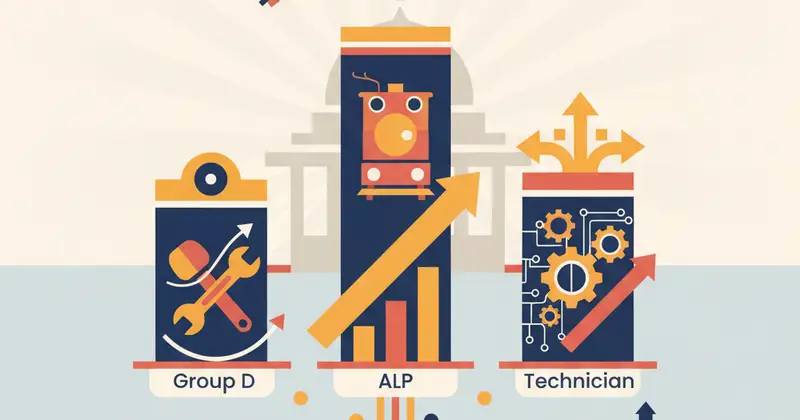
The Indian Railways is one of the largest employers in the world, and a job within this massive organization is a dream for millions of Indians. The promise of job security, decent pay, and a host of benefits makes railway recruitment a highly anticipated event. Among the most popular entry-level positions are Group D, Assistant Loco Pilot (ALP), and Technician. While all three offer a gateway into a stable government career, they are vastly different in terms of eligibility, work, salary, and future prospects.
If you're a railway job aspirant, you've likely found yourself at a crossroads, wondering which path is the right one for you. Should you aim for the widely accessible Group D posts? Or do you have the technical qualifications for the more specialized roles of ALP or Technician? This comprehensive guide will break down the key differences and similarities between these three coveted railway jobs, helping you make an informed decision for your future career. Let's dive deep into the world of Railway Group D, ALP, and Technician posts.
Understanding the Roles: An Overview
Before we compare, let's understand what each role entails. These jobs are the backbone of the Indian Railways, each contributing to the seamless operation of the world's fourth-largest rail network.
Railway Group D (Level 1 Posts)
Group D posts are the entry-level workforce of the Indian Railways. These roles are essential for the day-to-day maintenance and operational support of the entire railway infrastructure. They are recruited by the Railway Recruitment Cells (RRCs). Some common Group D posts include:

- Track Maintainer Grade IV
- Helper/Assistant in various departments (S&T, Electrical, Mechanical)
- Assistant Pointsman
- Hospital Assistant
Railway Assistant Loco Pilot (ALP)
The Assistant Loco Pilot is the co-pilot of a train. They work under the direct supervision of the main Loco Pilot, assisting in all aspects of train operation. It's a highly responsible job that requires sharp reflexes, excellent eyesight, and a strong technical aptitude. ALPs are crucial for ensuring the safe and timely movement of trains.
Railway Technician
Technicians are the technical experts responsible for the maintenance, repair, and overhaul of railway assets. They work in workshops, sheds, and on the field to ensure that all equipment, from signals and tracks to coaches and engines, is in perfect working condition. There are various grades and specializations within the Technician cadre, such as Technician Grade III Signal, Technician Fitter, Technician Welder, etc.
Eligibility Criteria: Who Can Apply?
The first step in choosing your career path is understanding the eligibility requirements. This is where the primary distinction between these posts lies. Your educational background will largely determine which of these jobs you can apply for.
| Criteria | Group D (Level 1) | Assistant Loco Pilot (ALP) | Technician |
|---|---|---|---|
| Educational Qualification | 10th Pass OR ITI from institutions recognised by NCVT/SCVT or equivalent. | 10th Pass + ITI from recognized institutions in specific trades OR 3 years Diploma in Mechanical/Electrical/Electronics/Automobile Engineering. | 10th Pass + ITI from recognized institutions in specific trades. For some Technician posts (e.g., Signal & Telecom), 10+2 with Physics and Maths is also accepted. |
| Age Limit (General Category) | 18 to 33 years | 18 to 30 years | 18 to 30 years |
| Medical Standards | Varies from B1, B2, C1, C2 depending on the post. Relatively less strict than ALP. | A-1 Medical Standard (Strictest). Requires 6/6 vision without glasses, no colour blindness. | Varies from B1, B2, C1 depending on the technical trade. Less strict than A-1. |
Key Takeaway: Group D is the most accessible, requiring only a 10th pass for many posts. ALP and Technician roles are specialized and demand an ITI or Diploma, making them suitable for candidates with a technical background. The medical standard, especially for ALP, is a critical and non-negotiable factor.
Selection Process: The Path to Recruitment
The journey to securing a railway job involves multiple stages of examination. The selection process for each post is designed to test the specific skills required for the role.
Group D Selection Process
- Computer Based Test (CBT): A single-stage CBT covering General Science, Mathematics, General Intelligence & Reasoning, and General Awareness & Current Affairs.
- Physical Efficiency Test (PET): Candidates who clear the CBT are called for PET. This is a qualifying test and involves running and weight lifting tasks to test physical fitness.
- Document Verification (DV) & Medical Examination: Successful candidates from PET are called for DV and a subsequent medical exam.
ALP & Technician Selection Process
The process for ALP and Technician is more complex and is conducted jointly by the Railway Recruitment Boards (RRBs).
- First Stage CBT (CBT-1): This is a common screening test for both ALP and Technician aspirants. It is of a qualifying nature to shortlist candidates for the next stage. The syllabus is similar to the Group D CBT but at a slightly higher level.
- Second Stage CBT (CBT-2): This stage has two parts:
- Part A: This part is common for all and its marks are used for the final merit list. It covers Maths, Reasoning, Basic Science & Engineering, and General Awareness.
- Part B: This is a qualifying test based on the candidate's chosen trade (for ITI/Diploma holders) or subject (for 10+2 PCM).
- Computer Based Aptitude Test (CBAT): This stage is ONLY for ALP candidates. It is a psychometric test to evaluate the candidate's aptitude for the job of a pilot (e.g., reaction time, concentration, depth perception). It is a mandatory qualifying test.
- Document Verification (DV) & Medical Examination: The final step for shortlisted candidates.
For the latest exam patterns and syllabus, always refer to the official notifications on our /rrb-syllabus page.
Job Profile and Nature of Work
What does a typical day look like in each of these roles? Understanding the work environment, responsibilities, and challenges is crucial for long-term job satisfaction.
Life as a Group D Employee
The work is physically demanding and often involves being outdoors. A Track Maintainer, for example, works on the railway tracks in all weather conditions, ensuring the safety of the line. A Pointsman is responsible for operating switches and signals. A Helper assists senior technicians in workshops or depots. While the work can be tough, it's the foundation upon which the entire railway system runs. The working hours are generally fixed (8 hours a day), but night shifts and emergency call-outs can occur, especially for track maintenance and pointsman roles.
Life as an Assistant Loco Pilot (ALP)
The life of an ALP is challenging and dynamic. Your 'office' is the locomotive cab. Key responsibilities include:
- Assisting the Loco Pilot in operating the train.
- Constantly monitoring signals, track conditions, and instrument panels.
- Calling out signals to the Loco Pilot.
- Performing minor troubleshooting on the locomotive.
- Learning the routes, signals, and gradients of the section.
The job involves irregular working hours, including long night shifts and being away from home for extended periods. It demands immense concentration and mental alertness. However, the thrill of controlling a massive train and the responsibility that comes with it is a unique experience.
Life as a Technician
A Technician's job is more predictable compared to an ALP's. Most Technicians work in workshops, maintenance sheds, or signal control rooms. Their work is hands-on and technical.
- Technician (Signal): Installs, maintains, and repairs the signaling system to ensure safe train passage.
- Technician (Carriage & Wagon): Inspects and repairs coaches and wagons to ensure passenger comfort and safety.
- Technician (Diesel/Electric Loco Shed): Works on the maintenance and overhaul of diesel or electric locomotives.
The work schedule is usually in shifts (morning, evening, night), but it's more structured than an ALP's roster. It's a great role for those who enjoy working with tools and solving technical problems.
Salary Structure and In-Hand Pay
Salary is a major deciding factor for any job aspirant. All three roles come under the 7th Central Pay Commission (CPC) matrix, but their pay levels and, consequently, their total emoluments differ.
| Component | Group D (Level 1) | ALP & Technician (Level 2) |
|---|---|---|
| Pay Level (7th CPC) | Level 1 | Level 2 |
| Basic Pay | ₹18,000 | ₹19,900 |
| Dearness Allowance (DA) | Calculated on Basic Pay (e.g., 50% of ₹18,000 = ₹9,000) | Calculated on Basic Pay (e.g., 50% of ₹19,900 = ₹9,950) |
| House Rent Allowance (HRA) | 9%, 18%, or 27% of Basic Pay depending on the city | 9%, 18%, or 27% of Basic Pay depending on the city |
| Transport Allowance (TA) | Fixed amount, varies by city | Fixed amount, varies by city |
| Other Allowances | Night Duty Allowance (if applicable) | Night Duty Allowance, Running Allowance (for ALP), etc. |
| Approx. Gross Salary (Initial, Class X City) | ~ ₹30,000 - ₹33,000 | ~ ₹35,000 - ₹40,000+ (ALP salary is higher due to Running Allowance) |
(Note: DA rates are revised periodically. The figures above are for illustrative purposes based on a hypothetical 50% DA rate.)
The key difference for an ALP is the Running Allowance, which is paid for every kilometer they run the train. This allowance significantly boosts their monthly income, often making their take-home salary much higher than that of a Technician or a Group D employee, even though they are at a similar base level.
Career Growth and Promotion Opportunities
A government job is not just a job; it's a career. Understanding the promotion ladder is essential for long-term planning.
Group D Career Path
A Group D employee has a clear, albeit slow, path for growth. After a few years of service, they become eligible for departmental exams for promotion to higher grades.
- Typical Path: Group D (Level 1) -> Promotion to Technician Grade III (Level 2) after passing a departmental exam.
- They can also appear for General Departmental Competitive Exams (GDCE) for posts like Clerk, Ticket Collector, or even ALP/Technician if they meet the eligibility criteria.
- With time and seniority, they can rise to supervisory roles within their department, reaching up to Level 5 or 6 by the time of retirement.
ALP Career Path
The career progression for an ALP is one of the fastest and most well-defined in the Railways.
- Assistant Loco Pilot (ALP) -> Senior ALP -> Loco Pilot (Shunting) -> Loco Pilot (Goods) -> Loco Pilot (Passenger) -> Loco Pilot (Mail/Express)
- Each promotion brings a significant jump in pay, responsibility, and prestige. Reaching the level of a Mail/Express Loco Pilot is a highly respected achievement.
Technician Career Path
A Technician also has a structured growth path based on seniority and departmental exams.
- Technician Grade III (Level 2) -> Technician Grade II (Level 4) -> Technician Grade I (Level 5)
- After reaching Technician Grade I, they can be promoted to Senior Section Engineer (SSE) or Junior Engineer (JE) through departmental exams.
- The growth is steady and provides opportunities to become a supervisor in the technical domain.
Which One Should You Choose?
The final decision rests on your qualifications, personality, and long-term goals. Here’s a summary to help you decide:
Choose Group D if:
- You have a 10th pass qualification and are looking for a secure government job.
- You are physically fit and prepared for manual labour.
- You want to enter the railway system and then work your way up through departmental exams.
Choose Technician if:
- You have an ITI qualification or 10+2 with PCM and enjoy hands-on technical work.
- You prefer a relatively stable work schedule with fixed working hours in shifts.
- You want a career in a specific technical field (e.g., signaling, electrical, mechanical) with steady growth.
Choose ALP if:
- You have the required technical qualification (ITI/Diploma) and meet the stringent A-1 medical standards.
- You are mentally and physically resilient, ready for a challenging job with irregular hours.
- You are attracted by a faster promotion path and a significantly higher salary potential due to running allowances.
Keep an eye on our /sarkari-result page for updates on the results of these examinations.
Checks to complete before you apply
Railway Group D, ALP, and Technician are all excellent entry points into a career with the Indian Railways. There is no single 'best' job; there is only the 'best' job for *you*. Group D offers accessibility, ALP offers high rewards with high responsibility, and Technician offers a stable career for those with technical skills. Evaluate your educational background, physical and medical fitness, and personal temperament. Analyze the job profiles and career trajectories we've outlined. By aligning your personal strengths and aspirations with the demands of the role, you can make a choice that leads to a fulfilling and successful career in the Indian Railways. Stay updated on all upcoming vacancies on our /government-jobs portal.
Frequently Asked Questions (FAQs)
Q1: Which job has the highest salary: Group D, ALP, or Technician? A1: Initially, ALP and Technician start at a higher basic pay (Level 2) than Group D (Level 1). However, due to the 'Running Allowance' paid per kilometer, the in-hand salary of an Assistant Loco Pilot (ALP) is significantly higher than both Technician and Group D employees. Over a career, an ALP's earnings potential is the highest among the three. Q2: Is a Group D job permanent? A2: Yes, all posts recruited through the RRC Group D process are permanent, central government jobs. After successfully completing the probation period, employees enjoy all the benefits of a permanent government servant, including job security, allowances, and a pension under the National Pension System (NPS). Q3: Can a Group D employee become a Loco Pilot? A3: Yes, it is possible. A Group D employee who acquires the necessary educational qualifications (e.g., ITI or Diploma in Engineering) can appear for the General Departmental Competitive Exam (GDCE) for the post of ALP. If they clear the exam, meet the stringent A-1 medical standards, and pass the CBAT, they can transition to the role of an Assistant Loco Pilot and begin their journey on that career path. Q4: What is the main difference in the work of an ALP and a Technician? A4: The main difference is 'operation' vs. 'maintenance'. An ALP is in the 'operations' department; their job is to run the train. Their workplace is the locomotive, and their hours are irregular. A Technician is in the 'maintenance' department; their job is to repair and maintain railway equipment (locos, coaches, signals). Their workplace is usually a workshop or a shed, and their work schedule is more structured. Q5: I have a 10+2 (PCM) qualification. Which of these jobs can I apply for? A5: With a 10+2 (Physics & Maths) qualification, you are eligible for certain Technician posts, specifically in the Signal and Telecommunication departments, as per previous RRB notifications. You are also eligible for Group D posts. You would NOT be eligible for the ALP post, which mandatorily requires an ITI or a Diploma in specific engineering trades. Always check the latest /admit-card and notification details for precise eligibility.Railway Group D vs ALP vs Technician Jobs
Related: Railway Recruitment Guide | Railway Jobs
FAQs
Which railway job pays best?ALP starts highestWhat's Group D qualification?10th + ITI certificateRelated Resources
- Latest Railway Job Notifications
- How to Prepare for Railway Exams
- 10th Pass Government Jobs
- Sarkari Result Live Updates
Related Government Job Resources
Continue with active job hubs and related government job pages on TrueJobs.
Tools for this recruitment topic
Use only the tools relevant to the dates, eligibility or documents discussed above.
TrueJobs Editorial Team
TrueJobs editorial desk
This article is prepared from the sources referenced in the guide and reviewed for clarity, links and dated information. Read our editorial and corrections policy.
Continue This Topic
Follow the closest earlier and newer coverage so older archive posts keep real contextual crawl paths.
Government Job Physical Fitness Test Guide 2026: Running, Height, Chest & Medical
Prepare for the 2026 government job physical fitness test. Our guide details key standards for running, height, chest, and medicals to help you succeed.
Bank PO vs SSC CGL 2026: Growth, Salary & Work-Life Balance
Choosing between a career as a Bank PO and an SSC CGL officer is a major decision. Our in-depth analysis compares career growth, salary, work-life balance, and job profiles to help you decide which path is right for you in 2026.
Read Next
State Government Jobs vs Central Government Jobs 2026: Salary, Transfer & Growth Compared

Bank PO vs SSC CGL 2026: Growth, Salary & Work-Life Balance

Contract vs Permanent Government Jobs in India: Salary, Stability & Your Career Choice

SSC CHSL vs SSC CGL 2026: Which Exam Should You Choose?
Explore Topics
Perfect Your Resume
Use our AI-powered Resume Builder to create ATS-optimized resumes.
AI Resume Builder