
Recruitment guide
Contract vs Permanent Govt Jobs: India Salary — Explained
Government jobs offer stability, but contract vs permanent roles differ greatly. Learn about salary structures, benefits, and career progression.

For millions of aspirants across India, a government job (sarkari naukri) represents more than just employment; it's a dream of stability, respect, and a secure future. This deep-rooted aspiration stems from the inherent benefits and social standing associated with public sector employment, a legacy that has been passed down through generations. In a country where economic uncertainties can be prevalent, the promise of a steady income, comprehensive benefits, and a job for life holds immense appeal, not just for the individual but for their entire family. This societal value often places government employees on a pedestal, making these roles highly coveted, influencing everything from marriage prospects to community standing.
The perception of government service as a noble and secure career path is deeply ingrained in the Indian psyche, offering a sense of purpose and contribution to national development.
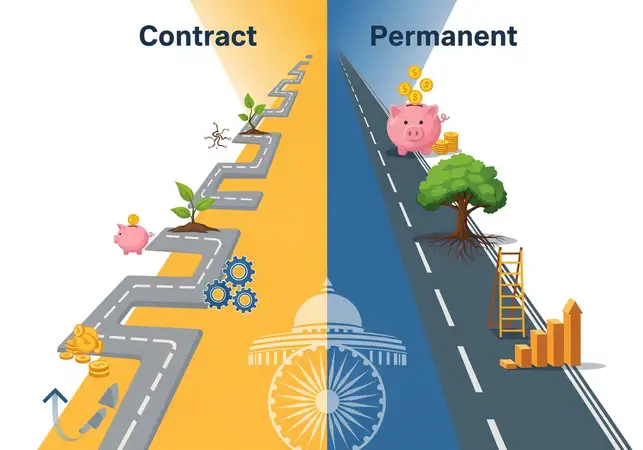
However, the landscape of government employment isn't always black and white. Beyond the coveted permanent positions, there's a significant segment of contractual government jobs that often create confusion and uncertainty for job seekers. These roles, while offering a foot in the door to public service, come with a different set of terms and conditions. Understanding the fundamental differences between these two types of roles—especially concerning salary, stability, long-term career prospects, and overall quality of life—is crucial for making an informed decision about your future. This comprehensive guide from TrueJobs.co.in aims to demystify both options, helping you weigh the pros and cons to choose the path that best aligns with your aspirations and career goals in the dynamic Indian job market.
We will delve into the nuances of each, providing practical insights to aid your career planning, ensuring you make a choice that supports your professional and personal well-being.
Understanding Permanent Government Jobs in India
Permanent government jobs are the traditional and most sought-after form of employment within the Indian public sector. These roles are typically filled through rigorous, competitive examinations conducted by central and state recruiting agencies like the Union Public Service Commission (UPSC), Staff Selection Commission (SSC), various State Public Service Commissions (PSCs), Railway Recruitment Boards (RRBs), and others. These examinations are designed to select the most competent candidates for a wide array of roles, from administrative services (like IAS, IPS) to technical, clerical, teaching, banking, defense civilian, and specialized positions across various ministries and departments.
Once selected, an employee enjoys a lifelong tenure until retirement, typically at the age of 60 or 62, subject to adherence to strict service rules and regulations laid down by the government. This long-term commitment from the employer provides an unparalleled sense of security and predictability, allowing individuals to build a stable career and life.
The Pillars of Permanent Employment
Permanent government jobs are underpinned by a robust legal and administrative framework. They are governed by specific service rules, acts, and constitutional provisions that safeguard the rights and responsibilities of employees. For instance, Article 311 of the Indian Constitution provides significant protection to civil servants against arbitrary dismissal, ensuring due process and protecting them from political interference, thereby upholding the neutrality of the bureaucracy. These rules, along with various service codes and conduct rules, define everything from probation periods, promotion criteria, disciplinary actions, and leave policies to pension benefits. This structured environment ensures fairness, transparency, and accountability, which are hallmarks of public administration.
The existence of such a comprehensive framework provides a strong sense of job security, as employees cannot be terminated without proper cause and due process, unlike in many private sector roles.

Furthermore, the legal framework for permanent government jobs is constantly evolving to adapt to modern governance needs while preserving the core principles of public service. This includes provisions for grievance redressal mechanisms, ensuring that employees have avenues to address concerns or disputes. The emphasis on merit-based selection through competitive exams ensures that the most capable individuals are inducted into the service, contributing to efficient public administration. The detailed service rules also cover aspects like inter-departmental transfers, deputation to other organizations, and even post-retirement re-employment policies, providing a holistic view of an employee's journey within the government sector.
Key Advantages of Permanent Government Jobs
The allure of permanent government jobs is multifaceted, extending beyond just job security. Here are some of the primary advantages:
- Unmatched Job Security: This is arguably the biggest draw. Once appointed, employees typically serve until retirement, barring extreme misconduct. This eliminates the constant threat of layoffs or economic downturns affecting employment, providing immense peace of mind. The constitutional safeguards and detailed service rules make it extremely difficult for an employee to be terminated arbitrarily, fostering a sense of psychological safety that is rare in other sectors.
- Attractive Salary and Allowances: Government salaries, especially after the implementation of Pay Commission recommendations, are competitive. Beyond the basic pay, employees receive numerous allowances such as Dearness Allowance (DA), House Rent Allowance (HRA), Travel Allowance (TA), Medical Allowance, and various special allowances depending on the role and location. These allowances significantly boost the take-home pay and contribute to a comfortable lifestyle. For example, DA is revised twice a year to offset inflation, ensuring that the purchasing power of the salary is maintained. HRA varies based on the classification of cities (X, Y, Z), providing support for accommodation costs.
- Comprehensive Benefits Package: Permanent employees are entitled to a wide range of benefits, including a robust pension scheme (either the Old Pension Scheme for those appointed before 2004 or the National Pension System for those appointed thereafter), gratuity, provident fund (GPF/EPF), and comprehensive medical facilities (CGHS/ECHS for central government employees and similar schemes for state employees). These benefits provide a strong social security net, covering healthcare needs and ensuring financial stability post-retirement. The CGHS (Central Government Health Scheme) provides comprehensive medical care to central government employees and their dependent family members, often at highly subsidized rates or free of cost, a significant financial relief.
- Fixed Working Hours and Work-Life Balance: While some roles may demand extended hours, many government jobs offer predictable working hours, typically 9 AM to 5 PM, with weekends off. This allows for a better work-life balance compared to many demanding private sector roles, enabling employees to pursue personal interests, spend time with family, and maintain their well-being. Generous leave policies, including earned leave, casual leave, medical leave, and special leave for various circumstances, further contribute to this balance.
- Opportunities for Career Growth and Promotion: Government departments have well-defined hierarchical structures and promotion policies. Employees can advance through the ranks based on seniority, performance, and clearing departmental examinations. This structured career path offers clear progression opportunities, leading to higher pay scales and increased responsibilities over time. Regular Departmental Promotion Committees (DPCs) ensure a systematic review of eligibility for promotions.
- Social Respect and Prestige: Holding a government position, particularly in prestigious services like the IAS or IPS, commands significant respect and social standing in Indian society. It is often seen as a mark of achievement and dedication, bringing honor to the individual and their family. This societal recognition extends to various other government roles, where employees are often viewed as contributors to national development.
- Training and Development: Government organizations invest in the continuous training and development of their employees. This includes induction training, in-service training programs, workshops, and opportunities for higher education or specialized courses, which help employees enhance their skills and stay updated in their respective fields. Institutions like the National Centre for Good Governance (NCGG) and various administrative academies regularly conduct such programs.
- Transferability and Exposure: Many government jobs involve transfers to different locations across the state or country. While this can sometimes be challenging, it also offers opportunities to experience diverse cultures, work environments, and gain broad exposure, which can be enriching both personally and professionally. For instance, an officer in an All India Service might serve in multiple states and at the central level, gaining a panoramic view of governance.
- Contribution to Public Service: Beyond personal benefits, permanent government jobs offer the profound satisfaction of contributing directly to public welfare and national development. Employees play a crucial role in policy implementation, service delivery, and maintaining law and order, which can be a powerful motivator for many.
Challenges of Permanent Government Jobs
Despite the numerous advantages, permanent government jobs also come with certain challenges:
- Intense Competition: The sheer number of applicants for government jobs means that competition is extremely high. Success often requires years of dedicated preparation and multiple attempts. For example, lakhs of candidates appear for examinations like the UPSC Civil Services Exam for a few hundred vacancies, making it one of the toughest exams globally. For more information on upcoming exams, check out our Sarkari Naukri section.
- Slow Career Progression: While there are opportunities for promotion, the pace of career advancement can sometimes be slower compared to the private sector, especially in certain departments. Promotions are often based on seniority rather than purely on merit or performance, which can be frustrating for highly ambitious individuals.
- Bureaucratic Environment: Government organizations are often characterized by hierarchical structures, extensive paperwork, and adherence to strict protocols. This can sometimes lead to slower decision-making processes and a perceived lack of dynamism. The emphasis on rules and procedures, while ensuring fairness, can sometimes hinder rapid innovation.
- Limited Scope for Innovation: Depending on the role, there might be less scope for radical innovation or entrepreneurial initiatives compared to the private sector. Roles are often defined by established procedures and policies, and deviation can be challenging. However, recent government initiatives are trying to foster innovation within the public sector.
- Transfer Policies: While transferability can be an advantage, frequent transfers, especially to remote or unfamiliar locations, can be disruptive for family life and personal commitments. Spouses might struggle to find employment, and children's education can be affected.
- Political Interference: In some instances, government employees, especially those in administrative roles, might face political pressure or interference, which can complicate their work and decision-making processes.
- Perception of Inefficiency: Despite efforts to improve, government departments sometimes carry a public perception of inefficiency or slow service delivery, which can be demotivating for dedicated employees.
Understanding Contractual Government Jobs in India
Contractual government jobs, while distinct from permanent roles, have become an increasingly prevalent feature of the Indian public sector. These positions are typically created to address specific project-based needs, temporary vacancies, or to bring in specialized expertise for a defined period. Unlike permanent employees, contractual staff are not on the regular payroll and are engaged for a fixed term, which can range from a few months to several years. They are often hired through outsourcing agencies, direct recruitment by departments for specific projects, or through schemes like the National Health Mission (NHM), Sarva Shiksha Abhiyan (SSA), various research projects, or IT initiatives.
These roles offer a different entry point into government service, often with less stringent selection processes than permanent positions, but also with fewer long-term assurances.
The Nature of Contractual Employment
Contractual employment in the government sector is characterized by its temporary nature and specific terms. The engagement is governed by a contract that outlines the duration of employment, remuneration, duties, and other conditions. These roles are often project-specific, meaning that once the project concludes or the funding runs out, the contract may not be renewed. This model allows the government to be agile in hiring for immediate needs without incurring long-term commitments, especially in areas requiring specialized skills that may not be available within the permanent workforce or for initiatives that are not intended to be permanent fixtures.
The rise of contractual employment can be attributed to several factors, including the need for specialized skills for short-term projects, budgetary constraints that limit the creation of new permanent posts, and the desire for greater flexibility in workforce management. These positions often fill critical gaps in areas like technology, research, healthcare, and education, where specific expertise is required for a limited duration. The terms of employment for contractual staff are typically less standardized than for permanent employees and can vary significantly from one contract to another, even within the same department. This variation extends to aspects like working hours, leave policies, and the scope of responsibilities, all of which are explicitly defined in the individual contract.
It's crucial for aspirants to thoroughly read and understand these contractual terms before accepting such a role.
Key Advantages of Contractual Government Jobs
While lacking the long-term security of permanent roles, contractual government jobs offer their own set of benefits:
- Easier Entry into Government Sector: The selection process for contractual roles is often less rigorous and faster than for permanent positions. This can be an excellent way for individuals to gain experience within a government setup without having to clear highly competitive examinations like UPSC or SSC. Many contractual roles involve direct interviews or selection based on academic merit and experience, significantly reducing the waiting period.
- Opportunity to Gain Experience: For fresh graduates or those looking to transition into government work, contractual roles provide valuable exposure to public administration, specific departmental functions, and government work culture. This experience can be a significant asset when applying for permanent positions later. It allows individuals to understand the nuances of government functioning, which can be a distinct advantage.
- Exposure to Diverse Projects: Contractual employees often work on specific projects, which can offer varied experiences and the opportunity to develop specialized skills. This project-based work can be dynamic and intellectually stimulating, especially for those who thrive on new challenges and prefer not to be tied to routine tasks. For example, working on a specific digital transformation project for a ministry can provide cutting-edge experience.
- Potentially Higher Initial Pay (in some specialized roles): In certain specialized fields, especially those requiring niche skills (e.g., IT, data analytics, specific research areas), contractual roles might offer a competitive salary package, sometimes even higher than entry-level permanent positions, to attract talent. This is particularly true for roles where the private sector also offers high remuneration for similar expertise.
- Networking Opportunities: Working within government departments, even on a contractual basis, allows individuals to build a professional network within the public sector. These connections can be beneficial for future career opportunities, both within and outside the government. Meeting permanent staff and other contractual employees can open doors to new roles or provide valuable insights into the job market.
- Flexibility (in some cases): Some contractual roles might offer more flexibility in terms of work hours or project involvement, especially in research or consulting-based positions, though this is not universally true. This flexibility can be appealing to individuals who prefer a non-traditional work arrangement or are balancing other commitments.
- Skill Enhancement: Many contractual roles are designed to address specific skill gaps. Working on such projects can lead to rapid skill enhancement and specialization, making the individual more marketable for future opportunities.
Challenges of Contractual Government Jobs
The temporary nature of contractual employment brings with it several significant challenges:
- Lack of Job Security: The most prominent disadvantage is the absence of job security. Employment is for a fixed term, and there is no guarantee of contract renewal. This uncertainty can be a constant source of stress and makes long-term planning difficult, impacting decisions like buying a home or starting a family.
- Limited or No Benefits: Contractual employees typically do not receive the comprehensive benefits package enjoyed by permanent staff. This often means no pension, gratuity, provident fund contributions, or full medical coverage. Their remuneration is often a consolidated pay, without additional allowances. This necessitates individuals to arrange for their own health insurance, retirement savings, and other social security measures.
- Lower Pay (often): While some specialized roles might offer competitive pay, many contractual positions, especially at lower levels, offer significantly lower salaries compared to their permanent counterparts, even for performing similar duties. This disparity can be a source of demotivation and financial strain.
- No Promotion or Career Progression: Contractual roles generally do not have a defined career path or promotion opportunities within the government structure. Growth is often limited to the duration of the contract. To advance, individuals usually have to seek new, higher-level contracts or transition to permanent roles.
- Lack of Social Standing: Despite working for the government, contractual employees may not enjoy the same level of social respect or stability associated with permanent government jobs. The temporary nature of their employment can sometimes lead to a perception of lesser status.
- Exploitation and Unequal Treatment: In some instances, contractual employees might face challenges related to unequal pay for equal work, lack of proper leave policies, or difficulties in accessing resources compared to permanent staff. There have been cases where contractual workers are paid significantly less for performing tasks identical to those of permanent employees.
- Uncertainty of Regularization: While there are instances where contractual employees are eventually regularized, this is not a guaranteed path and often depends on specific government policies, court interventions, or the creation of permanent posts, which can be a lengthy and uncertain process. Many contractual employees work for years hoping for regularization that never materializes.
- Limited Legal Protection: The legal protections available to contractual employees are often limited to the terms of their contract, unlike the extensive constitutional and service rule protections enjoyed by permanent staff. This can make it harder to address grievances or disputes.
Comparative Analysis: Contract vs. Permanent Government Jobs
To help you make an informed decision, let's directly compare the two types of government employment across key parameters:
1. Job Security and Stability
Permanent: Offers unparalleled job security, with employment guaranteed until retirement, barring serious misconduct. This provides a strong foundation for long-term financial and personal planning. Employees are protected by constitutional provisions and service rules against arbitrary termination. This allows for significant peace of mind and the ability to make long-term financial commitments like home loans or investments without constant worry about job loss.
Contractual: Lacks job security. Employment is for a fixed term, and renewal is not guaranteed. This can lead to significant stress and uncertainty, making it difficult to plan for the future, such as taking out loans or making major investments. The constant need to look for the next contract can be mentally taxing and disruptive to personal life.
2. Salary and Remuneration
Permanent: Follows structured pay scales determined by Pay Commissions. Includes basic pay, Dearness Allowance (DA), House Rent Allowance (HRA), Travel Allowance (TA), and various other allowances, which are revised periodically. The overall package is often very attractive and increases with seniority and promotions. These revisions ensure that the salary keeps pace with inflation and economic growth.
Contractual: Typically receives a consolidated salary without additional allowances. While some specialized roles might offer competitive pay, many are paid less than permanent employees for similar work. There is usually no provision for regular pay revisions or increments based on Pay Commission recommendations, meaning the salary might remain stagnant for the duration of the contract.
3. Benefits and Perks
Permanent: Enjoys a comprehensive benefits package including pension (OPS/NPS), gratuity, General Provident Fund (GPF), comprehensive medical facilities (CGHS/ECHS), subsidized housing, leave travel concession (LTC), and various types of leave (earned leave, medical leave, maternity/paternity leave). These benefits provide a robust social security net. The value of these non-monetary benefits often far exceeds their direct cost.
Contractual: Generally receives very limited or no benefits. Medical coverage, if any, is often basic. There are typically no pension or gratuity benefits, and leave policies may be less generous. This means individuals need to make their own arrangements for health insurance and retirement planning, which can be a significant financial burden.
4. Career Progression and Growth
Permanent: Offers a clear and structured career path with defined promotion policies based on seniority, performance, and departmental examinations. Employees can rise through the ranks, taking on greater responsibilities and higher pay scales. This provides a sense of long-term career trajectory and achievement.
Contractual: Limited or no formal career progression within the government setup. Growth is often restricted to the duration of the contract. Opportunities for advancement usually involve seeking new contracts or transitioning to permanent roles elsewhere, requiring proactive job searching.
5. Work-Life Balance
Permanent: Generally offers a better work-life balance with fixed working hours, regular holidays, and generous leave policies. This allows employees to manage personal and professional commitments effectively, fostering overall well-being.
Contractual: Can vary. While some roles may offer flexibility, others might involve demanding project deadlines. The constant uncertainty of contract renewal can also impact mental well-being and work-life balance, as individuals might feel pressured to perform beyond regular hours to secure extensions.
6. Social Standing and Prestige
Permanent: Commands significant social respect and prestige in Indian society, often associated with stability, authority, and public service. This social capital can translate into various personal and professional advantages.
Contractual: While working for the government carries some respect, it generally does not confer the same level of social standing or perceived stability as a permanent government job. The temporary nature can sometimes lead to questions about long-term career prospects.
7. Selection Process
Permanent: Involves highly rigorous, multi-stage competitive examinations (prelims, mains, interview) conducted by central or state recruiting bodies. The process is lengthy and highly competitive. Candidates often spend years preparing for these exams. You can find details about various Sarkari Exam Results on our portal.
Contractual: Often involves a simpler and faster selection process, such as walk-in interviews, shortlisting based on qualifications, or direct recruitment for specific projects. This makes entry easier but the roles are temporary. This faster process can be appealing for those seeking immediate employment.
Here's a summary table for quick reference:
| Feature | Permanent Government Job | Contractual Government Job |
|---|---|---|
| Job Security | High (until retirement) | Low (fixed-term contract) |
| Salary Structure | Structured pay scales with allowances (DA, HRA, TA, etc.) | Consolidated pay, often without allowances |
| Benefits | Comprehensive (Pension, Gratuity, PF, Medical, LTC, etc.) | Limited or no benefits |
| Career Growth | Defined promotion path, increments | Limited or no formal progression |
| Work-Life Balance | Generally good, fixed hours, generous leave | Varies, can be impacted by contract uncertainty |
| Social Standing | High respect and prestige | Moderate, less perceived stability |
| Selection Process | Rigorous competitive exams | Simpler, faster (interviews, direct recruitment) |
| Tenure | Lifelong (until retirement) | Fixed term (months to years) |
| Legal Protection | Strong constitutional and service rule protections | Limited, governed by contract terms |
| Financial Planning | Easier for long-term goals (housing, retirement) | Challenging due to uncertainty |
| Training & Development | Structured, continuous training programs | Often project-specific, less formal |
Making Your Career Choice: Which Path is Right for You?
The decision between a permanent and a contractual government job is a deeply personal one, influenced by your career aspirations, risk tolerance, financial needs, and life stage. There is no single "right" answer, as each path offers distinct advantages and disadvantages.
When to Aim for a Permanent Government Job:
- If Stability is Your Top Priority: If you value long-term job security, a predictable career path, and a stable income above all else, a permanent government job is the ideal choice. This path offers a foundation upon which you can build a secure future for yourself and your family.
- For Comprehensive Benefits: If you want a robust safety net including pension, medical facilities, and other social security benefits, permanent roles are unmatched. These benefits significantly reduce financial stress related to healthcare and post-retirement life.
- For a Structured Career Path: If you prefer a clear hierarchy, defined promotion opportunities, and a steady progression, permanent government service offers this. This predictability allows for long-term career planning and goal setting.
- If You Are Willing to Invest Time in Preparation: Be prepared for years of dedicated study and multiple attempts to clear the highly competitive examinations. This path requires significant perseverance and commitment. Access our Admit Cards section for exam updates.
- For Social Prestige: If the social respect and standing associated with government service are important to you, permanent roles deliver this in abundance. This can also positively impact personal aspects like marriage prospects and community recognition.
- If You Seek Work-Life Balance: While not universally true for all roles, many permanent government positions offer a better work-life balance compared to the demanding private sector, with fixed hours and generous leave policies.
- If You Want to Contribute to Public Service: The opportunity to serve the nation and contribute to public welfare is a significant motivator for many choosing permanent government service.
When to Consider a Contractual Government Job:
- As a Stepping Stone: If you are a fresh graduate or new to the job market and want to gain experience within the government sector, a contractual role can be an excellent entry point. It can provide valuable insights and networking opportunities, making your resume stronger for future applications.
- For Immediate Employment: If you need a job quickly and are not willing or able to spend years preparing for competitive exams, contractual roles offer faster recruitment processes. This can be crucial for individuals facing immediate financial needs.
- To Gain Specialized Experience: If you have niche skills and want to work on specific, interesting projects within the government, contractual roles often cater to such requirements. This can be particularly beneficial for professionals in IT, research, or specialized consulting fields.
- If You Are Exploring Career Options: It can be a good way to test the waters and see if government work culture suits you before committing to the rigorous process of securing a permanent position. It offers a low-commitment way to experience the public sector.
- If You Are Comfortable with Uncertainty: If you have a higher risk tolerance and are capable of managing periods of unemployment or transitioning between contracts, this path might suit you. This requires strong financial planning and adaptability.
- While Preparing for Permanent Roles: Many aspirants take up contractual roles to support themselves financially while simultaneously preparing for permanent government job examinations. This allows them to earn and gain experience without a complete break in their career. The experience gained can also be a talking point in interviews for permanent positions.
- For Project-Based Work Preference: If you prefer working on diverse, time-bound projects rather than long-term, routine tasks, contractual roles can offer this dynamic work environment.
Hybrid Approaches and Strategic Planning
It's also important to consider hybrid approaches. Many individuals start with contractual government jobs to gain experience and financial stability, while simultaneously preparing for permanent government job examinations. This strategy allows them to build their resume, understand the public sector environment, and earn an income, all while pursuing their ultimate goal of a permanent position. The experience gained in a contractual role can sometimes even be beneficial during interviews for permanent positions, demonstrating practical knowledge of government functioning.
For example, a candidate might work as a contractual data analyst for a government project, gaining practical experience in data management and policy analysis. This experience, combined with dedicated study, can significantly enhance their chances of clearing an SSC CGL exam for a permanent statistical investigator role. This strategic approach mitigates the financial strain of full-time exam preparation while building a relevant professional profile. It's about leveraging the present opportunity to pave the way for future aspirations. For more career insights, explore our career guidance blog.
Ultimately, your decision should be based on a thorough self-assessment of your priorities. Do you prioritize immediate income and experience over long-term security? Or are you willing to invest time and effort for the unparalleled stability and benefits of a permanent role? TrueJobs.co.in encourages you to weigh these factors carefully, research specific job requirements, and consider your personal circumstances before embarking on your career journey in the Indian public sector.
Checks to complete before you apply
Both permanent and contractual government jobs play vital roles in the functioning of India's public administration. While permanent positions remain the gold standard for stability, comprehensive benefits, and social prestige, contractual roles offer valuable entry points, project-specific expertise, and opportunities for immediate employment and experience. Understanding the fundamental differences in salary, job security, benefits, and career progression is paramount for any job seeker in India.
The Indian government job market is dynamic and constantly evolving. While the traditional appeal of permanent sarkari naukri remains strong, the increasing number of contractual roles reflects the government's need for flexibility and specialized skills for various projects and initiatives. Therefore, aspirants must not only be aware of the differences but also understand how these roles fit into the broader employment landscape and their personal career trajectory. Making an informed decision requires careful consideration of individual circumstances, including financial needs, career goals, risk appetite, and long-term aspirations. It's about finding the right balance that supports both professional growth and personal well-being.
As you navigate the vast landscape of government employment, remember that your career choice should align with your personal values, financial goals, and long-term aspirations. Whether you choose the path of unwavering stability or the flexibility of project-based work, TrueJobs.co.in is here to provide you with the latest job notifications, preparation resources, and career advice to help you achieve your dreams in the dynamic world of sarkari naukri.
FAQ
What is the main difference between permanent and contractual government jobs?
The main difference lies in job security and tenure. Permanent government jobs offer lifelong employment until retirement with comprehensive benefits and a structured career path, protected by service rules and constitutional provisions. Contractual government jobs are for a fixed term, lack job security, and typically offer limited or no benefits, with no guaranteed renewal or career progression within the government structure.
Can a contractual government employee become permanent?
While it is not a guaranteed path, there are instances where contractual employees are regularized into permanent positions. This usually depends on specific government policies, court interventions, the creation of new permanent posts, or if the employee successfully clears competitive examinations for permanent roles. However, regularization is often a lengthy and uncertain process, and should not be assumed as an automatic outcome of contractual employment.
Are the salaries for contractual government jobs always lower than permanent ones?
Generally, salaries for contractual government jobs are lower than their permanent counterparts, especially when considering the full package including allowances and benefits. However, in certain specialized fields (e.g., IT, data science, specific research roles) where niche skills are in high demand, contractual roles might offer competitive or even higher initial consolidated pay to attract talent, sometimes surpassing entry-level permanent salaries. But these usually do not come with the same long-term benefits or increments.
Contract vs Permanent Govt Jobs: Salary & Stability
Related: Latest Govt Jobs | Sarkari Naukri Perks
Related Government Job Resources
Continue with active job hubs and related government job pages on TrueJobs.
Tools for this recruitment topic
Use only the tools relevant to the dates, eligibility or documents discussed above.
TrueJobs Editorial Team
TrueJobs editorial desk
This article is prepared from the sources referenced in the guide and reviewed for clarity, links and dated information. Read our editorial and corrections policy.
Continue This Topic
Follow the closest earlier and newer coverage so older archive posts keep real contextual crawl paths.
Top 10 Free Government Job Preparation Apps & Websites 2026 | TrueJobs
Prepare for your dream government job with our list of the top 10 free bilingual apps & websites. Get mock tests and study materials for SSC, Banking, Railways, and more.
State Government Jobs vs Central Government Jobs 2026: Salary, Transfer & Growth Compared
Explore 2026 state vs central govt jobs: salary comparisons, transfer policies, and growth trajectories. TrueJobs.co.in analysis
Read Next

SBI PO vs IBPS PO — Which Should You Choose? Complete Comparison
State Government Jobs vs Central Government Jobs 2026: Salary, Transfer & Growth Compared

How to Prepare for SSC CGL in 6 Months — Complete Strategy Guide

Bank PO vs SSC CGL 2026: Growth, Salary & Work-Life Balance
Explore Topics
Perfect Your Resume
Use our AI-powered Resume Builder to create ATS-optimized resumes.
AI Resume Builder