
Recruitment guide
SBI PO vs IBPS PO – Which to Choose in 2026? — Explained
SBI PO vs IBPS PO — Which Should You Choose? Embarking on a career in India's dynamic banking sector is a dream for millions of aspirants. Among the...
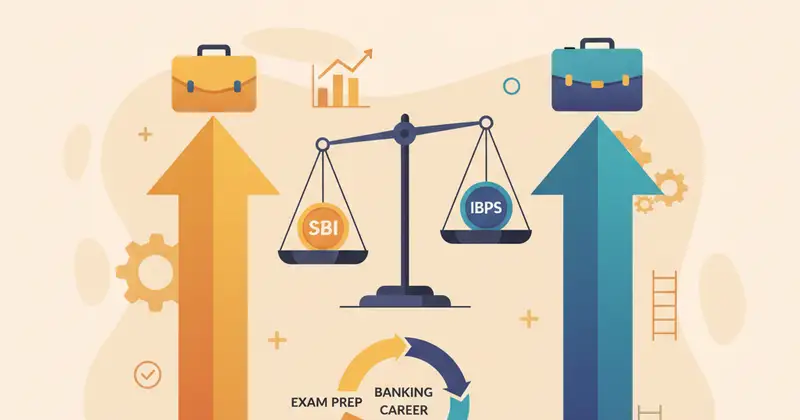
Choosing between SBI PO and IBPS PO is a critical decision for banking aspirants. This guide provides a detailed comparison of salary, career growth, and exam patterns. Make an informed choice for your banking career in 2026.
SBI PO vs IBPS PO — Which Should You Choose? Complete Comparison
A career as a Probationary Officer (PO) in India's public sector banking is a highly sought-after dream for millions. These roles, particularly at the State Bank of India (SBI) and through the Institute of Banking Personnel Selection (IBPS), offer stable government employment, robust career growth, attractive salaries, and a chance to contribute to the nation's financial backbone. As a PO, you'll engage in multifaceted responsibilities, including direct customer interaction, loan processing, branch operations, and regulatory compliance, making it a challenging yet rewarding path within India's dynamic banking sector.

However, distinguishing between SBI PO and IBPS PO can be perplexing for many aspirants. While both are entry-level managerial positions in public sector banks, they possess distinct characteristics in their selection processes, work cultures, and career trajectories. SBI, as India's largest public sector bank, operates with unique autonomy and scale, whereas IBPS manages recruitment for a consortium of other Public Sector Banks (PSBs). Grasping these nuances is vital for an informed decision that aligns with your career aspirations. This comprehensive guide aims to demystify these differences, empowering you to make the best career choice by understanding the subtle yet significant distinctions between these two coveted banking career paths.
Understanding the Probationary Officer Role
Before delving into the specifics of SBI PO and IBPS PO, it's crucial to understand the foundational role of a Probationary Officer. A PO is essentially an entry-level managerial position in a public sector bank. Upon selection, candidates undergo a probationary period, typically two years, during which they receive intensive training in various aspects of banking operations, including retail banking, rural banking, foreign exchange, credit, and marketing. This period equips them with necessary skills and knowledge, preparing them for future leadership roles and assessing their suitability for a permanent managerial position.
The day-to-day duties of a PO are dynamic and varied. They include direct customer interaction, handling customer queries, processing loan applications (personal, home, vehicle, agricultural, and business loans), managing cash operations, verifying documents, ensuring compliance with banking regulations, and promoting various banking products and services. POs are also involved in administrative tasks, report generation, and contributing to the overall business development of the branch. This role demands strong analytical skills, excellent communication abilities, a proactive approach to problem-solving, and a keen understanding of financial products, making it a pivotal position within the banking ecosystem that requires continuous learning and adaptability to evolving financial landscapes.

Key Differences in Recruitment Process
The recruitment process is often the first point of differentiation aspirants encounter. While both exams follow a similar three-tier structure – Preliminary Exam, Main Exam, and Interview – there are significant differences in their execution, difficulty, and specific components. Understanding these variations is crucial for tailoring your preparation strategy effectively.
Eligibility Criteria
The basic eligibility criteria for both SBI PO and IBPS PO are largely similar, ensuring a broad pool of qualified candidates. These common requirements reflect the fundamental expectations for entry-level managerial roles:
- Nationality: Indian citizen.
- Age Limit: Generally, candidates must be between 21 and 30 years of age, with relaxations for reserved categories (SC/ST, OBC, PwBD, Ex-servicemen) as per government norms. For instance, SC/ST candidates typically receive a 5-year relaxation, OBC candidates a 3-year relaxation, and PwBD candidates a 10-year relaxation. Always refer to the official notification for the specific cut-off date.
- Educational Qualification: A Bachelor's Degree in any discipline from a recognized university or any equivalent qualification recognized by the Central Government. This broad requirement allows graduates from various academic backgrounds to apply. Candidates in their final year/semester may also apply provisionally, provided they can produce proof of passing the degree examination at the time of the interview.
While core requirements are identical, aspirants should always refer to the official notification for the specific year as minor changes or clarifications can occur, such as minimum percentage in graduation or specific disability criteria. Ensure your university is recognized by the UGC or a similar statutory body.
Application Process and Exam Frequency
Both SBI PO and IBPS PO recruitments are annual processes, with notifications typically released in different periods. The application process for both is entirely online, involving registration, filling details, uploading scanned documents (photograph, signature, left thumb impression, handwritten declaration), and payment of application fees. It's crucial to follow exact specifications for document uploads to avoid rejection. Practical tip: always keep digital copies of your photograph and signature ready as per the specified dimensions.
- SBI PO: SBI conducts its own independent recruitment drive. The notification is usually released around September/October, with Prelims in November/December and Mains in January/February of the following year. This independent process allows SBI to tailor recruitment to its specific organizational needs.
- IBPS PO: IBPS conducts a common recruitment process for 11 participating Public Sector Banks (PSBs). The notification for IBPS PO is generally released around August, with Prelims in September/October and Mains in November. This centralized approach streamlines recruitment for multiple banks.
The distinct timelines allow dedicated aspirants to prepare and appear for both examinations, maximizing their chances of securing a PO position. Many candidates strategically plan their preparation to cover the syllabus for both, leveraging the overlap in subjects while focusing on the specific demands of each exam as their respective dates approach. Staying updated with official calendars is key to not missing deadlines.
Preliminary Examination (Prelims)
The Prelims for both exams are qualifying in nature; marks obtained here are not counted in the final merit list. Clearing this stage is mandatory to appear for the Mains. The primary purpose is to filter out a large number of applicants, ensuring only serious candidates with foundational aptitude proceed.
The structure is identical:
- Sections: English Language, Quantitative Aptitude, Reasoning Ability.
- Total Questions: 100 (30 for English, 35 each for Quant and Reasoning).
- Total Marks: 100.
- Duration: 1 hour (20 minutes per section).
- Negative Marking: 0.25 marks for each incorrect answer, necessitating careful attempt selection.
The primary difference lies in the difficulty level. SBI PO Prelims are generally perceived to be slightly tougher and more unpredictable than IBPS PO Prelims, often featuring trickier questions and a higher cut-off due to intense competition for fewer vacancies. For instance, SBI might present more complex reading comprehension or data interpretation sets requiring multiple calculations and logical steps, while IBPS might focus more on speed-based questions with direct calculations. A strong strategy for Prelims involves maximizing attempts with accuracy, as sectional as well as overall cut-offs must be cleared. Practicing with timed mock tests is essential to build both speed and accuracy.
Main Examination (Mains)
The Mains exam is where significant differences in difficulty, pattern, and scoring become more apparent. Marks from the Mains exam are crucial for the final merit list, carrying substantial weight in the overall selection process (typically 80% of the total score). This stage thoroughly assesses a candidate's comprehensive knowledge, analytical prowess, and communication skills.
IBPS PO Mains Structure
The IBPS PO Mains exam is a comprehensive assessment covering various facets of banking knowledge and aptitude:
- Objective Test: Comprises 4 sections – Reasoning & Computer Aptitude, General/Economy/Banking Awareness, English Language, Data Analysis & Interpretation.
- Total Questions: 155.
- Total Marks: 200.
- Duration: 3 hours.
- Descriptive Test: English Language (Letter Writing & Essay).
- Total Marks: 25.
- Duration: 30 minutes.
The objective test assesses analytical, logical, and general knowledge, while the descriptive test evaluates written communication skills. Sections like Reasoning & Computer Aptitude include advanced puzzles and basic computer knowledge, while Data Analysis & Interpretation focuses heavily on various DI charts and number series. General/Economy/Banking Awareness covers current affairs, static banking knowledge, economic terms, and government schemes.
SBI PO Mains Structure
The SBI PO Mains exam mirrors the structure of IBPS PO but elevates the challenge significantly:
- Objective Test: Also comprises 4 sections – Reasoning & Computer Aptitude, General/Economy/Banking Awareness, English Language, Data Analysis & Interpretation.
- Total Questions: 155.
- Total Marks: 200.
- Duration: 3 hours.
- Descriptive Test: English Language (Letter Writing & Essay).
- Total Marks: 50.
- Duration: 30 minutes.
Key distinctions:
- Difficulty: SBI PO Mains is widely considered significantly more challenging, with higher-level reasoning puzzles, intricate data interpretation sets requiring complex calculations, and nuanced English questions testing deeper comprehension. The General Awareness section often delves deeper into banking and financial news, requiring a thorough understanding of economic policies and regulatory updates.
- Descriptive Paper Weightage: SBI PO's descriptive section carries 50 marks, twice that of IBPS PO, indicating a greater emphasis on written communication skills. Candidates must structure arguments logically, concisely, and persuasively, as this section significantly impacts the final score.
- Sectional Timing: Both exams have sectional timings, requiring efficient time management. Strategic time allocation and question selection are paramount.
For both exams, candidates must clear both sectional and overall cut-offs in the objective test, and also qualify in the descriptive test. A strong performance in the Mains is the most critical factor for securing a place in the final merit list.
Interview and Group Discussion (GD)
The final stage of the selection process is the Interview, and for SBI PO, it often includes a Group Discussion (GD) component. This stage is crucial for assessing a candidate's personality, communication skills, leadership potential, and overall suitability for a managerial role.
- IBPS PO: Consists solely of a Personal Interview (PI) for 100 marks. The interview assesses personality, communication skills, general awareness, banking knowledge, problem-solving aptitude, and confidence. Interviewers look for clarity of thought, honesty, and a genuine interest in banking. Questions often revolve around current affairs, basic banking concepts, your resume, and situational judgment. Practical tip: Be prepared to discuss your motivations for joining the banking sector and how your skills align with the PO role.
- SBI PO: Typically includes both a Group Exercise (GE) and a Personal Interview (PI). The GE usually carries 20 marks, and the PI carries 30 marks, totaling 50 marks. The GE evaluates leadership, teamwork, communication, negotiation, and analytical skills in a group setting, where candidates discuss a topic or solve a problem collectively. The PI assesses similar traits as IBPS PO but often with a more rigorous approach, probing deeper into a candidate's motivations, understanding of the banking sector, and career aspirations within SBI.
The inclusion of a Group Exercise in SBI PO makes this stage more comprehensive and demanding, requiring candidates to demonstrate not just individual prowess but also their ability to function effectively in a team, articulate views, and arrive at a consensus – crucial skills for a future manager. Preparation involves practicing communication, body language, critical thinking, and mock group discussions and interviews.
Final Selection and Allotment
For both exams, the final merit list is prepared based on the combined scores of the Main Examination and the Interview/GD stage. The weightage for Mains vs. Interview/GD is typically 80:20 respectively, meaning the Mains exam score holds significant importance.
- SBI PO: Candidates are selected directly for SBI. If you clear the final cut-off, you will be joining the State Bank of India, a streamlined process for SBI's vast network.
- IBPS PO: Candidates are provisionally allotted to one of the participating Public Sector Banks based on their merit-cum-preference. This means you might be placed in Bank of Baroda, Punjab National Bank, Canara Bank, Union Bank of India, etc., depending on your score and the banks' requirements. Candidates typically provide a list of preferred banks during the application process, and allotment considers both merit and preference.
The provisional allotment in IBPS PO is followed by document verification and medical examination by the respective allotted bank. The final appointment is subject to clearing these checks, ensuring the candidate meets all eligibility criteria and is medically fit for the role. It's crucial to keep all original documents ready for verification.
Vacancies, Competition, and
Salary and Benefits Comparison
SBI PO offers a higher starting salary and better perks compared to IBPS PO. The pay structure includes basic pay, dearness allowance, and other allowances. This section breaks down the in-hand salary and benefits for both roles.
Career Growth and Promotion Path
Career progression differs significantly between SBI and other public sector banks. SBI has a faster promotion track and more diverse opportunities. Understand the long-term growth potential in each path.
Frequently Asked Questions (FAQs)
What is the main difference in job profile between SBI PO and IBPS PO?
The core job profile of a Probationary Officer is largely similar across both SBI and IBPS-allotted banks, focusing on managerial tasks, customer service, loan processing, and branch operations. However, SBI, being India's largest bank, often offers exposure to a wider range of specialized functions, larger branch networks, and potentially more complex financial products and international operations earlier in one's career. IBPS POs, depending on their allotted bank, might have a more localized or regional focus initially, though career progression can lead to similar opportunities.
Is the salary and benefits package significantly different for SBI PO vs IBPS PO?
While the basic pay scale for SBI PO and IBPS PO is generally similar as per the Bipartite Settlement, SBI POs often receive slightly higher allowances and perks, leading to a marginally better in-hand salary. SBI is known for its more comprehensive benefits package, including better housing, medical, and travel allowances, and potentially more attractive loan benefits. Both offer excellent stability, pension schemes, and opportunities for career growth, but SBI's overall compensation package is typically considered superior.
Which exam is easier to crack, SBI PO or IBPS PO?
Generally, the SBI PO exam is considered more challenging than the IBPS PO exam. This is due to several factors: a higher difficulty level in all stages (Prelims, Mains, and Interview/GD), fewer vacancies compared to the combined vacancies of all IBPS participating banks, and intense competition for the prestigious SBI brand. While both require rigorous preparation, SBI PO demands a deeper conceptual understanding, more advanced problem-solving skills, and superior performance across all sections to clear the higher cut-offs.
SBI PO vs IBPS PO: Ultimate Career Guide
Explore more: Banking Jobs | SBI Recruitment | Exam Prep
Choosing between SBI PO and IBPS PO? This guide breaks down key differences in recruitment, growth, and culture to help you decide.
Checks to complete before you apply
Choosing between SBI PO and IBPS PO depends on your career goals and risk appetite. SBI offers a higher salary and faster growth, while IBPS provides more bank options. Assess your priorities and exam preparation level to make the best choice for your future in banking.
Related Government Job Resources
Continue with active job hubs and related government job pages on TrueJobs.
Tools for this recruitment topic
Use only the tools relevant to the dates, eligibility or documents discussed above.
TrueJobs Editorial Team
TrueJobs editorial desk
This article is prepared from the sources referenced in the guide and reviewed for clarity, links and dated information. Read our editorial and corrections policy.
Continue This Topic
Follow the closest earlier and newer coverage so older archive posts keep real contextual crawl paths.
UPSC CSE Prelims Result 2026
UPSC CSE 2026 प्रारंभिक परिणाम की घोषणा महत्वपूर्ण है। कट-ऑफ, योग्यता और मुख्य परीक्षा की तैयारी के बारे में जानें।
Top 10 Free Government Job Preparation Apps & Websites 2026 | TrueJobs
Prepare for your dream government job with our list of the top 10 free bilingual apps & websites. Get mock tests and study materials for SSC, Banking, Railways, and more.
Read Next

UPSC vs SSC — Which is Right for You? A Complete Comparison

Contract vs Permanent Government Jobs in India: Salary, Stability & Your Career Choice

How to Prepare for SSC CGL in 6 Months — Complete Strategy Guide
State Government Jobs vs Central Government Jobs 2026: Salary, Transfer & Growth Compared
Explore Topics
Perfect Your Resume
Use our AI-powered Resume Builder to create ATS-optimized resumes.
AI Resume Builder