
Recruitment guide
Government vs Private Jobs: Which Is Better? 2026 — Explained
Compare government vs private jobs in India across job security, salary, work culture, and growth. Make an informed decision for your career path.
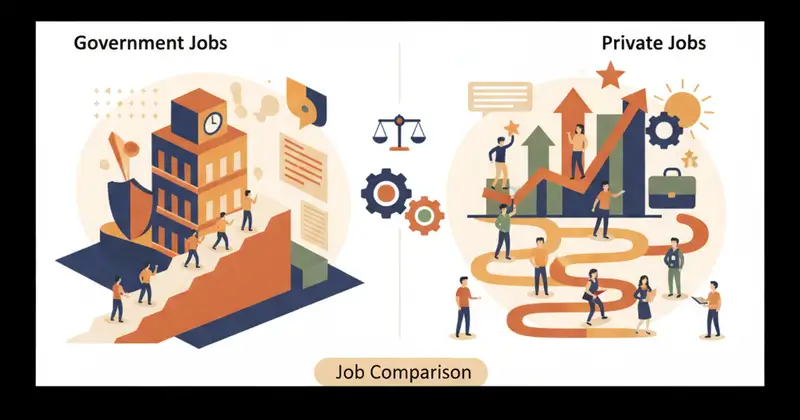
The "Government vs Private Jobs" debate is a staple in Indian households. This crucial career decision depends on your ambition, priorities, and skills. Understanding the core differences is the first step to choosing a path that aligns with your professional and personal goals.
Government vs Private Jobs: Which Is Better?
The "Government vs Private Jobs" debate has been a staple conversation in nearly every Indian household. This crucial career decision isn't one-size-fits-all, as it intricately depends on your personal ambition, family expectations, individual priorities, and even the skills you possess. For instance, a person driven by a desire for rapid innovation and high earning potential might lean towards the private sector, while someone prioritizing long-term stability, comprehensive benefits, and a sense of public service might find government jobs more appealing. Understanding the fundamental differences between these two broad sectors is the first step towards making an informed choice that aligns with your professional and personal aspirations, ensuring your career path truly resonates with your life goals and values.

The Core Difference: Stability vs. Agility
The primary appeal of government jobs is undeniable stability. These roles are often perceived as "for life," shielded from the volatile currents of market fluctuations, economic downturns, and industry-specific challenges. The structure is typically hierarchical, with established protocols, processes, and decision-making frameworks that ensure consistency and fairness. Change in these organisations is often gradual and systemic, ensuring a sense of predictability and continuity in operations. For many, a government job represents security, a steady paycheck, and a respectable position within society, offering a clear career trajectory and a predictable work environment. This inherent stability provides immense peace of mind, allowing employees to focus on their duties without the constant fear of job loss due to external economic pressures.
In stark contrast, the private sector's defining characteristic is its agility and dynamism. This sector is intensely performance-driven, competitive, and quick to adapt to market trends, technological advancements, and consumer demands. It actively rewards innovation, entrepreneurial spirit, and results-oriented approaches, fostering an environment where creativity and efficiency are highly valued. However, this dynamism often comes with a trade-off, namely, relatively less job security compared to its government counterpart. Performance metrics, company profitability, and broader market conditions heavily influence an employee's tenure and growth prospects. The private sector thrives on competition, constantly seeking to innovate, expand, and capture market share.
This translates into a fast-paced work environment where employees are expected to be proactive, adaptable, and continuously upgrade their skills to remain relevant and contribute effectively to the company's bottom line. Industries like Information Technology, E-commerce, Finance, and Consulting exemplify this high-octane environment, demanding constant evolution from their workforce.
Government Sector
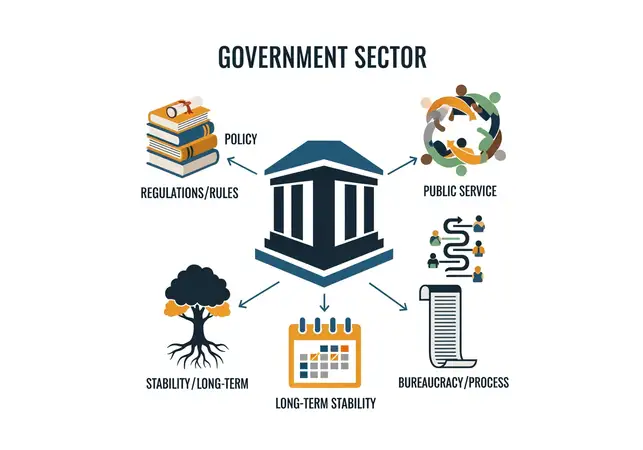
The primary appeal of government jobs is undeniable stability. These roles are often perceived as "for life," shielded from the volatile currents of market fluctuations, economic downturns, and industry-specific challenges. The structure is typically hierarchical, with established protocols, processes, and decision-making frameworks. Change in these organisations is often gradual and systemic, ensuring a sense of predictability. For many, a government job represents security, a steady paycheck, and a respectable position within society. This perception is deeply rooted in India's socio-economic fabric, where a stable government job has historically been a symbol of financial security, social standing, and a reliable future, especially for families in middle and lower-income brackets.
Government roles span various levels, including Central Government (e.g., IAS, IPS, Railway employees), State Government (e.g., State Civil Services, teachers, police), Public Sector Undertakings (PSUs) like ONGC, SBI, BHEL, and local bodies (e.g., municipal corporations), each offering a unique set of responsibilities, a consistent career trajectory, and a chance to contribute directly to public welfare and national development.
Private Sector
In stark contrast, the private sector's defining characteristic is its agility and dynamism. This sector is intensely performance-driven, competitive, and quick to adapt to market trends, technological advancements, and consumer demands. It actively rewards innovation, entrepreneurial spirit, and results-oriented approaches. However, this dynamism often comes with a trade-off, namely, relatively less job security compared to its government counterpart. Performance metrics, company profitability, and market conditions heavily influence an employee's tenure and growth. The private sector thrives on competition, constantly seeking to innovate, expand, and capture market share. This translates into a fast-paced work environment where employees are expected to be proactive, adaptable, and continuously upgrade their skills to remain relevant and contribute to the company's bottom line.
Industries like Information Technology, E-commerce, Finance, and Consulting exemplify this high-octane environment, where the pace of change is rapid and the demand for new skills is constant. Employees are often encouraged to take ownership, innovate, and directly impact the company's success, leading to potentially higher rewards but also greater risks.
Historical Context and Societal Impact
The preference for government jobs in India is not merely a contemporary phenomenon but is deeply embedded in the country's social and economic history. Post-independence, government jobs were instrumental in nation-building, offering not just employment but also a sense of purpose and contribution to society through roles in administration, infrastructure development, education, and healthcare. The stability, comprehensive pension benefits, and high social prestige associated with 'sarkari naukri' became aspirational, particularly in an economy with limited private sector opportunities and high unemployment. This legacy continues to influence career choices, especially in smaller towns and rural areas where the private sector's reach and perceived stability might still be lower, and a government job often elevates a family's social standing.
However, with economic liberalization starting in the 1990s and the subsequent rise of a robust private sector, especially in urban centers, the narrative is gradually shifting. There's a growing appreciation for innovation, entrepreneurship, and wealth creation, with many young professionals now actively seeking challenging and high-growth opportunities in the private sector, often driven by a desire for faster career progression and higher initial compensation.
1. Job Security: The Great Differentiator
The concept of job security is perhaps the most significant factor differentiating government and private sectors in India, influencing millions of career choices annually. It often serves as the primary motivator for individuals and families when weighing career options.
Government Jobs
The security offered by government jobs is legendary in India. Once an individual successfully navigates the rigorous selection process—often involving highly competitive examinations like UPSC (for IAS, IPS, IFS), SSC (for various central government ministries), Banking PO/Clerk exams, or State PSCs (for state administrative services)—and completes their probationary period, removal from service is exceedingly difficult. Termination usually only occurs in cases of severe misconduct, proven corruption, or serious legal issues, following a well-defined and often lengthy disciplinary process that includes multiple opportunities for defense and appeals. This immunity from economic downturns, industry shifts, and company-specific performance issues provides immense peace of mind.
For many families, particularly those from middle and lower-middle-income groups, this stability serves as a bedrock for financial planning and social standing. The long-term security allows for consistent financial planning, easier access to loans (e.g., home loans, education loans due to assured income), and a generally stress-free professional life concerning employment continuity. This stability is often seen as a guarantee for a dignified life, even after retirement, and reduces the mental burden associated with potential job loss.
Constitutional Safeguards and Due Process
Government employees in India are often protected by constitutional provisions (like Article 311 for civil servants) and elaborate service rules. These safeguards ensure that no employee can be dismissed, removed, or reduced in rank without a proper inquiry and a reasonable opportunity to be heard. This due process makes arbitrary termination virtually impossible, providing a strong legal shield against unfair employment practices. Such robust protections are a cornerstone of the perceived 'job for life' aspect of government employment, distinguishing it sharply from the private sector.
Understanding Probationary Periods in Government Jobs
While government jobs offer unparalleled security, it's important to understand the probationary period. This initial phase, typically one to two years, is a trial period during which the employee's conduct, performance, and adherence to rules are closely monitored. Successful completion of probation is crucial for confirmation of service. While termination during probation is possible for unsatisfactory performance or conduct, it is still less common than in the private sector and usually involves specific procedures and opportunities for improvement, often with a focus on training and development rather than immediate dismissal.
Private Jobs
Job security in the private sector is intrinsically linked to individual performance, the company's financial health, and broader economic conditions. Layoffs, retrenchments, and organizational restructuring are common business realities in a competitive market. Companies might downsize due to automation (e.g., AI replacing manual tasks), mergers and acquisitions, shifts in market demand, or simply poor financial performance. While high-performing employees in niche areas might enjoy a degree of stability, the overall landscape is one where continuous learning, skill upgrades, and adaptability are crucial for long-term employment. The fear of redundancy can be a constant underlying work pressure for many, driving a need for continuous self-improvement and networking.
Employment contracts in the private sector are often "at-will," meaning either the employer or employee can terminate the relationship with appropriate notice (typically 1-3 months), making tenure less certain. Severance packages may be offered, but they are not always guaranteed or as comprehensive as the long-term security offered by government roles.
The Role of Economic Cycles in Private Sector Security
The private sector is highly susceptible to economic cycles. During boom periods, job creation is robust, and opportunities abound. However, economic slowdowns, recessions, or even industry-specific crises (like the dot-com bubble burst, the 2008 financial crisis, or recent tech industry layoffs) can lead to widespread job losses. Companies often resort to cost-cutting measures, including layoffs, hiring freezes, and salary reductions, to maintain profitability and survive. This inherent volatility makes long-term career planning in the private sector more dynamic and requires individuals to be prepared for potential transitions, constantly evaluating market trends and their own skill relevance.
Verdict: The government sector undisputedly wins on job security, offering a level of stability that few private companies can match. This factor alone often sways many Indian job seekers towards government roles, especially those prioritising long-term peace of mind over rapid career shifts and the inherent risks of the private sector.
2. Salary, Perks, and Benefits
Comparing compensation and benefits packages between these sectors requires a nuanced understanding, as direct comparisons can be misleading due to varying structures, short-term gains versus long-term security, and the intangible value of certain benefits.
Government Jobs
- Starting Salary: Entry-level government salaries, especially for administrative or clerical roles, can sometimes be lower than those offered by top-tier private companies or high-growth startups in specialized fields like IT or finance. However, they are generally competitive within their pay scales, which are determined by the recommendations of central Pay Commissions. These commissions periodically revise salaries and allowances, ensuring that government employees' compensation keeps pace with inflation and economic growth.
- Salary Growth: Salary growth in government jobs is predictable and primarily time-bound, following the recommendations of Pay Commissions (e.g., 7th Pay Commission). Employees receive incremental raises based on years of service, promotions, and periodic pay revisions. While not exponential, it's a steady and assured increase, often accompanied by significant jumps when a new Pay Commission's recommendations are implemented, ensuring a consistent rise in earning potential over a career.
- Perks & Retirement Benefits: This is where government jobs often shine, offering a comprehensive and robust suite of benefits designed for long-term financial and social security:
- Dearness Allowance (DA): A crucial component to offset inflation, revised periodically (usually twice a year). It's a percentage of the basic salary, ensuring purchasing power is maintained against rising costs of living.
- House Rent Allowance (HRA): Provided based on the city of posting (classified as X, Y, or Z cities based on population), offering significant financial assistance for accommodation expenses.
- Travel Allowance (TA): Covers expenses for official travel and daily commuting, ensuring employees are not burdened by transport costs related to their work.
- Extensive medical benefits (e.g., CGHS - Central Government Health Scheme, ECHS - Ex-servicemen Contributory Health Scheme) covering employees and their dependents, offering cashless treatment, reimbursement for a wide range of medical services, and access to a network of empanelled hospitals. This significantly reduces the financial burden of healthcare.
- Pension scheme: A significant advantage for post-retirement financial security. While pre-2004 recruits fall under the Old Pension Scheme (OPS) with a guaranteed pension (typically 50% of the last drawn basic salary), post-2004 recruits fall under the National Pension System (NPS), which is market-linked but still a robust social security net with substantial employer contributions, providing a structured approach to retirement savings.
- Gratuity, provident fund (GPF), leave encashment, subsidised housing (often through government quarters), and education allowances for children are also common, providing a holistic support system for employees and their families throughout their service and into retirement.
- Other benefits can include subsidized canteen facilities, interest-free advances for certain purchases (e.g., festivals, vehicles), opportunities for study leave with pay to enhance qualifications, and various welfare schemes.
Decoding Government Allowances
Government allowances are meticulously structured to provide a stable and comprehensive financial package that extends beyond the basic salary. DA and HRA are dynamic components, adjusted based on inflation and location, respectively, ensuring that the real value of the salary is largely preserved. The medical benefits are a major draw, alleviating the financial burden of healthcare for employees and their families, a critical concern in India. The pension system, whether OPS or NPS, provides a crucial safety net for old age, a benefit often missing in the private sector, placing the responsibility of retirement security squarely on the employer.
Understanding these components is key to appreciating the true value of a government salary package beyond just the basic pay, as they contribute significantly to an employee's overall financial well-being and long-term security.
Private Jobs
- Starting Salary: Often higher, especially for in-demand skills in sectors like IT, finance, management consulting, and healthcare. Graduates from premier institutions (IITs, IIMs) often command hefty starting packages, sometimes significantly exceeding entry-level government salaries. This is particularly true for roles requiring specialized technical expertise (e.g., AI engineers, data scientists, cybersecurity specialists) or strong business acumen and leadership potential.
- Salary Growth: Salary growth is typically performance-based and can be exponential for high achievers. Annual appraisals, skill acquisition, taking on more responsibilities, and achieving aggressive targets can lead to significant jumps in compensation. However, non-performers or those in stagnant roles might see minimal increases, and salary stagnation is a real concern for some, highlighting the direct link between performance and reward.
- Perks & Retirement Benefits: These vary widely by company size, industry, role, and the company's financial health.
- May include Employee Stock Ownership Plans (ESOPs), which can be lucrative if the company performs well and its stock value appreciates, offering employees a direct stake in the company's success and potential for wealth creation.
- Performance bonuses, project incentives, and commission structures are common, directly linking compensation to individual or team achievements and motivating employees to exceed targets.
- Modern amenities like gym memberships, free meals, transport facilities, extensive health insurance (often more comprehensive and flexible than basic government schemes), and wellness programs are increasingly offered to attract and retain top talent, focusing on employee well-being and convenience.
- Fewer traditional retirement benefits: While EPF (Employee Provident Fund) is standard (with both employee and employer contributions), a guaranteed pension structure akin to government jobs is rare. This makes retirement planning largely a personal responsibility, requiring individuals to actively save and invest. Gratuity and superannuation benefits exist but are dependent on company policies and length of service, and are often less comprehensive than government pensions.
- Other benefits can include professional development budgets, international travel opportunities, flexible work arrangements (including remote work options), and rapid career progression through leadership development programs.
Private Sector Compensation Models
Private sector compensation is often designed to incentivize performance and align employee interests with company goals. Variable pay components like bonuses, commissions, and ESOPs can significantly boost overall earnings, but they also introduce an element of risk, as their realization depends on individual and company performance. The focus is on rewarding merit and contribution, which can lead to rapid wealth creation for top performers. However, the onus of long-term financial planning, especially for retirement, largely falls on the individual, requiring careful investment and savings strategies to build a secure future without the safety net of a guaranteed pension.
Verdict: The private sector often offers higher initial salaries and the potential for rapid salary growth tied to performance, especially for specialized skills. However, government jobs provide a superior, more secure, and comprehensive package of long-term benefits, especially in terms of retirement planning, medical coverage, and social security, offering a predictable financial trajectory. The choice here depends on whether you prefer immediate high earning potential and performance-driven rewards or long-term financial security and assured benefits with a slower but steady growth.
3. Work Culture and Environment
The daily experience of working is profoundly shaped by the prevailing culture and environment of an organisation. These differ significantly between the government and private sectors, impacting job satisfaction, stress levels, and personal growth.
Government Jobs
- Work Culture: Generally perceived as more relaxed with fixed working hours (typically 9 AM to 5 PM), promoting a better work-life balance. The emphasis is often on process adherence, rule-following, and public service, ensuring fairness and accountability. While there can be periods of intense work, especially during policy implementation or crisis management, the overall pace is usually slower and more predictable. Decision-making can be hierarchical and involve multiple layers of approvals, leading to a methodical but sometimes slow execution of tasks.
- Pressure and Stress: Comparatively less pressure and stress related to individual performance targets, primarily due to the assured job security and a focus on procedural correctness over aggressive financial targets. The pressure often stems from public scrutiny, political interference, managing large-scale public projects with limited resources, or dealing with bureaucratic hurdles rather than individual sales quotas or strict deadlines.
- Innovation and Dynamism: Can sometimes lack innovation, dynamism, and quick decision-making due to bureaucratic hierarchies, established protocols, and a risk-averse approach. The focus is often on maintaining the status quo and ensuring compliance. Technological adoption can be slower, though this is gradually changing with 'Digital India' initiatives pushing for e-governance, automation, and citizen-centric services, aiming to streamline processes and improve efficiency.
- Collaboration: Often involves working within well-defined departmental silos, with inter-departmental collaboration being more formal, protocol-driven, and sometimes challenging due to rigid structures. The emphasis is on individual departmental responsibilities rather than cross-functional team projects.
- Office Infrastructure: While improving, infrastructure can sometimes be traditional or older compared to modern private sector offices, especially in older government buildings. However, many government offices are undergoing modernization, and new establishments feature contemporary facilities, digital tools, and improved working conditions, reflecting a gradual shift towards better work environments.
Bureaucracy vs. Meritocracy in Government Work Culture
The bureaucratic nature of government work, while ensuring fairness, transparency, and accountability, can sometimes stifle individual initiative and innovation. Promotions are often tied to seniority and experience rather than purely merit or exceptional performance, which can occasionally demotivate high performers seeking rapid advancement. However, for those who value a structured environment, clear guidelines, and adherence to established norms, this culture provides a predictable framework for operations and decision-making. The overarching focus is on serving the public good and upholding constitutional values, which can be a strong intrinsic motivator for many employees, offering a sense of purpose beyond financial gain.
Private Jobs
- Work Culture: Fast-paced, dynamic, and often deadline-driven. The emphasis is on efficiency, productivity, target achievement, and continuous innovation. Adaptability, resilience, and continuous learning are key traits for success. Companies often foster a competitive environment where individual and team performance are constantly measured, rewarded, and publicly acknowledged.
- Pressure and Stress: High-pressure environment is common, especially in demanding industries like IT, finance, and consulting, where client expectations and market competition are intense. The need to meet aggressive targets, perform consistently, handle rapid changes, and often work extended hours can lead to higher stress levels and potential burnout. The constant drive for results means employees are often expected to go beyond standard working hours and be available for urgent tasks.
- Innovation and Dynamism: Highly values innovation, agility, and quick decision-making. Companies are constantly seeking to gain a competitive edge, leading to a dynamic environment where new ideas, cutting-edge technologies (e.g., AI, machine learning, blockchain), and market strategies are embraced faster. There's often a culture of experimentation, learning from failures, and rapid iteration to stay ahead of competitors.
- Collaboration: Encourages cross-functional teamwork, brainstorming sessions, and often a more flat organizational structure, especially in startups and tech companies, promoting open communication. Agile methodologies are common,
Related: Top Govt Jobs | Career Planning Guide
Choosing between government and private sector jobs? Discover key differences in stability, growth, and benefits to make an informed career decision.
FAQs
Which offers better job security?Government jobsAre private jobs better for growth?Often faster in private sectorRelated Resources
- Latest Government Jobs
- How to Prepare for Government Exams
- Understanding 7th Pay Commission Salary
Checks to complete before you apply
Ultimately, the choice between a government and private job is deeply personal. There is no single "better" option, only the one that best fits your individual goals, risk tolerance, and desired lifestyle. Carefully weigh the trade-offs between stability and growth potential to make the right decision for your long-term career in India.
Related Government Job Resources
Continue with active job hubs and related government job pages on TrueJobs.
Tools for this recruitment topic
Use only the tools relevant to the dates, eligibility or documents discussed above.
TrueJobs Editorial Team
TrueJobs editorial desk
This article is prepared from the sources referenced in the guide and reviewed for clarity, links and dated information. Read our editorial and corrections policy.
Continue This Topic
Follow the closest earlier and newer coverage so older archive posts keep real contextual crawl paths.
Best Career Options After 12th in India
Discover top career choices after 12th in India. TrueJobs.co.in provides comprehensive guidance on emerging opportunities and pathways.
Step-by-Step Guide to Getting Your First Job in 2026
Transition from college to career with our 2026 job guide. Master AI-proof applications and remote work strategies.
Read Next

Freelancing vs Full-Time Jobs: Pros and Cons

Railway Recruitment 2026: 50,000+ Expected Vacancies, Department-Wise Full Update

Best Career Options After 12th in India

SSC 2026 Calendar Released: Complete Exam Dates, Vacancies & Smart Preparation Timeline
Explore Topics
Perfect Your Resume
Use our AI-powered Resume Builder to create ATS-optimized resumes.
AI Resume Builder