
Career guide
DRDO & ISRO Defence Jobs 2026: Salary & Eligibility — Explained
Dreaming of a prestigious career in national service? Explore opportunities in DRDO, ISRO, and defence research. This guide covers eligibility, salary, and entry for 2026.

Dreaming of a career that combines cutting-edge science, national service, and unparalleled prestige? India's premier defence and space research organizations – the Defence Research and Development Organization (DRDO) and the Indian Space Research Organisation (ISRO) – offer exactly that. These institutions are the bedrock of India's technological prowess, driving innovation in critical sectors like national security, space exploration, and indigenous technology development. With India's ambitious vision for 2026 and beyond, opportunities within DRDO, ISRO, and other defence research sectors are expanding significantly. This comprehensive guide provides essential insights into securing a coveted position, covering eligibility, salary structures, and effective entry strategies, helping you navigate your path to a truly impactful career.
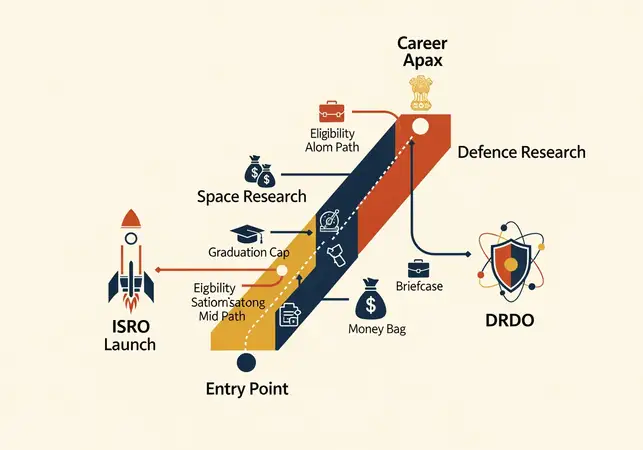
Why Choose a Career in DRDO, ISRO, or Defence Research?
A career in DRDO, ISRO, or the broader defence research sector transcends a mere job; it's a profound commitment to national progress and scientific innovation. These roles are highly sought after for compelling reasons:
- National Pride & Impact: Your work directly contributes to strengthening India's defence capabilities and advancing its space ambitions. Imagine contributing to missions like Chandrayaan or Mangalyaan, developing critical missile systems like Agni or Prithvi, or enhancing surveillance technologies that safeguard the nation. This direct impact fosters immense national pride and a sense of purpose, knowing that your skills are directly serving the nation's strategic interests and global standing.
- Cutting-Edge Research & Innovation: Engage with state-of-the-art technology and participate in groundbreaking research that pushes the boundaries of science and engineering. From developing advanced materials and artificial intelligence for defence applications to designing next-generation satellites and propulsion systems for space exploration, you'll be at the forefront of technological advancement. These organizations invest heavily in R&D, providing access to world-class laboratories, instrumentation, and collaborative environments that foster continuous learning and innovation.
- Job Security & Stability: As central government organizations, DRDO and ISRO offer unparalleled job security and stability. Employees benefit from a structured career path, clear promotion policies, and a robust framework of rules and regulations that ensure fair treatment and long-term employment. This stability allows professionals to focus on their research and development without the anxieties often associated with private sector employment.
- Professional Growth & Development: Both DRDO and ISRO are committed to the continuous professional development of their employees. They offer extensive training programs, opportunities for higher education (including sponsored M.Tech and Ph.D. programs), participation in national and international conferences, and exposure to diverse projects across various scientific and engineering disciplines. This environment ensures that your skills remain relevant and you continue to grow as a professional throughout your career.
- Attractive Salary & Benefits: While the primary motivation is often national service, these organizations offer competitive salary packages aligned with the 7th Central Pay Commission. Beyond the basic pay, employees receive a comprehensive suite of allowances and benefits, making the overall compensation package highly attractive and comparable to leading public sector undertakings.
- Global Recognition: India's achievements in space and defence are globally recognized. Working with DRDO or ISRO means being part of a team that contributes to these monumental successes, bringing you individual recognition and the prestige of being associated with world-renowned scientific endeavors.
Choosing a career in these sectors is an investment in your future, offering a unique blend of intellectual challenge, national service, and personal fulfillment that few other professions can match. It's an opportunity to be a part of India's journey towards self-reliance and global leadership in science and technology.

Eligibility Criteria for DRDO, ISRO & Defence Research Jobs
To embark on a career with DRDO, ISRO, or other defence research entities, aspirants must meet specific eligibility criteria that typically encompass nationality, age, and educational qualifications. These requirements ensure that only the most qualified and dedicated individuals are selected for these critical roles.
General Eligibility Requirements
- Nationality: Applicants must be citizens of India. This is a fundamental requirement for all positions within these strategic government organizations.
- Age Limits: Age criteria vary significantly depending on the post and the organization.
- For Scientist/Engineer 'B' (DRDO) and Scientist/Engineer 'SC' (ISRO), the upper age limit for general category candidates is typically around 28 to 35 years, with relaxations for OBC, SC/ST, and PwBD categories as per government rules.
- For Technical Assistant and Technician 'A' roles, the age limit might range from 18 to 28 years.
- Administrative and other support staff positions also have specific age brackets.
- It is crucial to refer to the official notification for the exact age limits applicable to the specific recruitment drive you are interested in.
Educational Qualifications
The academic qualifications are perhaps the most critical component of the eligibility criteria, varying widely based on the nature of the role.
- For Scientists/Engineers (Group 'A' Gazetted Posts):
- Bachelor's Degree (B.E./B.Tech): A first-class Bachelor's degree in Engineering or Technology in relevant disciplines is often the minimum requirement. Common disciplines include Electronics & Communication Engineering, Mechanical Engineering, Computer Science Engineering, Electrical Engineering, Aerospace Engineering, Civil Engineering, Instrumentation Engineering, and Chemical Engineering. A minimum aggregate percentage (e.g., 60% or 65%) is usually stipulated.
- Master's Degree (M.E./M.Tech): For some specialized roles or direct entry at higher levels, a Master's degree in Engineering or Technology is preferred or mandatory.
- Postgraduate Degrees in Science (M.Sc./Ph.D.): Candidates with M.Sc. or Ph.D. degrees in Physics, Chemistry, Mathematics, Material Science, Earth Sciences, and other relevant scientific disciplines are also recruited for research-oriented positions.
- GATE Score: For Scientist/Engineer 'B' in DRDO (through RAC) and Scientist/Engineer 'SC' in ISRO, a valid GATE (Graduate Aptitude Test in Engineering) score in the relevant engineering discipline is often a primary shortlisting criterion.
- For Technical Cadre (Technical Assistant 'B', Technician 'A'):
- Diploma: For Technical Assistant 'B' positions, a first-class Diploma in Engineering or Technology in relevant disciplines (e.g., Mechanical, Electrical, Electronics, Computer Science) from a recognized institution is required.
- ITI Certificate: For Technician 'A' roles, an ITI (Industrial Training Institute) certificate in a specific trade (e.g., Fitter, Electrician, Machinist, Welder) along with a 10th-grade pass is typically required.
- For Administrative & Allied Cadre (Admin Officer, Junior Assistant, Store Assistant, etc.):
- Graduate Degree: A Bachelor's degree in any discipline from a recognized university is generally required.
- Specific Skills: Depending on the role, proficiency in typing, computer applications, shorthand, or specific administrative software may be necessary.
Essential Skills and Aptitudes
Beyond formal qualifications, certain inherent skills and aptitudes are highly valued:
- Strong Analytical and Problem-Solving Skills: The ability to dissect complex problems and devise innovative solutions is paramount in research and development.
- Technical Proficiency: A deep understanding of core engineering/scientific principles and their practical applications.
- Innovation and Creativity: A drive to explore new ideas and contribute to groundbreaking advancements.
- Teamwork and Collaboration: Most projects are collaborative, requiring effective communication and teamwork.
- Attention to Detail: Precision is critical in scientific research and defence applications.
- Communication Skills: The ability to articulate complex ideas clearly, both verbally and in writing.
Salary Structure and Benefits
A career with DRDO, ISRO, or other defence research organizations is not only about national service but also offers a highly attractive and secure remuneration package. The salary structure is governed by the 7th Central Pay Commission, ensuring uniformity and competitiveness.
Competitive Salary Packages
Salaries are structured according to the Central Government's Pay Matrix. For instance, a newly recruited Scientist 'B' in DRDO or Scientist/Engineer 'SC' in ISRO typically starts at Pay Level 10 of the 7th CPC Pay Matrix. This translates to a basic pay of ₹56,100 per month. Along with various allowances, the gross monthly salary can be significantly higher, often exceeding ₹80,000 to ₹90,000 at the entry level, depending on the city of posting and other factors. As employees gain experience and are promoted, their pay levels and basic pay increase substantially.
Allowances and Perks
Beyond the basic pay, employees are entitled to a comprehensive range of allowances and benefits, which significantly enhance the overall compensation package:
- Dearness Allowance (DA): Revised periodically to offset inflation, currently a significant percentage of the basic pay.
- House Rent Allowance (HRA): Provided based on the class of the city (X, Y, or Z), ranging from 9% to 27% of the basic pay.
- Transport Allowance (TA): Compensates for commuting expenses, varying based on pay level and city.
- Medical Facilities: Comprehensive medical coverage for employees and their dependents through the Central Government Health Scheme (CGHS) or similar schemes.
- Leave Travel Concession (LTC): Allows employees and their families to travel to their hometown or any place in India, with travel expenses reimbursed.
- Provident Fund (PF) & Gratuity: Retirement benefits ensuring financial security post-service.
- Pension Scheme: A defined contribution pension scheme (National Pension System - NPS) for employees recruited after 2004.
- Subsidized Canteen Facilities: Access to nutritious meals at subsidized rates.
- Government Accommodation: Eligibility for government housing in many locations, subject to availability.
- Professional Development Support: Financial assistance for attending conferences, workshops, and pursuing higher education.
- Children's Education Allowance (CEA): Financial support for the education of up to two children.
Career Progression
Both DRDO and ISRO offer excellent opportunities for career advancement based on performance, experience, and qualifications. Scientists and Engineers typically follow a fast-track promotion scheme, with regular assessments and opportunities to move to higher scientific grades (e.g., Scientist 'C', 'D', 'E', 'F', 'G', 'H' / Outstanding Scientist / Distinguished Scientist). Technical and administrative staff also have well-defined promotion channels, ensuring continuous growth and recognition throughout their service.
Effective Entry Strategies and Recruitment Process
Securing a position in DRDO, ISRO, or other defence research organizations requires a strategic approach, thorough preparation, and a clear understanding of their respective recruitment processes. TrueJobs.co.in is an excellent resource for staying updated on the latest notifications.
Understanding the Recruitment Cycles
Recruitment drives for various positions are conducted periodically, often annually, depending on the organization's requirements. It is crucial for aspirants to regularly check official websites (drdo.gov.in, isro.gov.in) and reputable job portals like TrueJobs.co.in for the latest job notifications, application deadlines, and detailed eligibility criteria. Timely application is key, as late submissions are strictly not entertained.
Recruitment for Scientists/Engineers (Group 'A' Gazetted)
The selection process for Scientist/Engineer roles is highly competitive and rigorous, designed to identify top talent.
- For DRDO (through RAC - Recruitment & Assessment Centre):
- GATE Score Shortlisting: For many engineering disciplines, candidates are primarily shortlisted based on their valid GATE scores. A high GATE score is often a prerequisite for being called for an interview.
- Written Examination (if applicable): For some specific disciplines or in cases where GATE scores are not the sole criterion, a written examination may be conducted to assess technical knowledge and aptitude.
- Personal Interview: This is a crucial stage where candidates are evaluated on their technical depth, research aptitude, problem-solving abilities, communication skills, and motivation to join the organization. The interview panel typically comprises senior scientists and experts in the relevant field.
- For ISRO (through ISRO Centralized Recruitment Board - ICRB):
- Written Test: ISRO typically conducts its own written test for Scientist/Engineer 'SC' positions. This test assesses fundamental knowledge in the respective engineering or science discipline.
- Personal Interview: Candidates who qualify the written test are called for an interview. Similar to DRDO, the interview focuses on technical understanding, project experience, and suitability for research and development roles within ISRO.
Recruitment for Technical Cadre (Technical Assistant 'B', Technician 'A')
The selection process for technical positions focuses on practical skills and foundational knowledge.
- Written Test: An objective-type written test is conducted, covering subjects like general knowledge, arithmetic, reasoning, and technical knowledge specific to the trade or diploma discipline.
- Skill Test: Candidates who clear the written test are invited for a skill test. This practical test evaluates their proficiency in the relevant trade (e.g., operating machinery for a Fitter, circuit assembly for an Electronics Technician, typing speed for a Technical Assistant).
Recruitment for Administrative & Support Staff
For administrative and allied positions, the selection process typically involves:
- Written Test: This usually includes sections on General Intelligence & Reasoning, General Awareness, Quantitative Aptitude, and English Language.
- Skill Test: Depending on the post, a skill test such as typing test, computer proficiency test, or shorthand test may be conducted.
- Interview: A personal interview to assess communication skills, personality, and suitability for the administrative role.
Preparation Tips for Success
To maximize your chances of success, consider the following strategies:
- Strong Academic Foundation: Focus on building a robust understanding of your core engineering or science subjects during your graduation and post-graduation. Conceptual clarity is paramount.
- GATE Preparation: If aspiring for Scientist/Engineer roles, dedicate significant effort to preparing for the GATE examination. A top score can open doors to interviews at DRDO and ISRO.
- Technical Knowledge: For all technical roles, ensure your technical knowledge is up-to-date and comprehensive. Practice problem-solving and stay abreast of recent advancements in your field.
- Aptitude & Reasoning: For written tests, practice general aptitude, reasoning, and quantitative skills regularly.
- Communication & Interview Skills: Develop strong communication skills. Practice mock interviews, articulate your project work clearly, and be prepared to discuss your research interests and motivations.
- Projects & Internships: Engage in relevant academic projects, internships, or research work. Practical experience and a strong project portfolio can significantly boost your profile during interviews.
- Stay Updated: Keep track of current affairs, especially in science, technology, defence, and space sectors. Familiarize yourself with the recent achievements and ongoing missions of DRDO and ISRO.
- Refer to Previous Year Papers: Solve previous years' question papers for written tests to understand the pattern and type of questions asked.
Beyond DRDO & ISRO: Other Defence Research Opportunities
While DRDO and ISRO are the flag bearers, the broader Indian defence research ecosystem offers numerous other opportunities. Several Public Sector Undertakings (PSUs) and government organizations are actively involved in defence production, R&D, and strategic projects. These include Hindustan Aeronautics Limited (HAL), Bharat Electronics Limited (BEL), Bharat Dynamics Limited (BDL), Mazagon Dock Shipbuilders Limited (MDL), and various ordnance factories. Many of these organizations have their own R&D divisions and recruit engineers, scientists, and technical staff through competitive examinations or GATE scores. Additionally, academic institutions often collaborate with DRDO and ISRO on specific research projects, offering avenues for researchers and project staff. Exploring these diverse options can broaden your career prospects in the national security and technological advancement domain.
Conclusion: Your Path to a Fulfilling Career
A career in DRDO, ISRO, or the wider defence research sector is more than just a job; it's a calling to contribute to India's scientific prowess and national security. It offers an unparalleled blend of intellectual challenge, professional growth, attractive compensation, and immense national pride. By understanding the eligibility criteria, preparing diligently for the rigorous selection processes, and staying informed through resources like TrueJobs.co.in, you can significantly enhance your chances of securing a coveted position. Embrace the opportunity to be a part of India's journey towards self-reliance and global leadership in science and technology, and embark on a truly fulfilling and impactful career path.
DRDO/ISRO Defence Jobs 2026 Guide
Related: Top Govt Jobs | Resume Tips
Related: Top Government Jobs | Resume Tips
Related Resources
- Latest Sarkari Naukri 2026
- Engineering Government Jobs
- Government Exam Preparation Guide
Reader questions: Career
What qualifications are needed?
Engineering/science degrees required
What's the salary range?
₹56,100 - ₹2,50,000/month
TrueJobs Editorial Team
TrueJobs editorial desk
This article is prepared from the sources referenced in the guide and reviewed for clarity, links and dated information. Read our editorial and corrections policy.
Continue This Topic
Follow the closest earlier and newer coverage so older archive posts keep real contextual crawl paths.
CAPF (AC) vs NDA vs CDS: Best Defence Career After Graduation in 2026
Confused between CAPF, NDA and CDS? Discover the best defence career options after graduation in 2026 with eligibility criteria and career trajectories.
Apprenticeship Jobs in India 2026: Stipend, Top Companies & NAPS Guide
भारत में 2026 तक अप्रेंटिसशिप नौकरियों का भविष्य जानें। स्टाइपेंड, शीर्ष कंपनियां और NAPS लाभों के बारे में विस्तृत जानकारी प्राप्त करें।
Read Next
CAPF (AC) vs NDA vs CDS: Best Defence Career After Graduation in 2026

Apprenticeship Jobs in India 2026: Stipend, Top Companies & NAPS Guide

Optimize Your LinkedIn for Indian Jobs: A Step-by-Step Guide

Top PSU Jobs in India 2026: BHEL, ONGC, IOCL Salary, Selection & Application Guide
Explore Topics
Perfect Your Resume
Use our AI-powered Resume Builder to create ATS-optimized resumes.
AI Resume Builder