
Career guide
CAPF vs NDA vs CDS: Best Defence Career Paths 2026 — Explained
Confused between CAPF, NDA and CDS? Discover the best defence career options after graduation in 2026 with eligibility criteria and career trajectories.

Choosing a defence career after graduation is a significant decision. This guide compares CAPF (AC), NDA, and CDS exams for 2026. We break down eligibility, selection, and career paths to help you decide.
CAPF (AC) vs NDA vs CDS: Best Defence Career After Graduation in 2026
Serving the nation in uniform is a noble ambition for many young Indians. For graduates seeking a challenging and rewarding career in the defence and paramilitary forces, understanding the various entry pathways is crucial. While the National Defence Academy (NDA), Combined Defence Services (CDS), and Central Armed Police Forces (Assistant Commandants) (CAPF AC) exams are all conducted by the Union Public Service Commission (UPSC) and lead to esteemed officer-level positions, they cater to different eligibility criteria, offer distinct career paths, and require specific preparation strategies. This comprehensive guide focuses on the best defence career paths after graduation in 2026, clarifying the nuances between CAPF (AC), NDA, and CDS to help graduates make informed decisions about their future in national service.

Understanding the Pathways: A Quick Overview
Before delving into specifics, let's briefly understand each examination and its target audience, focusing on graduate-level entry points. Each of these three exams represents a different philosophy of entry into national service — from school-level induction to post-graduate specialisation. Knowing where you stand in terms of age, educational background, and personal career goals is the first step toward choosing the right path.
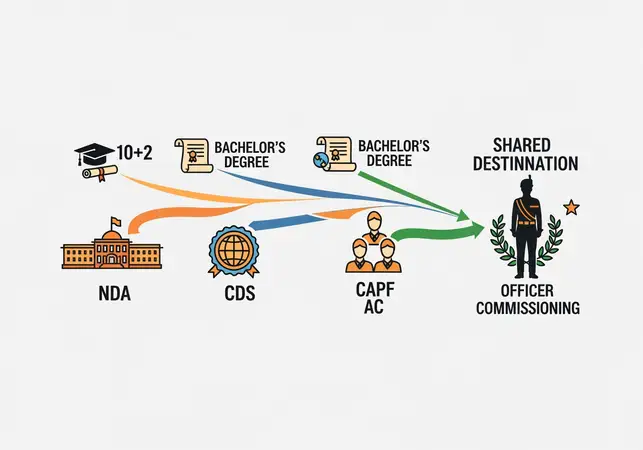
- NDA (National Defence Academy) Exam: This is a prestigious 10+2 entry for candidates typically aged 16.5–19.5 years. It's a direct path to becoming an officer in the Indian Army, Navy, or Air Force after rigorous training at the NDA, Khadakwasla. Crucially, NDA is NOT a graduate entry scheme. It's designed for those who wish to start their military career right after school, leading to a Bachelor's degree and subsequent specialised training.
- CDS (Combined Defence Services) Exam: This is the primary UPSC-conducted gateway for graduates to join the Indian Army, Navy, and Air Force as commissioned officers. It is open to unmarried graduates (with specific degree requirements for each service) and leads to training at prestigious institutions like the Indian Military Academy (IMA), Naval Academy, or Air Force Academy.
- CAPF (AC) (Central Armed Police Forces – Assistant Commandants) Exam: This UPSC examination recruits Assistant Commandants for India's Central Armed Police Forces — namely, BSF, CRPF, CISF, ITBP, SSB, NSG, and SSF. It is open to graduates of any discipline and offers an officer-level career in paramilitary service, with a distinct but equally important role in national security.
While all three routes lead to respected careers in uniform, each demands a different level of preparation, offers a different service environment, and suits a different type of candidate. The following sections break down each pathway in detail to help you choose the option that best aligns with your profile and aspirations.
NDA: The School-Level Gateway to Military Service
The National Defence Academy examination is widely regarded as one of India's most competitive and celebrated entrance tests. Conducted twice a year by UPSC, it selects candidates at the 10+2 stage for a three-year training programme at the NDA campus in Khadakwasla, Pune, followed by pre-commissioning training at the respective service academies. The NDA route is the earliest possible entry point into the Indian Armed Forces and produces some of the most battle-hardened and professionally accomplished officers in the country.
Who Is NDA For?
NDA is strictly for candidates who have passed or are appearing in Class 12. The age bracket is 16.5 to 19.5 years at the time of joining. This means that if you are already a graduate, you are likely age-ineligible for NDA, unless you completed your graduation unusually early. For the purpose of this article — which focuses on career options after graduation in 2026 — NDA is included primarily as a reference point to help graduates understand why it is no longer an option for them and how it compares to the other two pathways.
Why NDA Matters for Context
Despite being ineligible for graduates, understanding the NDA pathway is important because it contextualises the culture and prestige of armed forces careers. NDA officers tend to have longer service tenures, more opportunities for specialised roles, and are often considered the backbone of the officer corps in the Army, Navy, and Air Force. This context helps graduates appreciate what they are stepping into when they choose CDS as an alternative graduate-level entry.
- Eligibility: Class 12 pass or appearing; age 16.5–19.5 years
- Services Covered: Indian Army, Indian Navy, Indian Air Force
- Training Location: NDA, Khadakwasla; followed by IMA, Dehradun / Naval Academy / Air Force Academy
- Suitable for Graduates: Generally not applicable due to age restrictions
CDS: The Graduate Route to Commissioned Officer Status
The Combined Defence Services examination is the most well-known route for graduates aspiring to become commissioned officers in the Indian Armed Forces. Conducted twice a year by UPSC, CDS opens doors to the Indian Military Academy (IMA) in Dehradun, Officers Training Academy (OTA) in Chennai, Indian Naval Academy in Ezhimala, and Air Force Academy in Dundigal. It is a rigorous selection process that tests candidates on their academic knowledge, mental agility, physical fitness, and officer-like qualities.
Eligibility Criteria for CDS
The eligibility requirements differ slightly depending on which service a candidate wishes to join:
- Indian Military Academy (IMA) and Officers Training Academy (OTA) — Army: A degree in any discipline from a recognised university is sufficient. Candidates must be unmarried. For IMA, the age limit is typically 19-24 years. For OTA, it's 19-25 years.
- Indian Naval Academy: A degree in Engineering is required, or a degree with Physics and Mathematics at the 10+2 level in certain streams. Candidates must be unmarried and typically aged 19-24 years.
- Air Force Academy: A degree with Physics and Mathematics at 10+2 level, or a Bachelor's degree in Engineering. Candidates must be unmarried and typically aged 20-24 years.
- Age Limit: Varies by academy — generally between 19 and 25 years, with slight variations for OTA (up to 25 years for men and women). Specific age cut-offs are mentioned in each official notification.
- Marital Status: Candidates for IMA and academies must be unmarried at the time of joining (OTA has a separate provision for widows and divorcees who meet specific criteria).
- Nationality: A candidate must be an Indian citizen, or a subject of Nepal/Bhutan, or a Tibetan refugee who came over to India before 1st January 1962 with the intention of permanently settling in India.
Selection Process for CDS
The CDS selection process has two major stages. The first is a written examination conducted by UPSC, covering English, General Knowledge, and Elementary Mathematics (Mathematics is not required for OTA). The written exam is objective type and carries negative marking for incorrect answers. Candidates must clear a minimum cut-off in each paper and overall to qualify for the next stage.
The second stage is the Services Selection Board (SSB) interview, which is a five-day assessment of psychological aptitude, group dynamics, and personality traits. SSB is known for being extremely demanding, assessing not just intelligence but also leadership potential, emotional resilience, and Officer Like Qualities (OLQs). The SSB process includes various tests such as psychological tests (Thematic Apperception Test - TAT, Word Association Test - WAT, Situation Reaction Test - SRT, Self-Description Test - SDT), Group Testing Officer (GTO) tasks (group discussion, group planning exercise, progressive group task, half group task, individual obstacles, command task, final group task), and personal interviews. Candidates who clear SSB are then evaluated for medical fitness by a board of military doctors before final merit listing.
The medical standards are stringent and ensure that only physically and mentally robust individuals are inducted into the armed forces.
Career Trajectory in the Armed Forces via CDS
Officers commissioned through CDS begin their careers as Lieutenants (Army), Sub-Lieutenants (Navy), or Flying Officers (Air Force). Promotions follow a structured timeline, with opportunities to rise to senior ranks over the course of a full career. For instance, a Lieutenant can expect to be promoted to Captain in 2 years, Major in 6 years, and Lieutenant Colonel in 13 years, subject to performance and vacancies. Beyond these, selection to Colonel, Brigadier, Major General, Lieutenant General, and General is based on merit and selection boards.
The armed forces also offer post-retirement benefits including pension, medical facilities (ECHS), canteen access (CSD), and accommodation support. Officers can additionally pursue staff courses, foreign postings, and UN peacekeeping missions over their service tenure, which significantly broadens their experience and skill set. The training received is world-class, encompassing not just military tactics but also leadership, management, and strategic thinking. Many officers also pursue higher education while in service, sponsored by the forces. For more details on career progression and benefits, candidates can refer to the official websites of the Indian Army, Navy, and Air Force.
- Starting Rank: Lieutenant / Sub-Lieutenant / Flying Officer
- Written Exam Subjects: English, General Knowledge, Elementary Mathematics (no Maths for OTA)
- SSB Interview: Mandatory for all candidates, a comprehensive 5-day assessment
- Service Duration: Permanent Commission or Short Service Commission options available. Permanent Commission (PC) offers a full career until retirement, while Short Service Commission (SSC) is for a fixed tenure (e.g., 10 or 14 years), with an option to apply for PC.
- Post-retirement Benefits: Pension, medical facilities (ECHS), CSD canteen, housing assistance, re-employment opportunities.
- Training Academies: IMA (Dehradun), OTA (Chennai), INA (Ezhimala), AFA (Dundigal).
CAPF (AC): The Paramilitary Officer Career
The CAPF Assistant Commandant examination is conducted once a year by UPSC and is specifically designed to recruit officers for India's Central Armed Police Forces. These forces play a vital role in internal security, border management, counter-insurgency operations, VIP protection, and industrial security across the country. For graduates who desire a uniformed career at the officer level but may not meet the specific degree or age requirements of CDS, CAPF (AC) is an excellent alternative that commands equal respect and offers comparable career benefits.
Forces Covered Under CAPF (AC)
The CAPF examination recruits Assistant Commandants for the following forces:
- BSF (Border Security Force): Guards India's international borders with Pakistan and Bangladesh, preventing trans-border crimes and infiltration. It's often referred to as India's First Line of Defence.
- CRPF (Central Reserve Police Force): India's largest central armed police force, involved in counter-insurgency operations, maintaining law and order, and assisting state police forces. It has specialized units like CoBRA for Naxal operations.
- CISF (Central Industrial Security Force): Provides security to major government industries, airports, seaports, nuclear installations, and critical infrastructure across India. It also has a fire wing.
- ITBP (Indo-Tibetan Border Police): Safeguards the India-China border in high-altitude Himalayan terrain. They are trained for mountain warfare and are often deployed in extreme weather conditions.
- SSB (Sashastra Seema Bal): Guards borders with Nepal and Bhutan, focusing on preventing cross-border crimes, smuggling, and illegal infiltration.
- NSG (National Security Guard): India's elite counter-terrorism and special operations unit. While not directly recruited through CAPF (AC), officers from other CAPFs and the Army can be deputed to NSG after gaining experience.
- SSF (Special Security Force): This is not a standalone CAPF but rather a term that can sometimes refer to specialized units or security details within existing forces, or in some contexts, specific security arrangements for sensitive establishments. The primary CAPFs for which ACs are recruited are BSF, CRPF, CISF, ITBP, and SSB.
Eligibility Criteria for CAPF (AC)
One of the most attractive aspects of CAPF (AC) is the flexibility of its eligibility norms. Any graduate from a recognised university, regardless of their discipline, can apply. This makes it accessible to humanities, commerce, and science graduates alike. The age limit is generally between 20 and 25 years as on the cut-off date specified in the notification, with relaxations available for OBC (3 years), SC/ST (5 years), and other reserved categories (e.g., ex-servicemen). Both male and female candidates are eligible to apply, and there are specific physical standards that must be met, including height, chest (for men), and weight. Candidates must also be medically fit as per the prescribed standards.
Selection Process for CAPF (AC)
The CAPF (AC) selection process is conducted in three stages. The first is a written examination consisting of two papers. Paper I (General Ability and Intelligence) is objective type with multiple-choice questions, covering General Mental Ability, General Science, Current Events, Indian Polity and Economy, Indian History, and Indian and World Geography. Paper II (General Studies, Essay and Comprehension) is descriptive, requiring candidates to write essays, précis, and demonstrate comprehension skills in English or Hindi. Both papers are crucial for merit ranking.
The second stage is a Physical Standards Test (PST) and Physical Efficiency Test (PET), which assesses running (100m and 800m), long jump, and shot put. Candidates must qualify in these tests; failure to do so leads to disqualification. This stage ensures that candidates possess the necessary physical attributes for a demanding career in uniform. The physical standards are different for male and female candidates.
The third and final stage is a Personal Interview and Medical Examination conducted by a Board of Officers. The interview assesses the candidate's personality, general awareness, communication skills, and suitability for a leadership role in the CAPFs. It carries significant weight in the final merit list. Following the interview, candidates undergo a thorough medical examination to ensure they meet the stringent health standards required for service. The overall process, while demanding, is considered slightly more accessible than the SSB interview required for CDS, as it focuses more on academic knowledge and general personality assessment rather than the intense psychological profiling of SSB.
Career Trajectory in CAPF as an Assistant Commandant
Officers joining as Assistant Commandants (AC) can rise through the ranks to become Deputy Commandant (DC), Commandant, Deputy Inspector General (DIG), Inspector General (IG), and eventually Director General (DG) of their respective force. The career offers a structured promotion path, posting across varied terrains and operational environments, and the opportunity to serve in specialised roles within a chosen force, such as intelligence, training, logistics, or even deputation to other government departments or international missions. CAPF officers also receive attractive pay under the 7th Pay Commission, including pay scale equivalent to Group A Central Government officers, along with facilities such as government accommodation, medical coverage (CGHS), and pension.
They also get opportunities for advanced training, both in India and abroad, to enhance their professional skills. The nature of duties is diverse, ranging from maintaining law and order in sensitive areas to guarding international borders, providing security to vital installations, and engaging in anti-Naxal operations. This offers a dynamic and impactful career for those committed to national security.
- Starting Rank: Assistant Commandant (Group A Gazetted Officer)
- Degree Requirement: Any graduation from a recognised university
- Physical Test: Mandatory PST and PET, with specific events and qualifying times/distances.
- Interview: Personal Interview with a Board of Officers, assessing personality and general suitability.
- Promotion Path: AC → Deputy Commandant → Commandant → DIG → IG → DG (subject to service rules and vacancies).
- Pay & Benefits: 7th Pay Commission scales, DA, HRA, medical facilities, pension, government accommodation.
CAPF (AC) vs CDS vs NDA: A Comparative Overview
To help graduates make an informed decision, the following table summarises the key differences across the three pathways:
| Parameter | NDA | CDS | CAPF (AC) |
|---|---|---|---|
| Conducted By | UPSC | UPSC | UPSC |
| Minimum Qualification | Class 12 (10+2) | Graduation (specific degrees for Navy/Air Force) | Any Graduation |
| Age Limit | 16.5–19.5 years | 19–25 years (varies by academy and notification) | 20–25 years (with category relaxations) |
| Services | Indian Army, Indian Navy, Indian Air Force | Indian Army, Indian Navy, Indian Air Force | BSF, CRPF, CISF, ITBP, SSB |
| Nature of Service | Military (Combat, Strategic & Administrative) | Military (Combat, Strategic & Administrative) | Paramilitary / Internal Security, Border Management |
| Interview Type | SSB (5-day comprehensive assessment) | SSB (5-day comprehensive assessment) | Personal Interview by Board of Officers |
| Suitable for Graduates? | Generally No (age bar and 10+2 entry) | Yes, primary graduate entry for Armed Forces | Yes, primary graduate entry for CAPFs |
| Frequency of Exam | Twice a year | Twice a year | Once a year |
| Physical Test | Part of medicals and training | Part of medicals and training | Mandatory PST & PET stage in selection process |
| Marital Status | Unmarried | Unmarried (for IMA, INA, AFA). OTA has specific provisions. | No restriction (can be married) |
Which Is the Best Defence Career After Graduation in 2026?
The answer to this question depends entirely on your individual profile, aspirations, and circumstances. There is no single "best" option — each pathway offers its own set of rewards, challenges, and lifestyle demands. However, the following guidance can help you narrow down your choice:
Choose CDS If:
- You have a strong desire to serve in the Indian Army, Navy, or Air Force as a commissioned officer, embracing the core military ethos.
- You hold the required degree (any graduation for IMA/OTA; Engineering or Physics-Maths for Navy/Air Force) and meet the specific academic prerequisites.
- You are within the age limit (typically up to 25 years for most academies) and are unmarried.
- You are physically and mentally robust, prepared for rigorous training and the demanding lifestyle of the armed forces.
- You are prepared for the rigorous SSB interview process and want the prestige and unique challenges of a defence commission.
- You are open to a career that may involve combat deployments, high-risk postings, and frequent transfers across the country and potentially abroad.
- You are drawn to the strategic and tactical aspects of military operations and leadership.
Choose CAPF (AC) If:
- You want an officer-level uniformed career with significant responsibility but perhaps a slightly different operational focus than the traditional armed forces.
- You are from a humanities or commerce background and wish to serve in a security role, as CAPF (AC) has broad degree eligibility.
- You are interested in internal security, border management, counter-insurgency, VIP protection, or infrastructure security within India's borders.
- You prefer the structure of a central government career with defined promotion timelines and a strong emphasis on law enforcement and public order.
- You want an alternative to the SSB and find the CAPF Board Interview more aligned with your strengths, focusing on general personality and awareness.
- You are eligible under reserved category relaxations that extend your age window, making it a viable option even if you've crossed the CDS age limit.
- You are seeking a career that balances operational duties with administrative responsibilities, often working closely with civil administration.
Consider NDA Only If:
- You are still in Class 12 or have just completed it and are within the age bracket of 16.5–19.5 years.
- You want the longest possible career tenure in the armed forces, starting from the very beginning, with a comprehensive three-year cadet training followed by specialized service training.
- You aspire to be among the most senior leadership of the Indian military over a full-length career, as NDA cadets often form a significant portion of the top brass.
- You are committed to a life of military discipline and camaraderie from a young age.
Preparation Tips for Graduates Targeting CDS and CAPF (AC) in 2026
Since NDA is generally not applicable for graduates, the focus for 2026 aspirants should be on preparing effectively for either CDS or CAPF (AC), or ideally both simultaneously, since there is considerable overlap in the syllabus.
Common Preparation Strategy
- General Knowledge and Current Affairs: Both exams require a strong grasp of national and international events, Indian history, geography, polity, economy, science, and defence affairs. Reading a quality newspaper daily (e.g., The Hindu, The Indian Express), following reputable news channels, and revising standard GK books (e.g., Lucent's General Knowledge) is essential. Make notes on important events and facts.
- English Proficiency: CDS places significant emphasis on English grammar, comprehension, and vocabulary through its dedicated English paper. CAPF (AC) also tests essay writing, précis, and comprehension in Paper II. Build both analytical and expressive English skills. Practice writing essays on contemporary topics, improve your vocabulary, and work on grammar rules.
- Elementary Mathematics (for CDS IMA/INA/AFA): For CDS, a good understanding of Class 10-level mathematics is crucial for those aiming for IMA, INA, or AFA. Practice topics like arithmetic, algebra, geometry, trigonometry, and statistics. For OTA and CAPF (AC), while there isn't a dedicated Maths paper, basic quantitative aptitude is part of General Mental Ability.
- Physical Fitness: CAPF (AC) has a mandatory physical test (PST/PET) as a separate stage, requiring specific performance in running, long jump, and shot put. CDS requires a high level of fitness for SSB and subsequent academy training. Begin a structured physical training programme well in advance, including running, strength training, and improving stamina. Consult a doctor before starting any rigorous regimen.
- Previous Year Papers: Solving past question papers from UPSC for both CDS and CAPF (AC) is one of the most effective preparation strategies. It familiarises you with the pattern, difficulty level, types of questions, and time management required. Analyze your performance to identify weak areas. You can find these on the UPSC website or various coaching portals.
- Mock Interviews and Group Discussions: For CDS, SSB preparation is a separate and dedicated endeavour. Join a reputed SSB coaching programme or attend practice sessions for Psychological Tests, Group Tasks, and Personal Interviews. Focus on developing Officer Like Qualities (OLQs). For CAPF (AC), practise formal interview responses covering your background, current affairs, defence awareness, and motivation to join the forces. Participate in mock interviews to gain confidence.
- Time Management and Study Plan: Create a realistic study schedule that covers all subjects for your chosen exam(s). Allocate sufficient time for revision, practice, and physical fitness. Consistency is key.
Important Timelines to Keep in Mind for 2026
UPSC releases its annual calendar at the beginning of each year, listing tentative dates for all examinations. Aspirants should bookmark the official UPSC website (upsc.gov.in) and set reminders for CAPF (AC) and CDS notifications. Typically, CDS exams are held twice a year (CDS I and CDS II), and CAPF (AC) once a year. Applications must be submitted online through the UPSC portal (upsconline.nic.in) within the stipulated window, and admit cards are issued only to eligible registered candidates. Missing a notification can mean waiting an entire cycle — so timely registration is critical. Stay updated with admit card and result announcements on TrueJobs.co.in.
Final Thoughts: Serving India in Uniform After Graduation
Whether you choose the armed forces through CDS or the paramilitary route through CAPF (AC), both pathways offer an extraordinary opportunity to serve India at the highest level of national security and public duty. These are not merely jobs — they are callings that demand discipline, sacrifice, integrity, and an unwavering commitment to the nation. The uniform commands respect, and the responsibilities are immense, but so are the rewards in terms of personal growth, leadership development, and the satisfaction of contributing directly to national well-being.
For graduates in 2026, the key is to begin early, prepare comprehensively, stay physically fit, and remain updated on official UPSC announcements. Both CDS and CAPF (AC) are highly competitive examinations, and only the most committed and well-prepared candidates make it through. However, with the right strategy and sincere dedication, a career in uniform is an achievable and immensely fulfilling goal. Remember that the journey itself, through preparation and selection, will hone many qualities essential for an officer – resilience, perseverance, and a strong sense of purpose.
Revisit this guide as you refine your preparation, and stay tuned to TrueJobs.co.in for the latest notifications, detailed syllabus breakdowns, eligibility updates, and career guidance for all government and defence jobs in 2026. Consider exploring our career guidance articles for more insights.
FAQ
What is the main difference between CDS and CAPF (AC) for a graduate?
The main difference lies in the nature of service and the forces you join. CDS leads to commissioned officer roles in the Indian Army, Navy, and Air Force (traditional military), focusing on external defence and combat. CAPF (AC) leads to Assistant Commandant roles in Central Armed Police Forces (paramilitary), focusing on internal security, border management, and law enforcement. CDS has stricter degree requirements for Navy/Air Force and a more intense SSB interview, while CAPF (AC) accepts any graduate and has a different interview format.
Can I apply for both CDS and CAPF (AC) simultaneously?
Yes, absolutely. Many aspirants apply for both CDS and CAPF (AC) as they are distinct examinations with separate application processes and selection cycles. There is significant overlap in the General Knowledge and English syllabus, making it feasible to prepare for both. However, you must be mindful of the specific requirements, such as the Elementary Mathematics paper for CDS (for IMA/INA/AFA) and the descriptive Paper II for CAPF (AC), as well as the different physical standards and interview formats. Managing your preparation strategy effectively for both can increase your chances of success in a uniformed service.
Are there opportunities for women in CDS and CAPF (AC)?
Yes, both CDS and CAPF (AC) offer excellent opportunities for women. Women are eligible to apply for the Officers Training Academy (OTA) through CDS for the Indian Army, and for all branches of the CAPFs as Assistant Commandants. The eligibility criteria, selection process, and career progression are largely similar for both male and female candidates, with some specific relaxations or differences in physical standards. The government is continuously working to enhance the role and opportunities for women in both the armed forces and paramilitary forces, making these attractive career paths for female graduates.
CAPF (AC) vs NDA vs CDS: Defence Careers Post-Graduation
TrueJobs Editorial Team
TrueJobs editorial desk
This article is prepared from the sources referenced in the guide and reviewed for clarity, links and dated information. Read our editorial and corrections policy.
Continue This Topic
Follow the closest earlier and newer coverage so older archive posts keep real contextual crawl paths.
Optimize Your LinkedIn for Indian Jobs: A Step-by-Step Guide
Unlock Indian job opportunities with LinkedIn optimization. TrueJobs shows how to tailor profiles for India's unique market needs.
DRDO, ISRO & Defence Research Jobs 2026: Your Guide to Eligibility, Salary & Entry
Dreaming of a prestigious career in national service? Explore opportunities in DRDO, ISRO, and defence research. This guide covers eligibility, salary, and entry for 2026.
Read Next

Optimize Your LinkedIn for Indian Jobs: A Step-by-Step Guide

DRDO, ISRO & Defence Research Jobs 2026: Your Guide to Eligibility, Salary & Entry

डिप्लोमा धारकों के लिए बेस्ट सरकारी और प्राइवेट नौकरियाँ 2026 — सैलरी और अप्लाई प्रोसेस

Apprenticeship Jobs in India 2026: Stipend, Top Companies & NAPS Guide
Explore Topics
Perfect Your Resume
Use our AI-powered Resume Builder to create ATS-optimized resumes.
AI Resume Builder