
Recruitment guide
EWS Certificate 2026: Eligibility, Documents & Apply — Explained
Applying for government jobs under the EWS quota in 2026? Our guide covers EWS certificate eligibility, required documents, and the full application process.
Securing a government job in India is a dream for millions. The competition is fierce, and every advantage counts. One of the most significant provisions introduced in recent years for job aspirants is the 10% reservation for Economically Weaker Sections (EWS). To claim this benefit, you need a valid EWS Certificate. As we look towards government job opportunities in 2026, understanding the nuances of this certificate is more crucial than ever.
This comprehensive guide by TrueJobs.co.in will walk you through everything you need to know about the EWS Certificate for government jobs in 2026. We'll cover the eligibility criteria, the documents you'll need, the detailed application process, its validity, and answers to the most common questions. Read on to ensure you are fully prepared to claim your rightful reservation.
What is the EWS Certificate?
The EWS Certificate is an official document that identifies an individual as belonging to the Economically Weaker Section of society. This concept was introduced through the 103rd Constitutional Amendment Act, 2019. The primary purpose of this provision is to provide a 10% reservation in direct recruitment for civil posts and services in the Government of India and for admission to educational institutions.
It's important to note that this reservation is exclusively for individuals who are not covered under any other reservation scheme, such as those for Scheduled Castes (SC), Scheduled Tribes (ST), or Other Backward Classes (OBC). In essence, it is a reservation for the economically disadvantaged among the General Category candidates. This certificate acts as your proof of eligibility, allowing you to apply for vacancies listed under the EWS quota in various /government-jobs advertisements.
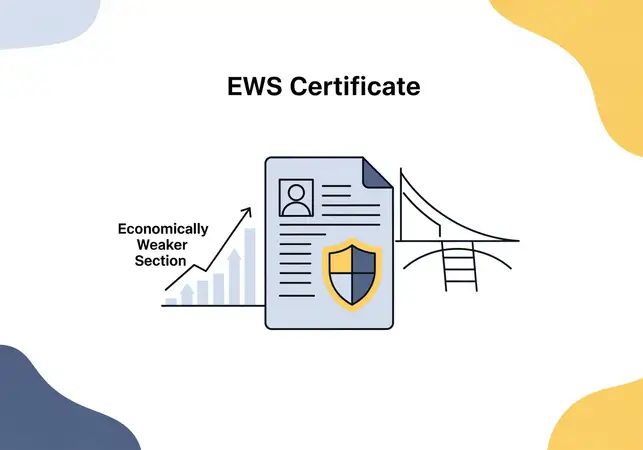
EWS Certificate Eligibility Criteria for 2026
To obtain an EWS certificate, an applicant must satisfy a set of specific criteria related to their caste, family income, and assets. While the government can revise these rules, the criteria for 2026 are expected to remain consistent with the current guidelines. It is always best to cross-reference with the official notification of the job you are applying for.
1. General Category Status
The foremost condition is that the applicant must not belong to any of the communities recognized as Scheduled Caste (SC), Scheduled Tribe (ST), or Other Backward Classes (OBC) under the Central List. You must be a General Category candidate to be eligible for an EWS certificate.
2. Family Income Criteria
The gross annual income of your 'family' from all sources (salary, agriculture, business, profession, etc.) for the financial year preceding the year of application must be less than ₹8 lakh. For a certificate application in the financial year 2025-2026, the income of the financial year 2024-2025 will be considered.
The term 'family' for this purpose includes:
- The applicant seeking the certificate.
- Their parents.
- Their spouse.
- Their children below the age of 18 years.
- Their siblings below the age of 18 years.
3. Asset Ownership Criteria
In addition to the income limit, your family must not own or possess any of the following assets. If your family owns even one of these assets, you will be deemed ineligible for the EWS certificate, regardless of your annual income.
| Asset Type | Eligibility Condition |
|---|---|
| Agricultural Land | Less than 5 acres of agricultural land. |
| Residential Flat | Less than 1000 sq. ft. of residential flat area. |
| Residential Plot (in Notified Municipalities) | Less than 100 sq. yards of residential plot. |
| Residential Plot (in other areas) | Less than 200 sq. yards of residential plot. |
Important Note: The property held by the 'family' in different locations must be clubbed together when determining EWS status. For example, if your family owns 3 acres of agricultural land in one village and 3 acres in another, the total holding is 6 acres, making you ineligible.
Required Documents for EWS Certificate Application
To apply for the EWS certificate, you need to gather a set of documents to prove your identity, address, income, and assets. Having these documents ready will make the application process much smoother. The exact list can vary slightly from state to state, but the following are generally required:
- Application Form: The prescribed EWS certificate application form, duly filled and signed.
- Identity Proof: Any one of the following - Aadhaar Card, PAN Card, Voter ID Card, Passport, Driving License.
- Address Proof: Aadhaar Card, Passport, Utility Bill (Electricity/Water), Domicile Certificate, or Ration Card.
- Photographs: 2-3 recent passport-sized photographs.
- Self-Declaration/Affidavit: A self-declaration on a stamp paper stating that you belong to the General category and that all the information provided by you is correct.
- Income Certificate: An Income Certificate issued by a competent authority (like Tehsildar). Alternatively, you can submit the latest Income Tax Returns (ITR), Form 16 from your employer, or salary slips for the last few months.
- Land/Property Documents: Papers related to any property or land owned by the family (e.g., Khasra, Khatauni, Registration Deed) to verify the asset criteria.
- Caste Proof: While you are applying as a General candidate, some states may ask for old land records or documents (like a school leaving certificate of a parent/grandparent) that do not mention SC/ST/OBC status. A self-declaration is usually sufficient.
Ensure all photocopies are self-attested before submission.
How to Apply for an EWS Certificate (Online & Offline Process)
The application process for an EWS certificate can be done either offline or online, depending on the state you reside in. Here’s a breakdown of both methods.
Offline Application Process
This is the traditional and most common method available in almost all states.
- Get the Application Form: Visit your local designated government office, which could be the Tehsil/Taluk office, Sub-Divisional Magistrate (SDM) office, or the District Magistrate (DM)/Collector's office. Obtain the EWS Certificate application form. You can often download this form from the district's official website as well.
- Fill the Form: Carefully fill in all the required details in the application form without any errors or overwriting.
- Attach Documents: Attach self-attested photocopies of all the required documents as listed in the section above. Keep the original documents handy for verification.
- Submit the Application: Submit the completed form along with the documents to the concerned officer at the same office.
- Get an Acknowledgement: Upon submission, you will receive an acknowledgement slip with an application number. Keep this slip safe as it is required for tracking your application status and for collecting the certificate.
- Verification: The concerned authorities, often the local Patwari or Revenue Inspector, will conduct a verification of your income and assets. They may visit your residence or ask you to present original documents.
- Certificate Issuance: Once the verification is successful, the competent authority will issue the EWS certificate. You can collect it from the office after the specified processing time (usually 15-21 days).
Online Application Process
Many states have digitized their citizen services and offer an online portal to apply for certificates. The steps are generally as follows:
- Visit the State Portal: Go to your state's official e-District or citizen service portal (e.g., Delhi's e-District portal, UP's e-Sathi portal).
- Register/Login: If you are a new user, you will need to register on the portal by providing basic details like your name, mobile number, and Aadhaar number. If you already have an account, log in with your credentials.
- Select the Service: Navigate to the services section and search for "Issuance of Income and Asset Certificate for EWS" or a similar service name.
- Fill the Online Form: An online application form will appear. Fill it with accurate information, just as you would with a physical form.
- Upload Documents: Scan and upload clear copies of all the required documents in the specified format (usually PDF or JPG) and size.
- Pay the Fee: If applicable, pay the nominal application fee through the online payment gateway using a debit card, credit card, or net banking.
- Submit and Track: After final submission, an acknowledgement receipt with an application number will be generated. You can use this number to track the status of your application on the same portal. Once approved, you can usually download the digitally signed EWS certificate directly from the portal.
Validity and Renewal of the EWS Certificate
This is one of the most critical aspects to understand for any government job aspirant. Misunderstanding the validity rules can lead to the cancellation of your candidature.
- Validity Period: An EWS certificate is valid for one financial year. A certificate issued in the financial year 2025-2026 (i.e., from April 1, 2025, to March 31, 2026) will be valid only until March 31, 2026.
- Relevance for Job Applications: For any government job application, the EWS certificate must be valid on the closing date of the application submission. For example, if a job's application deadline is October 30, 2025, you must possess an EWS certificate issued in the financial year 2025-2026, based on your family's income from the financial year 2024-2025.
- No Renewal, Only Re-application: There is no concept of 'renewing' an EWS certificate. Every year, you must apply for a fresh certificate. This is because your eligibility is based on the income of the preceding financial year, which changes every year.
Pro Tip: To avoid last-minute hassles, make it a practice to apply for your new EWS certificate at the beginning of every financial year, i.e., in April. This ensures you have a valid certificate ready for any /sarkari-result or job notification that comes up during the year.
Common Mistakes to Avoid
Applying for an EWS certificate can be tricky. Here are some common pitfalls to avoid:
- Incorrect Income Calculation: Failing to include income from all sources (e.g., rental income, agricultural income) or misinterpreting the definition of 'family' can lead to rejection.
- Ignoring Asset Criteria: Many applicants focus only on the ₹8 lakh income limit and forget about the asset criteria. Even if your income is low, owning a 1000 sq. ft. flat will make you ineligible.
- Waiting Until the Last Minute: The certificate issuance process takes time (2-3 weeks or more). Waiting until a job application deadline is near is a recipe for disaster.
- Using an Expired Certificate: Submitting a certificate from the previous financial year for a new application will lead to automatic rejection of your candidature.
- Format Mismatch (Central vs. State): Central government jobs (UPSC, SSC, Railways, Banks) require the EWS certificate to be in a specific format prescribed by the Government of India. State government jobs may have their own format. It is always safest to get the certificate made in the Central Government format, as it is widely accepted. Always check the job notification for the prescribed format.
Checks to complete before you apply
The EWS reservation is a valuable opportunity for many aspirants from the general category to secure a coveted government position. The key to leveraging this benefit lies in understanding the rules and being proactive. As you prepare for government exams in 2026, ensure that you clearly understand the eligibility criteria, keep your documents in order, and apply for your EWS certificate at the beginning of each financial year.
By following the steps outlined in this guide, you can navigate the application process smoothly and focus on what truly matters: your exam preparation. Stay updated with the latest job openings and guidelines on TrueJobs.co.in, your trusted partner in your journey towards a successful career in the government sector. Keep checking our /admit-card and results pages for timely updates on your applications.
Frequently Asked Questions (FAQs)
Q1. Is the EWS certificate valid for both central and state government jobs? A1. Generally, yes. However, the format of the certificate might be a crucial factor. Central government jobs require a specific format prescribed by the Department of Personnel and Training (DoPT), Government of India. While many states accept this format, some may have their own. It is always best to get the certificate in the central government format and check the specific requirements mentioned in the state government's job notification. Q2. What financial year is considered for the EWS income criteria? A2. The income criteria are always based on the financial year *preceding* the year of application. For instance, if you are applying for an EWS certificate in the financial year 2025-2026 (from April 1, 2025, to March 31, 2026), the gross annual income of your family for the financial year 2024-2025 (from April 1, 2024, to March 31, 2025) will be considered. Q3. I belong to an OBC category in my state list but not in the central list. Can I apply for an EWS certificate for central government jobs? A3. No. The EWS reservation is for persons who are not covered under the scheme of reservation for SCs, STs, and OBCs. If a candidate's caste is listed in the Central List of OBCs, they are considered OBC for central government purposes and are therefore not eligible for an EWS certificate, even if they do not fall in the 'creamy layer'. Q4. What if my family income increases above ₹8 lakh after I get the EWS certificate? A4. The EWS certificate is valid for the entire financial year in which it is issued, based on the income of the previous financial year. If your income increases in the current year, your existing certificate remains valid until March 31st of that financial year. However, when you apply for a fresh certificate for the next financial year, you will no longer be eligible as your income from the preceding year would be over the ₹8 lakh limit. Q5. Who is the issuing authority for the EWS certificate? A5. The issuing authority for the 'Income and Asset Certificate' for EWS varies by state but is a gazetted officer of a certain rank. This typically includes the District Magistrate (DM), Additional District Magistrate (ADM), Collector, Deputy Commissioner, Additional Deputy Commissioner, Sub-Divisional Magistrate (SDM), Talukdar, or Tehsildar. The certificate must be issued by an officer not below the rank of Tehsildar.EWS Certificate for Govt Jobs 2026: Eligibility & Application Guide
Related: Government Job Reservations Explained | Essential Documents Checklist
FAQs
What's EWS validity?1 yearCan OBC apply?NoRelated Resources
- Latest Sarkari Naukri
- Government Job Categories
- OBC/SC/ST Certificate Guide
- Admit Card Download
Related Government Job Resources
Continue with active job hubs and related government job pages on TrueJobs.
Tools for this recruitment topic
Use only the tools relevant to the dates, eligibility or documents discussed above.
TrueJobs Editorial Team
TrueJobs editorial desk
This article is prepared from the sources referenced in the guide and reviewed for clarity, links and dated information. Read our editorial and corrections policy.
Continue This Topic
Follow the closest earlier and newer coverage so older archive posts keep real contextual crawl paths.
Govt Job Certificates 2026: Domicile, Caste, Income & Character Rules
Planning to apply for government jobs in 2026? Understand the crucial rules and requirements for Domicile, Caste, Income, and Character certificates to ensure a smooth application process.
OBC-NCL Certificate Validity for Govt Jobs 2026: Rules & Mistakes
Planning to apply for government jobs in 2026 under the OBC-NCL category? Understand the crucial validity rules and common mistakes to ensure your application is successful.
Read Next

Govt Job Certificates 2026: Domicile, Caste, Income & Character Rules

Medical Test in Govt Jobs 2026: Common Rejection Reasons

Govt Exam Form Correction 2026: A Step-by-Step Guide

Govt Job Document Verification 2026: Checklist & Rejection Reasons
Explore Topics
Perfect Your Resume
Use our AI-powered Resume Builder to create ATS-optimized resumes.
AI Resume Builder