
Recruitment guide
Write Job Descriptions That Attract Talent — Explained
Learn how to write effective job descriptions that attract top talent with tips on structure, SEO, and inclusivity.

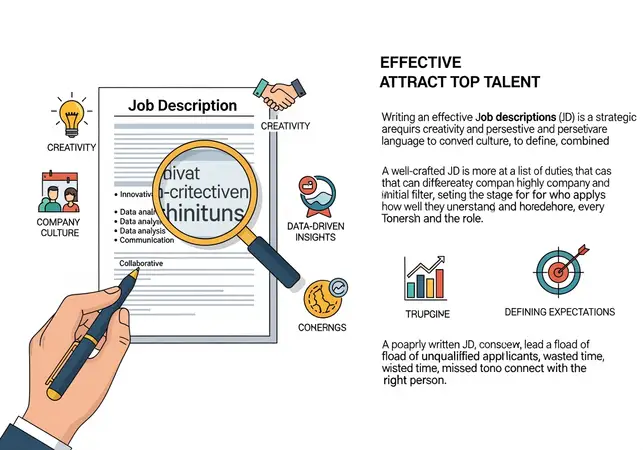
Writing an effective job description (JD) is a strategic blend of art and science. It requires creativity and persuasive language to convey company culture, combined with precision and data-driven insights to define expectations. A well-crafted JD is crucial for attracting highly qualified candidates, setting clear expectations from day one, and reducing early turnover by ensuring a realistic understanding of the role. In India's competitive job market, a superior JD acts as your company's ambassador, effectively communicating your values, work environment, and opportunities to attract and retain top talent.
Why Job Descriptions Matter
The job description is often the first touchpoint, serving as your company's initial pitch and a powerful employer branding tool. A poorly written JD deters top talent and attracts unqualified applicants, wasting recruitment resources. In India's competitive market, a well-articulated JD is a strategic necessity to cut through the noise, connect with ideal candidates, and save significant time and effort.
Beyond being a mere list of tasks and qualifications, a job description is a critical marketing document. It's the first impression a potential employee gets of your organization, influencing their decision to apply or look elsewhere. In a talent-scarce environment, particularly for specialized roles, a compelling JD can be the differentiator that secures a top candidate's interest over a competitor.
The Cost of Ineffective JDs
An ineffective job description can lead to several costly outcomes for an organization. Firstly, it results in a high volume of unqualified applications, which consumes valuable time for recruiters and hiring managers who must sift through irrelevant resumes. This increases the "time to hire" and consequently, the "cost per hire." Secondly, a vague or misleading JD can lead to a mismatch between the candidate's expectations and the actual role, resulting in early employee turnover. This not only incurs re-recruitment costs but also impacts team morale and productivity. Lastly, a consistently poor experience with JDs can damage an organization's employer brand, making it harder to attract quality talent in the future.

Impact on Candidate Experience
From a candidate's perspective, the JD is their primary window into your organization. A clear, engaging, and well-structured JD provides a positive candidate experience, making them feel valued and informed. Conversely, a confusing JD leads to frustration and a negative employer brand perception, causing top talent to look elsewhere in a market where candidate experience is paramount.
A positive candidate experience begins even before the application. When a job seeker encounters a well-written JD, they gain a clear understanding of the role's responsibilities, the required skills, and the company culture. This transparency builds trust and encourages qualified individuals to apply. Conversely, a JD that is riddled with jargon, lacks essential details, or has an uninviting tone can quickly deter even the most interested candidates. In today's digital age, where information spreads rapidly, a negative candidate experience can significantly harm an organization's reputation.
Strengthening Employer Branding
Your job descriptions are powerful marketing tools communicating your company's mission, values, and culture. An effective JD goes beyond listing duties; it paints a picture of what it's like to work at your company, highlighting unique benefits, growth opportunities, and the impact an employee can make. This proactive approach to employer branding attracts candidates who are not just looking for a job, but a career aligned with their values and aspirations.
In the Indian context, where company loyalty and growth opportunities are highly valued, incorporating aspects of your company's long-term vision, employee development programs, and community involvement can significantly enhance your employer brand through the JD. It's an opportunity to showcase your organization as a desirable workplace, emphasizing aspects like work-life balance, innovative projects, and a supportive team environment. By consistently presenting a strong and authentic employer brand through your JDs, you build a reputation that attracts and retains top talent over the long term.
Key Components of an Effective Job Description
A well-structured job description is a blueprint for success in talent acquisition. Each section plays a vital role in informing candidates, attracting the right fit, and streamlining the hiring process. Here's a breakdown of the essential components:
1. Compelling Job Title
The job title is the first thing a candidate sees and often dictates whether they click to learn more. It should be clear, concise, and reflective of the actual role and seniority. Avoid internal jargon or overly creative titles that might confuse candidates or hinder search engine optimization (SEO).
- Why it's important: A clear title helps candidates quickly identify relevant roles and improves searchability on job boards and applicant tracking systems (ATS).
- Tips for writing:
- Use standard industry titles (e.g., "Software Engineer," "Marketing Manager," "Data Analyst").
- Specify seniority level (e.g., "Senior," "Junior," "Lead").
- Include functional area if necessary (e.g., "HR Business Partner," "Financial Analyst").
- Consider adding a key differentiator if applicable (e.g., "Full-Stack Developer - React/Node.js").
2. Engaging Company Overview
This section introduces your organization to potential candidates. It's an opportunity to showcase your company's mission, vision, values, industry, and what makes it a unique place to work. This helps candidates understand the organizational context and culture.
- Why it's important: It helps candidates determine if their values align with the company's and provides a sense of purpose beyond the daily tasks.
- Tips for writing:
- Keep it concise but informative (2-3 paragraphs).
- Highlight your company's impact, achievements, or unique selling points.
- Mention your company culture and what it's like to be part of the team.
- If applicable, include information about your market position or growth trajectory, especially relevant for startups or fast-growing companies in India.
3. Concise Job Summary/Overview
This section provides a high-level summary of the role's purpose, its main contributions, and how it fits into the broader team or organization. It should be an elevator pitch for the position, capturing the essence of the job.
- Why it's important: It gives candidates an immediate understanding of the role's core function and significance, helping them quickly assess if it aligns with their career goals.
- Tips for writing:
- Clearly state the primary objective of the role.
- Mention who the role reports to and key internal/external stakeholders.
- Highlight the main impact or contribution expected from this position.
- Use strong action verbs to describe the role's essence.
4. Detailed Responsibilities and Duties
This is the core of the JD, outlining the day-to-day tasks, projects, and expectations for the role. It should be comprehensive yet clear, avoiding ambiguity.
- Why it's important: Provides clarity on daily activities, helps candidates envision themselves in the role, and serves as a basis for performance evaluations.
- Tips for writing:
- Use bullet points for readability.
- Start each point with a strong action verb (e.g., "Develop," "Manage," "Analyze," "Collaborate").
- Focus on outcomes and impact rather than just tasks (e.g., "Improve customer satisfaction by 15%" instead of "Handle customer queries").
- Prioritize responsibilities, listing the most critical ones first.
- Be realistic about the scope of the role; avoid an exhaustive list that might overwhelm or deter candidates.
5. Required Qualifications and Skills
This section specifies the essential education, experience, and technical competencies candidates must possess to be considered for the role. Distinguish between "must-haves" and "nice-to-haves."
- Why it's important: Filters out unqualified applicants and ensures that candidates meet the minimum criteria for success in the role.
- Tips for writing:
- Clearly list educational requirements (e.g., "Bachelor's degree in Computer Science").
- Specify years of relevant experience.
- Detail technical skills and software proficiency (e.g., "Proficiency in Python, SQL, AWS").
- Be realistic with requirements; an overly long list can discourage diverse candidates.
- Consider including specific certifications or licenses if mandatory.
6. Preferred Qualifications and Soft Skills
While not strictly mandatory, preferred qualifications can help differentiate candidates and identify those who might excel. Soft skills are increasingly important for team dynamics and overall success.
- Why it's important: Helps identify candidates who are a better cultural fit and possess attributes that contribute to long-term success.
- Tips for writing:
- List preferred but not essential experience, education, or technical skills.
- Highlight key soft skills relevant to the role and company culture (e.g., "Excellent communication," "Problem-solving," "Team player," "Adaptability," "Leadership potential").
- Provide examples of how these skills are applied in the role.
7. Benefits and Perks
This section is crucial for attracting top talent, especially in a competitive market like India. Go beyond basic salary to highlight the total compensation package and other advantages of working at your company.
- Why it's important: Differentiates your company from competitors and addresses what candidates value beyond salary.
- Tips for writing:
- List standard benefits (e.g., health insurance, provident fund (PF), gratuity, ESI, paid time off).
- Highlight unique perks (e.g., flexible work hours, remote work options, professional development budget, employee wellness programs, free meals, transport facilities).
- Mention opportunities for career growth, training, and mentorship.
- Emphasize work-life balance initiatives.
8. Call to Action (CTA)
A clear and concise call to action guides candidates on how to apply, making the process straightforward and encouraging completion.
- Why it's important: Streamlines the application process and ensures interested candidates know the next steps.
- Tips for writing:
- Clearly state "Apply Now" or "Submit your resume and cover letter through our career portal."
- Include any specific instructions (e.g., "Please include a portfolio link").
- Provide a direct link to the application page if possible.
9. Equal Opportunity Statement
An Equal Opportunity Employer (EOE) statement reinforces your commitment to diversity and inclusion, assuring all qualified candidates that they will receive consideration regardless of background.
- Why it's important: Promotes diversity, ensures legal compliance, and enhances your employer brand as an inclusive workplace.
- Tips for writing:
- Use standard EOE language.
- Reinforce your commitment to a diverse and inclusive workforce.
- This is particularly important in India, where diversity and inclusion initiatives are gaining significant traction.
Best Practices for Crafting Compelling JDs
Beyond the structural components, certain best practices can significantly enhance the effectiveness of your job descriptions, making them more attractive and efficient in the Indian job market.
Clarity and Conciseness
Avoid jargon, acronyms, and overly complex language. Use simple, direct sentences that are easy to understand. While being comprehensive, strive for conciseness to maintain candidate engagement. Long, rambling JDs can overwhelm and deter applicants.
- Practical Tip: Read your JD aloud. If it sounds clunky or confusing, revise it. Ask a colleague from a non-HR background to review it for clarity.
Inclusive Language
Use gender-neutral language (e.g., "they" instead of "he/she," "Chairperson" instead of "Chairman"). Avoid biased terms or requirements that might inadvertently exclude certain groups. Emphasize diversity and inclusion as part of your company culture.
- Practical Tip: Use tools or checklists to identify and remove biased language. Focus on skills and qualifications rather than demographic characteristics.
Highlighting Company Culture and Values
Integrate your company's values, mission, and unique culture throughout the JD, not just in the company overview. Describe the team environment, collaboration styles, and the impact employees have. This helps candidates determine cultural fit.
- Practical Tip: Weave in cultural elements when describing responsibilities (e.g., "Collaborate cross-functionally to foster a culture of innovation") or benefits (e.g., "Enjoy our vibrant team events and employee recognition programs").
Focus on Outcomes, Not Just Tasks
Instead of merely listing duties, describe the impact the role will have on the company, customers, or projects. Candidates are more motivated by understanding how their work contributes to a larger goal.
- Practical Tip: For each responsibility, ask "Why is this important?" The answer often reveals the desired outcome. For example, instead of "Manage social media accounts," write "Drive brand engagement and lead generation through strategic social media campaigns."
Keywords Optimization for ATS and Search Engines
Many companies use Applicant Tracking Systems (ATS) to filter resumes. Incorporate relevant keywords from the job title, responsibilities, and qualifications that candidates are likely to use in their resumes and job searches. This improves visibility and ensures qualified candidates are not overlooked.
- Practical Tip: Research common keywords for the role using job board searches or industry terms. Include variations of terms if appropriate.
Mobile-Friendliness and Readability
A significant portion of job seekers access job boards on mobile devices. Ensure your JD is easily readable on small screens, with clear headings, bullet points, and short paragraphs. Avoid large blocks of text.
- Practical Tip: Preview your JD on a mobile device. Use an appropriate font size and line spacing.
Regular Review and Update
Job roles evolve, and so should your JDs. Regularly review and update existing job descriptions to ensure they accurately reflect the current responsibilities, required skills, and market conditions. Outdated JDs can lead to misaligned expectations and recruitment challenges.
- Practical Tip: Schedule annual or semi-annual reviews of all JDs with hiring managers. Update JDs immediately when role scope or reporting structures change.
Common Mistakes to Avoid in Job Descriptions
While focusing on best practices is crucial, being aware of common pitfalls can save significant time and resources in the recruitment process. Avoiding these mistakes ensures your JD is a magnet for the right talent.
1. Vague or Generic Language
Using terms like "responsible for various tasks" or "assists as needed" provides no real insight into the role. Such ambiguity confuses candidates and can attract applicants who don't truly understand the job, leading to poor fit.
- Impact: High volume of unqualified applications, increased time-to-hire, and frustration for both recruiters and candidates.
- Solution: Be specific. Clearly define responsibilities, projects, and expected outcomes using strong, descriptive action verbs.
2. Laundry List of Requirements
Listing an excessive number of "must-have" qualifications, especially for entry-level or mid-level roles, can deter highly qualified candidates who might not check every single box. This is particularly true for women and underrepresented groups who may be less likely to apply if they don't meet 100% of the criteria.
- Impact: Narrows the talent pool unnecessarily, potentially missing out on excellent candidates who are quick learners or have transferable skills.
- Solution: Distinguish between "
Related: Top Recruitment Strategies | Employer Branding Guide
FAQ
Why are job descriptions important?They attract talent and set expectationsWhat makes JDs effective?Clarity and realistic portrayalRelated Resources
- Employer's Guide to TrueJobs.co.in
- Building a Strong Employer Brand in India
- Effective Interview Techniques for Hiring Managers
Related Government Job Resources
Continue with active job hubs and related government job pages on TrueJobs.
Tools for this recruitment topic
Use only the tools relevant to the dates, eligibility or documents discussed above.
TrueJobs Editorial Team
TrueJobs editorial desk
This article is prepared from the sources referenced in the guide and reviewed for clarity, links and dated information. Read our editorial and corrections policy.
Continue This Topic
Follow the closest earlier and newer coverage so older archive posts keep real contextual crawl paths.
ATS-Friendly Resume: How to Beat Applicant Tracking Systems
Learn how to create an ATS-friendly resume that passes applicant tracking systems and gets you interviews.
Railway Recruitment 2026: 50,000+ Expected Vacancies, Department-Wise Full Update
Railway Recruitment 2026 is set to be a massive hiring drive with over 50,000 expected vacancies across NTPC, Group D, ALP, and JE. Get a complete breakdown of posts and eligibility.
Read Next
UPSC Civil Services Exam 2026: Prelims Result, Mains Admit Card, and Final Updates
UPSC Indian Forest Service 2026: Prelims Result, Mains Exam, Admit Card, Selection
UPSC NDA & NA II 2026: Notification, Application, Exam, and SSB Updates
UPSC CDS II 2026: Notification, Application, Exam Date, and Result
Explore Topics
Perfect Your Resume
Use our AI-powered Resume Builder to create ATS-optimized resumes.
AI Resume Builder