
Recruitment guide
Government Jobs 2026: Hindi Typing Roles (Clerk — Explained
Explore upcoming government jobs in 2026 for candidates with Hindi typing skills. This guide covers key roles like Clerk, Stenographer, and Assistant in court, secretariat, and other departments. Learn about eligibility, salary, and preparation strategies.

In the vast landscape of Indian government employment, specific skills often open doors to stable and rewarding careers. One such invaluable skill, particularly in a country where Hindi is widely spoken and serves as an official language, is Hindi typing. As we look ahead to 2026, numerous opportunities are expected to arise in various government departments that specifically seek candidates proficient in Hindi typing. These roles are not just about data entry; they are foundational positions in the administrative machinery, ensuring smooth communication and efficient record-keeping. If you possess or are looking to develop this crucial skill, you're on the right path to securing a coveted government job in sectors like clerical, judicial, and secretariat services.
This comprehensive guide from TrueJobs.co.in will delve into the types of roles available, their eligibility, preparation strategies, and the bright career prospects that await you.

Why Hindi Typing Skills are in Demand for Government Jobs
Hindi, being one of the official languages of the Union of India and widely used across many states, plays a pivotal role in government administration. From drafting official letters and maintaining records to processing applications and communicating with the public, proficiency in Hindi is often a non-negotiable requirement. The government's continuous push for local language proficiency in public services further amplifies the demand for Hindi typists and those with related skills. This demand is not merely a formality; it ensures that government services are accessible and efficient for a majority of the population, fostering better governance and public interaction.
For aspiring government employees, mastering Hindi typing offers a distinct advantage. Many positions, especially at the entry and mid-levels, require candidates to demonstrate a certain speed and accuracy in Hindi typing tests. This skill acts as a filtering criterion, allowing departments to select candidates who can immediately contribute to their operational needs. Moreover, with the increasing digitization of government records and communication, the ability to type efficiently in Hindi on computers has become even more critical. Departments such as the Central Secretariat, various State Secretariats, District Courts, High Courts, and numerous ministries and public sector undertakings consistently recruit individuals with these specialized linguistic and technical skills.
These roles are essential for the day-to-day functioning of government offices, making Hindi typing a highly sought-after and practical skill for public service aspirants.
Key Government Roles Requiring Hindi Typing (Clerk, Court, Secretariat)
The scope for Hindi typing proficiency extends across several critical government sectors. Understanding these roles can help you tailor your preparation and career aspirations. Here, we detail some of the most prominent positions:
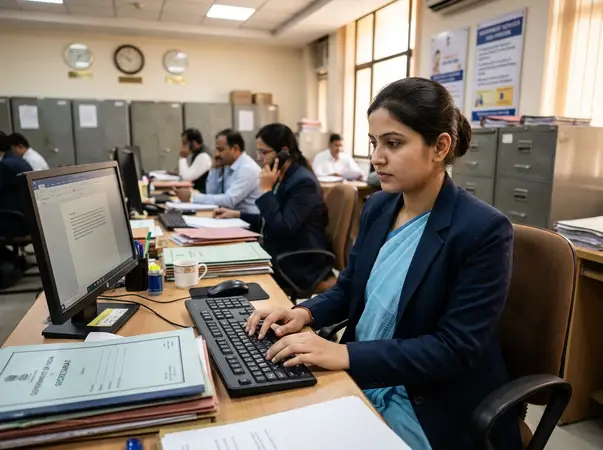
Clerical Positions (Clerk, Junior Assistant, Data Entry Operator)
Clerical positions form the backbone of any administrative setup. These roles are abundant across various central and state government departments, ministries, and public sector undertakings. Candidates in these roles are responsible for a wide array of tasks that demand efficient Hindi typing skills.
- Description of Duties: Clerks, Junior Assistants, and Data Entry Operators primarily handle routine office work. This includes maintaining files and records, data entry into computer systems, drafting official letters and documents in Hindi, processing applications, managing correspondence, and assisting senior officials with administrative tasks. Their work ensures the smooth flow of information and efficient execution of departmental functions.
- Typical Departments: These positions are found in almost every government department, including railways, post offices, banks (for clerical roles), various ministries (e.g., Ministry of Home Affairs, Ministry of Finance), state-specific departments (e.g., Revenue Department, Education Department), and public sector banks.
- Typing Speed Requirements: While specific requirements can vary, a common benchmark for Hindi typing tests is usually around 25 to 30 words per minute (WPM) with a high degree of accuracy (typically 90-95%). Some roles might require slightly higher speeds, especially for data-intensive operations.
- Educational Qualifications: Generally, candidates are required to have passed 10th or 12th standard examinations from a recognized board. For some higher-level clerical roles, a bachelor's degree from a recognized university might be preferred or mandatory.
Court Roles (Stenographer, Typist, Lower Division Clerk in Courts)
The judicial system heavily relies on accurate and timely documentation, making Hindi typing and shorthand skills indispensable for court roles. These positions are crucial for recording proceedings and managing judicial records.
- Description of Duties: Court Stenographers are responsible for recording court proceedings verbatim using shorthand (often in Hindi), which is then transcribed into typed documents. Court Typists and Lower Division Clerks (LDCs) in courts handle the typing of judgments, orders, affidavits, legal documents, and maintaining case files. They also assist judges and legal officers with administrative and clerical support.
- Specific Courts: Opportunities exist in District Courts, High Courts, various Tribunals (e.g., Central Administrative Tribunal, National Green Tribunal), and other judicial bodies across the country.
- Typing/Shorthand Requirements: For Stenographer roles, proficiency in Hindi shorthand (e.g., 80-100 WPM) along with Hindi typing (e.g., 25-35 WPM) is essential. For Typist and LDC roles, a good Hindi typing speed (similar to clerical positions) with high accuracy is typically required.
- Educational Qualifications: Most court-related typing and stenography positions require a 12th pass certificate. Some higher-level stenographer positions might prefer or necessitate a graduate degree.
Secretariat Positions (Personal Assistant, Stenographer, Office Assistant)
Secretariat roles are integral to the top administrative bodies of both central and state governments. These positions often involve working directly with senior officials, demanding high levels of efficiency and discretion.
- Description of Duties: Personal Assistants (PAs) and Stenographers in Secretariats provide comprehensive secretarial and administrative support to senior officers. This includes typing official correspondence, reports, and policy documents in Hindi, managing appointments, handling communications, maintaining confidential files, and preparing presentations. Office Assistants perform similar clerical and administrative duties, focusing on general office management and documentation.
- Departments: These roles are predominantly found in the Central Secretariat (various ministries and departments of the Government of India) and State Secretariats (various departments of state governments).
- Typing/Shorthand Requirements: For Stenographer and PA roles, a strong command over Hindi shorthand (e.g., 80-100 WPM) and Hindi typing (e.g., 30-40 WPM) is crucial. Office Assistant roles typically require good Hindi typing speed and accuracy.
- Educational Qualifications: A 12th pass certificate is often the minimum requirement, with many positions preferring or mandating a bachelor's degree. Experience in office administration or secretarial work can also be an added advantage.
Eligibility Criteria and Application Process for 2026 Aspirants
Understanding the eligibility requirements and the application process is the first step towards securing a government job. While specific details can vary by recruitment agency and post, there are general guidelines that aspirants for 2026 should be aware of.
General Eligibility
- Nationality: Candidates must be citizens of India. For certain state government jobs, domicile requirements for that specific state might also apply.
- Age Limits: The typical age limit for most entry-level government jobs ranges from 18 to 27 or 30 years. However, there are significant age relaxations for candidates belonging to reserved categories (SC/ST/OBC), Persons with Disabilities (PwD), and Ex-Servicemen, as per government rules. It's crucial to check the specific notification for exact age criteria.
- Educational Qualifications: As detailed in the previous section, qualifications vary by post. Clerical and court typist roles often require a 10th or 12th pass, while some higher-level positions or those in Secretariats might require a graduate degree. Always refer to the official notification for the precise educational requirements for the post you are interested in.
Hindi Typing Proficiency
This is the core skill for the jobs discussed. The typing test is usually a crucial stage of the selection process, often qualifying in nature.
- Minimum Speed Requirements: Most government jobs requiring Hindi typing specify a minimum speed, commonly ranging from 25 to 35 words per minute (WPM). For stenographer roles, Hindi shorthand speed (e.g., 80-100 WPM) is also tested, followed by transcription into Hindi typing.
- Accuracy Expectations: Speed alone is not sufficient; accuracy is paramount. Recruiters typically look for an accuracy rate of 90-95% or higher. Mistakes in typing can lead to deductions or even disqualification.
- Typing Test Format: Typing tests are almost always conducted on a computer. Candidates are usually provided with a passage in Hindi which they need to type within a stipulated time. The specific font (e.g., Kruti Dev, Mangal) and keyboard layout (e.g., Remington Gail, Inscript) might be specified in the notification. It's vital to practice on the exact font and layout mentioned.
Application Process Overview
The application process for government jobs is largely standardized, but candidates must remain vigilant for official announcements.
- Notification Release: Job notifications are released by various recruiting bodies such as the Staff Selection Commission (SSC), State Public Service Commissions (PSCs), High Courts, and individual ministries/departments. These are published on their official websites, in the Employment News weekly, and prominently featured on job portals like TrueJobs.co.in.
- Online Application Steps:
- Registration: Create an account on the recruiting body's portal.
- Form Filling: Accurately fill in personal, educational, and contact details.
- Document Upload: Upload scanned copies of photographs, signatures, educational certificates, and caste certificates (if applicable) in the specified format and size.
- Fee Payment: Pay the application fee online through various modes (net banking, debit/credit card, UPI). Fee waivers are often available for reserved categories and female candidates.
- Final Submission: Review the application form carefully before final submission and take a printout for future reference.
- Important Dates: Pay close attention to the application window (start and end dates), last date for fee payment, and tentative dates for written examinations and skill tests. Missing a deadline can lead to disqualification. Keep an eye on our /sarkari-result">Sarkari Result section for updates on application statuses and results.
How to Prepare for Hindi Typing Government Jobs
Effective preparation is the cornerstone of success in any competitive examination, and government jobs requiring Hindi typing are no exception. A dual focus on both the written examination and the typing skill test is essential.
Mastering Hindi Typing
The typing test is often a qualifying hurdle. Dedicated and consistent practice is the only way to achieve the required speed and accuracy.
- Practice Methods:
- Online Tutors/Software: Utilize online Hindi typing tutors or software specifically designed for Hindi (e.g., Typing Master for Hindi, various free online typing practice websites). These often provide structured lessons and track progress.
- Daily Practice: Dedicate at least 1-2 hours daily to typing practice. Consistency is more important than long, infrequent sessions.
- Focus on Accuracy First, Then Speed: Initially, prioritize typing without errors, even if it means typing slowly. Once accuracy is achieved (aim for 95% or higher), gradually work on increasing your speed.
- Ergonomics and Posture: Maintain proper posture, keep your wrists straight, and ensure your keyboard and screen are at an ergonomic height. This prevents fatigue and potential injuries during long practice sessions and the actual test.
- Recommended Typing Tools/Software: Practice with the specific font (e.g., Kruti Dev 010, Mangal) and keyboard layout (e.g., Remington Gail, Inscript) that is generally used in government exams. Many online platforms allow you to select these options.
Written Examination Preparation
Most government jobs involve a written examination before the skill test. The syllabus typically covers common subjects.
- Common Subjects:
- General Awareness/General Knowledge: Current affairs, Indian history, geography, polity, economy, science, and static GK.
- Reasoning Ability: Verbal and non-verbal reasoning, analytical skills, problem-solving.
- Quantitative Aptitude: Basic arithmetic, algebra, geometry, trigonometry, data interpretation.
- General Hindi/English: Grammar, vocabulary, comprehension, sentence structure, error detection. For Hindi typing jobs, General Hindi is often a significant component.
- Study Materials and Previous Year Papers: Refer to standard textbooks, government publications, and reputable online resources. Solving previous year's question papers is invaluable for understanding the exam pattern, question types, and time management.
- Mock Tests: Regularly take full-length mock tests to simulate exam conditions. This helps in identifying weak areas, improving speed, and managing time effectively.
Interview Preparation (if applicable)
Some government roles, especially at higher clerical or assistant levels, might include an interview stage. While not all Hindi typing jobs have an interview, it's good to be prepared.
- Common Interview Questions: Be ready to answer questions about your background, motivation for joining government service, knowledge about the department, and situational questions.
- Communication Skills: Practice clear and concise communication. Even if the primary skill is typing, good verbal communication is always a plus.
- Professionalism: Dress appropriately, maintain eye contact, and demonstrate confidence and a positive attitude.
For more detailed preparation strategies and study materials, explore our /exam-preparation">Exam Preparation section.
Salary, Career Growth, and Benefits
A government job is often sought after not just for its stability but also for its competitive remuneration, comprehensive benefits, and clear career progression paths. Roles requiring Hindi typing are no exception.
Salary Structure
Salaries for government employees are determined by the 7th Pay Commission recommendations. Entry-level positions generally fall under Pay Level 2 to Pay Level 4, depending on the specific role and department.
- Entry-level Salaries:
- Clerk/Junior Assistant/Typist: Typically fall under Pay Level 2 or 3. The basic pay could range from ₹19,900 to ₹21,700 per month.
- Stenographer/Personal Assistant: Often fall under Pay Level 4. The basic pay could range from ₹25,500 per month.
- Allowances: In addition to the basic pay, government employees receive various allowances, significantly increasing their in-hand salary. These include:
- Dearness Allowance (DA): Revised periodically to offset inflation.
- House Rent Allowance (HRA): Varies based on the city category (X, Y, Z).
- Transport Allowance (TA): Provided for commuting expenses.
- Medical Allowance: For medical expenses.
- Other allowances like Children Education Allowance, Leave Travel Concession (LTC), etc.
- Total Monthly Emoluments: For an entry-level position, the gross salary (basic + allowances) can range from approximately ₹30,000 to ₹45,000 or more per month, depending on the pay level and posting location.
Career Progression
Government jobs offer structured career growth opportunities based on seniority, performance, and departmental examinations.
- Promotional Avenues: A Clerk can be promoted to Senior Clerk, then to Assistant, Section Officer, and further up the administrative ladder. Similarly, a Stenographer can become a Senior Stenographer, Personal Assistant, or even Private Secretary to senior officials. These promotions often come with increased responsibilities, higher pay scales, and enhanced status.
- Opportunities for Further Education/Training: Many government departments encourage employees to pursue further education or specialized training, often providing study leave or financial assistance. This helps in personal and professional development and opens doors for higher-level positions.
Perks and Benefits
Beyond salary, government jobs come with a host of non-monetary benefits that contribute to a secure and comfortable life.
- Job Security: One of the most significant advantages is the high degree of job security, making it a preferred choice for many.
- Pension Schemes: New recruits are covered under the National Pension System (NPS), providing a financial safety net post-retirement.
- Medical Facilities: Employees and their dependents are covered under various government health schemes, ensuring access to quality medical care.
- Leave Benefits: Generous leave policies, including earned leave, casual leave, medical leave, and maternity/paternity leave, ensure a good work-life balance.
- Work-Life Balance: While workload can vary, government jobs generally offer a predictable work schedule and holidays, contributing to a better work-life balance compared to many private sector roles.
- Social Status: Government employment often carries a certain level of respect and social status in Indian society.
These comprehensive benefits make government jobs, including those requiring Hindi typing, highly attractive career options for aspirants across India. For the latest job notifications and detailed salary structures, keep checking our /latest-jobs">Latest Jobs section.
Checks to complete before you apply
The demand for Hindi typing skills in government jobs is a testament to the language's enduring importance in India's administrative framework. As we look towards 2026, the landscape for roles such as Clerk, Typist, Stenographer, and Office Assistant in various government departments, courts, and secretariats remains promising. These positions offer not just a stable income but also a secure future, opportunities for career growth, and a comprehensive benefits package that few other sectors can match. Mastering Hindi typing, coupled with strong general knowledge and reasoning abilities, can be your gateway to a fulfilling career in public service.
TrueJobs.co.in encourages all aspirants to begin their preparation early. Dedicate time to perfecting your Hindi typing speed and accuracy, alongside a robust study plan for the written examinations. Stay updated with official notifications, understand the eligibility criteria thoroughly, and practice diligently. Your efforts today will pave the way for a successful career in a government job requiring Hindi typing in 2026 and beyond. Keep visiting TrueJobs.co.in for the latest updates, notifications, and preparation resources to guide you on your journey.
Frequently Asked Questions
Q1: Is Hindi typing mandatory for all government jobs?
A1: No, Hindi typing is not mandatory for all government jobs. It is specifically required for certain administrative, clerical, court, and secretarial roles where official communication and record-keeping are predominantly done in Hindi. Many other government jobs, especially in technical, professional, or management cadres, might not require any typing skills or may only require English typing.
Q2: What is the typical Hindi typing speed required for government jobs?
A2: The typical Hindi typing speed required for government jobs ranges from 25 to 35 words per minute (WPM). For Stenographer positions, a higher speed in Hindi shorthand (e.g., 80-100 WPM) is usually required, followed by transcription into Hindi typing at a specified speed. Accuracy is equally important, with most tests expecting 90-95% accuracy or higher.
Q3: Can I apply for these jobs if I only know English typing?
A3: If a job notification explicitly states that Hindi typing is a mandatory requirement, then knowing only English typing will not suffice for that particular post. However, many government jobs require only English typing, or both English and Hindi typing. Always check the specific job advertisement for the exact skill requirements before applying.
Q4: Which states have more opportunities for Hindi typing jobs?
A4: States in the Hindi belt of India, such as Uttar Pradesh, Bihar, Madhya Pradesh, Rajasthan, Haryana, Uttarakhand, Himachal Pradesh, Chhattisgarh, and Jharkhand, generally have a higher number of opportunities for Hindi typing jobs in their state government departments and courts. Additionally, central government departments and ministries located in Delhi and other Hindi-speaking regions also frequently recruit for these roles.
Q5: What are the best resources for Hindi typing practice?
A5: There are several excellent resources for Hindi typing practice. These include online typing tutors (e.g., Typing Baba, India Typing, Online Typing Tutor), dedicated software for Hindi typing (e.g., Typing Master for Hindi, various free Kruti Dev/Mangal font typing software), and practicing with Hindi passages from books or newspapers. Consistency and choosing the correct font (Kruti Dev, Mangal) and keyboard layout (Remington Gail, Inscript) as specified in job notifications are key.
Related Resources
- Latest Government Jobs
- Typing Test Preparation Guide
- Clerk Job Vacancies
Related Government Job Resources
Continue with active job hubs and related government job pages on TrueJobs.
Tools for this recruitment topic
Use only the tools relevant to the dates, eligibility or documents discussed above.
TrueJobs Editorial Team
TrueJobs editorial desk
This article is prepared from the sources referenced in the guide and reviewed for clarity, links and dated information. Read our editorial and corrections policy.
Continue This Topic
Follow the closest earlier and newer coverage so older archive posts keep real contextual crawl paths.
Government Jobs Requiring Shorthand in 2026: Stenographer, PA & More
Discover why shorthand remains a crucial skill for Indian government jobs in 2026. This guide covers top roles like Stenographer and PA, eligibility, and preparation strategies for a stable career.
Government Jobs Accepting Apprenticeship Experience in 2026: Your Pathway to Success
Discover how your apprenticeship experience can unlock government job opportunities in 2026. This guide covers key sectors like PSUs and Railways, eligibility benefits, and strategies to secure your dream role in the Indian government sector.
Read Next

Government Jobs Requiring Shorthand in 2026: Stenographer, PA & More

Government Jobs Accepting Apprenticeship Experience in 2026: Your Pathway to Success

Government Jobs 2026: Your Pathway with CCC/O Level Computer Certificate

Government Jobs Through Sports Quota in 2026: Unveiling the Vacancy Sources
Explore Topics
Perfect Your Resume
Use our AI-powered Resume Builder to create ATS-optimized resumes.
AI Resume Builder