
Career guide
Your Ultimate Guide to Securing a Job with Indian 2026 — Explained
Dreaming of a stable career with Indian Railways? This ultimate guide for 2026 breaks down the recruitment process, types of vacancies, eligibility, and essential preparation strategies to help you succeed in RRB exams.

Securing a government job is a dream for millions in India, and a position with the Indian Railways is often considered the pinnacle of this aspiration. Known for its unparalleled job security, extensive social benefits, and the profound opportunity to serve the nation, a career in the railways is highly sought after. The Indian Railways, being one of the world's largest employers with over 1.2 million employees, offers a vast array of opportunities across various departments, playing a crucial role in the country's infrastructure and economy. While we cannot predict the future with certainty, the cyclical nature of Railway recruitment, driven by retirements, new projects, and government initiatives, means that a significant number of opportunities for 2026 are always on the horizon. This guide is designed to provide you with a comprehensive roadmap to navigate the upcoming Railway Vacancies in the year 2026, helping you prepare effectively and maximize your chances of success.
Understanding the Structure of Indian Railways Recruitment
Before diving into preparation strategies, it is crucial to understand the organizational framework of Indian Railways recruitment. The recruitment process is not monolithic; it is conducted by different bodies for different levels of positions. Grasping this structure will help you identify the right opportunities and tailor your preparation accordingly.
Primary Recruiting Bodies
The bulk of the recruitment is handled by two major bodies:
- Railway Recruitment Boards (RRBs): There are 21 RRBs across India, each catering to a specific geographical zone. RRBs primarily handle the recruitment for Group 'C' and Group 'D' (now reclassified as Level-1, 2, 3, 4, and 5 as per the 7th Central Pay Commission) non-gazetted posts. Examples include positions like Junior Clerk, Ticket Collector, Goods Guard, Track Maintainer, and Assistant Station Master.
- Railway Recruitment Cells (RRCs): RRCs operate under the various railway zones (like Northern Railway, Western Railway, etc.) and are typically responsible for recruiting staff for specific zones, often for more localized or departmental requirements.
For higher-level gazetted officer roles (Group 'A' and 'B'), recruitment is primarily conducted through:
- Union Public Service Commission (UPSC): The UPSC conducts the Civil Services Examination (CSE) for entry into the Indian Railway Service (IRS), Indian Railway Traffic Service (IRTS), Indian Railway Accounts Service (IRAS), and Indian Railway Personnel Service (IRPS).
- Specialized Exams: For technical posts, the UPSC also conducts the Engineering Services Examination (ESE) for recruiting officers in the Indian Railway Service of Engineers (IRSE), Indian Railway Service of Mechanical Engineers (IRSME), and other technical branches.
Popular Job Categories and Posts for 2026
Based on previous recruitment cycles, the following categories are expected to have substantial vacancies in the 2026 recruitment drives:
- Technical Departments: This includes roles for Junior Engineers (JE), Senior Section Engineers, and Depot Material Superintendents (DMS) in disciplines like Civil, Mechanical, Electrical, Electronics, and Telecommunications.
- Non-Technical Popular Categories (NTPC): This is a major recruitment drive for roles such as Traffic Assistant, Goods Guard, Senior Clerk-cum-Typist, Junior Accounts Assistant, and Time Keeper.
- Level-1 Posts: These are crucial ground staff positions like Track Maintainer, Helper/Assistant in various workshops, Pointsman, and other miscellaneous categories.
- Graduate and Undergraduate Posts: Various posts under RRBs that require either graduation or 10+2/ITI as the minimum educational qualification.
- Station Master and Train Guard: These are highly sought-after roles responsible for the safe and efficient operation of train movements.
Eligibility Criteria for Indian Railways Jobs 2026
The eligibility criteria are the first and most important checkpoint. Failing to meet any of these will disqualify your application. While specific criteria will be detailed in the official 2026 notifications, you can expect them to align with the following general standards.
Nationality and Age Limit
Applicants must be citizens of India. The standard age limit for most RRB and RRC exams is between 18 to 33 years. However, the government provides age relaxation for reserved categories as per standard norms:
| Category | Age Relaxation |
|---|---|
| Other Backward Classes (OBC) | Up to 3 years |
| Scheduled Caste/Scheduled Tribe (SC/ST) | Up to 5 years |
| Persons with Benchmark Disabilities (PwBD) | Up to 10 years |
| Ex-Servicemen | As per government guidelines |
The crucial date for determining age limit is typically January 1st of the year the notification is released. Always refer to the official notification for the exact cut-off date.
Educational Qualifications
The required educational qualification is entirely dependent on the post you are targeting. Here’s a general breakdown:
- Level-1 Posts: Usually require a minimum of 10th pass or ITI from a recognized board/institute.
- Group C Non-Technical Posts (NTPC): Require a minimum qualification of 12th pass (+2 Stage) or a University Degree. Some specific posts may require graduation.
- Technical Posts (JE, SSE): Require a diploma or a degree in the relevant engineering discipline (e.g., Civil, Mechanical, Electrical, Electronics) from a recognized university.
- Assistant Loco Pilot (ALP): Requires ITI in specified trades or a diploma in mechanical/electrical/electronics engineering.
- Gazetted Officer Posts (via UPSC): Require a university degree from a recognized institution. The engineering posts require a degree in engineering.
It is imperative that you have all your educational certificates and documents, along with any required caste/category certificates, scanned and ready for the online application process.
The Application Process: A Step-by-Step Guide for 2026
The application process for Indian Railways is conducted exclusively online through the official websites of the respective RRBs or RRCs. Here is a detailed breakdown of the steps you will likely need to follow in 2026.
Step 1: Notification and Registration
The journey begins with the release of the official notification on the websites of the RRBs (e.g., rrbbbs.gov.in, rrcb.gov.in) and the Indian Railways' central portal, indianrailways.gov.in. Read the notification PDF meticulously—every single detail matters. Understand the number of vacancies, post-wise eligibility, exam pattern, and application timeline. The first step is to click on the "New Registration" link and provide basic details like name, mobile number, and email ID to generate a unique Registration Number.
Step 2: Filling the Application Form
Log in with your registration details and carefully fill in the extensive application form. This will require you to enter:
- Personal details (name, father's name, date of birth)
- Educational qualifications (with percentages, year of passing, board/university)
- Communication address
- Category and sub-category details (SC/ST/OBC/EWS/UR)
- Choice of exam centers (you will be given a list of cities to choose from)
Double-check every entry for accuracy. Any discrepancy found later can lead to the cancellation of your candidature.
Step 3: Uploading Documents and Payment of Fee
You will be required to upload scanned copies of your photograph, signature, and sometimes other documents like educational certificates or thumb impression as per the specified size and format. The application fee varies by category:
- General/OBC male candidates: Usually between ₹500 - ₹600
- SC/ST/PwBD/Female/Transgender/Ex-Servicemen: Typically exempt from paying the fee
Payment can be made online through net banking, credit/debit cards, or via offline mode through SBI bank challan.
Step 4: Final Submission and Printout
After successful payment, review your application one final time and submit it. It is highly recommended to take a printout of the final submitted application form and the payment receipt for your records and future reference throughout the recruitment process.
Exam Pattern and Selection Process
The selection process for most non-gazetted posts is multi-tiered, designed to thoroughly assess a candidate's aptitude and knowledge.
Standard Selection Stages
- First Stage Computer Based Test (CBT 1): This is a common preliminary screening test for many posts. It typically consists of questions from Mathematics, General Intelligence and Reasoning, General Awareness, and General Science. The difficulty level is usually moderate.
- Second Stage Computer Based Test (CBT 2): This is the main examination, which is more advanced and specialized. The syllabus is deeper and more aligned with the technical or non-technical requirements of the specific post.
- Skill Test/Typing Test: For clerical posts, a skill test involving typing speed in Hindi or English is mandatory. You must achieve a certain Words Per Minute (WPM) score to qualify.
- Document Verification (DV): Shortlisted candidates are called to a verification center where their original documents (educational certificates, caste certificate, photo ID, application printout) are physically verified.
- Medical Examination: Finally, selected candidates must undergo a thorough medical examination to ensure they are medically fit for the demanding roles within the railways.
For technical posts like JE, there may be a single CBT instead of two stages. For ALP posts, there is an additional Computer Based Aptitude Test (CBAT).
Effective Preparation Strategy for 2026 Recruitment
Starting your preparation early is the key to cracking the highly competitive Railway exams. With 2026 as your target, you have the advantage of time.
Know the Syllabus Inside Out
Your first task is to download and master the syllabus from the previous year's notification for your target post. The syllabus for 2026 is unlikely to see drastic changes. Break down the syllabus subject-wise and topic-wise, and create a study plan that covers every single item.
Create a Realistic Study Plan
Develop a disciplined daily and weekly study routine. Allocate specific time slots for each subject, giving more time to your weaker areas. Consistency is far more important than studying for long hours sporadically. Include time for revision and taking mock tests in your schedule.
Mastery Through Mock Tests and Previous Papers
This is the most critical part of your preparation. Regularly taking full-length mock tests under timed conditions will:
- Familiarize you with the exam interface and pattern.
- Improve your speed and accuracy.
- Help you identify your strong and weak areas.
- Build your exam temperament and time-management skills.
Analyze your performance after each test to understand where you went wrong and rectify your mistakes.
Focus on General Awareness and Current Affairs
This section is a major differentiator. Develop a habit of reading a national newspaper daily. Follow a good monthly current affairs magazine. Focus specifically on news related to Indian Railways—new projects, policies, inaugurations, and budget allocations. Also, study static GK related to Indian geography, history, polity, and economics.
Staying Updated for 2026 Notifications
The official notification for 2026 vacancies will likely be released in the months leading up to that year. To ensure you don't miss any update:
- Bookmark and regularly check the official RRB websites (a consolidated list is available on https://www.indianrailways.gov.in/).
- Enable push notifications from the official TrueJobs.co.in app or website.
- Follow reputable news sources for government job alerts.
- Join online forums and communities where aspirants share information, but always verify any news from official sources.
Related Resources
- Latest Railway Job Notifications
- Government Exam Syllabus
- Exam Preparation Strategies
Reader questions: Railway
When will RRB announce 2026 vacancies?
RRB follows cyclical patterns - stay tuned!
What qualifications are needed?
Depends on post - check RRB guidelines
How to apply online?
Visit RRB's official website during recruitment
What's the exam pattern?
Varies by post category - CBT format
Is there age relaxation?
Yes, per government norms
TrueJobs Editorial Team
TrueJobs editorial desk
This article is prepared from the sources referenced in the guide and reviewed for clarity, links and dated information. Read our editorial and corrections policy.
Continue This Topic
Follow the closest earlier and newer coverage so older archive posts keep real contextual crawl paths.
नर्सिंग ऑफिसर सरकारी नौकरी 2026: AIIMS, ESIC, रेलवे और राज्य अस्पताल गाइड
नर्सिंग ऑफिसर सरकारी नौकरी 2026 के लिए आवेदन करने की पूरी जानकारी प्राप्त करें। AIIMS, ESIC, रेलवे और राज्य अस्पतालों में नर्सिंग ऑफिसर के पद के लिए आवेदन प्रक्रिया, योग्यता मानदंड और तैयारी टिप्स जानें।
पब्लिक सेक्टर बैंकों में गैर-पीओ सरकारी नौकरी 2026: संपूर्ण गाइड
भारत में सरकारी नौकरी की तलाश कर रहे युवाओं के लिए पब्लिक सेक्टर बैंक (PSB) एक आकर्षक विकल्प हैं। यह गाइड 2026 में क्लर्क, SO जैसे गैर-पीओ पदों के लिए पात्रता, चयन प्रक्रिया और करियर अवसरों पर विस्तृत जानकारी प्रदान करती है।
Read Next

GATE के जरिए सरकारी नौकरी 2026: PSU, DRDO, BARC, ISRO विकल्प
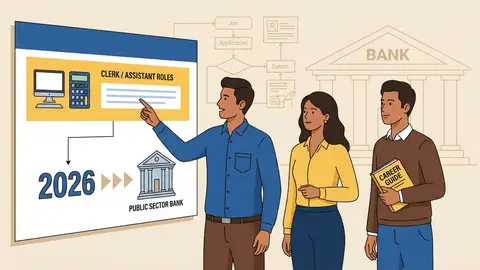
पब्लिक सेक्टर बैंकों में गैर-पीओ सरकारी नौकरी 2026: संपूर्ण गाइड
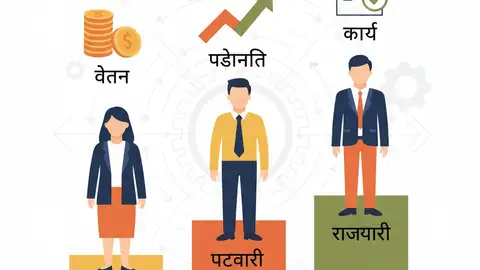
लेखपाल vs पटवारी vs राजस्व निरीक्षक 2026: वेतन, कार्य और पदोन्नति की तुलना

पीडब्ल्यूबीडी उम्मीदवारों के लिए सरकारी नौकरी 2026: वास्तविक अवसर और तैयारी
Explore Topics
Perfect Your Resume
Use our AI-powered Resume Builder to create ATS-optimized resumes.
AI Resume Builder