
Recruitment guide
Supreme Court JCA 2026: Eligibility, Salary, Selection — Explained
The Supreme Court Junior Court Assistant (JCA) 2026 offers a prestigious career opportunity. This comprehensive guide covers eligibility, typing test details, salary structure, and the complete selection process for aspiring candidates.

The Supreme Court of India offers a prestigious career opportunity through its Junior Court Assistant (JCA) recruitment. This role is a gateway to working within the apex judicial body of the country, demanding precision and dedication. For 2026, aspirants can anticipate a significant number of vacancies, making it a highly sought-after position for graduates seeking a stable and respectable government job.
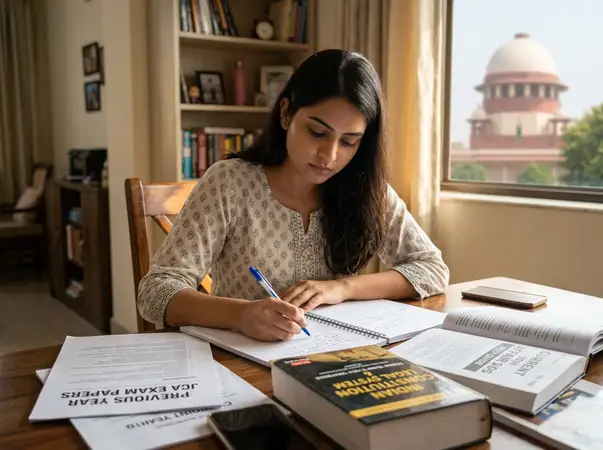
Quick Overview: Supreme Court JCA 2026
- Expected Vacancies: Approximately 200-250 (based on previous recruitment cycles)
- Application Period: Expected August - September 2026 (exact dates to be announced)
- Eligibility: Bachelor's Degree + 35 WPM English Typing Speed
- Salary: Pay Level 6 (Basic Pay ₹35,400 - ₹1,12,400) + Allowances
- Selection Process: Written Test, Typing Test, Descriptive Test, Interview
- Official Website: main.sci.gov.in/recruitment
What is the Supreme Court Junior Court Assistant (JCA) Post?
The Junior Court Assistant (JCA) is a Group 'B' non-gazetted post within the Supreme Court of India. JCAs perform various administrative, secretarial, and clerical duties essential for the smooth functioning of the Court. Their responsibilities include maintaining court records, assisting judges and senior officials, handling correspondence, and performing data entry tasks. This role provides a unique opportunity to contribute directly to the Indian judicial system.
Supreme Court JCA 2026: Expected Vacancies and Important Dates
While the official notification for 2026 is awaited, previous recruitment drives indicate a consistent demand for Junior Court Assistants. Based on historical data, aspirants can expect around 200 to 250 vacancies for the 2026 cycle. This number offers a competitive yet achievable target for dedicated candidates.

The application process typically spans a few weeks, followed by examination stages. The table below provides estimated dates for the Supreme Court JCA 2026 recruitment, based on past trends. Candidates should regularly check the official Supreme Court website for precise announcements.
| Event | Expected Date (2026) |
|---|---|
| Official Notification Release | July/August 2026 |
| Online Application Start Date | August 2026 |
| Online Application Last Date | September 2026 |
| Admit Card Release (Written Test) | October 2026 |
| Written Examination Date | November 2026 |
| Written Exam Result | December 2026 |
| Typing Test & Descriptive Test | January 2027 |
| Interview | February 2027 |
| Final Result | March 2027 |
Supreme Court JCA 2026 Eligibility Criteria: Can You Apply?
Meeting the eligibility criteria is the first step towards securing a JCA position. Candidates must satisfy specific educational, age, and typing proficiency requirements to be considered for the role. These conditions ensure that selected individuals possess the foundational skills necessary for the job.
Educational Qualification
- Bachelor's Degree: Candidates must hold a Bachelor's Degree from a recognized university. There is no specific stream requirement; any graduate can apply.
- Typing Speed: A minimum speed of 35 words per minute (WPM) in English typing on a computer is mandatory. This speed is calculated on the basis of 10-minute typing test with 10% mistakes permissible.
- Computer Knowledge: A working knowledge of computer operations is essential. This includes familiarity with MS Word, Excel, PowerPoint, and the internet.
Age Limit
The age limit for Supreme Court JCA is typically calculated as of a specific cut-off date, usually the last date of application. The general age range is 18 to 30 years, with relaxations for reserved categories as per Government of India norms.
| Category | Age Limit (as of 1st September 2026, expected) | Age Relaxation |
|---|---|---|
| General (UR) | 18 - 30 years | N/A |
| Other Backward Classes (OBC) | 18 - 33 years | 3 years |
| Scheduled Castes (SC) | 18 - 35 years | 5 years |
| Scheduled Tribes (ST) | 18 - 35 years | 5 years |
| Persons with Benchmark Disabilities (PwBD) | Up to 40 years | 10 years |
| Ex-Servicemen | As per Govt. rules | Period of military service + 3 years |
Nationality
Applicants must be citizens of India.
Supreme Court JCA Selection Process 2026: Step-by-Step Guide
The selection process for the Supreme Court JCA is rigorous, comprising multiple stages designed to assess a candidate's aptitude, skills, and personality. Each stage is crucial, and candidates must qualify in one to proceed to the next.
- Written Examination (Objective Type): This is the initial screening stage, testing general knowledge, English language proficiency, aptitude, and computer awareness.
- Typing Test (English): Candidates who clear the written exam proceed to this stage. It assesses typing speed and accuracy on a computer.
- Descriptive Test (English): This stage evaluates writing skills, including essay writing, precis writing, and comprehension.
- Interview: Shortlisted candidates from the previous stages face an interview to assess their communication skills, general awareness, and suitability for the role.
- Document Verification: Before final selection, all original documents related to educational qualifications, age, category, and other claims are verified.
- Medical Examination: Finally, selected candidates undergo a medical examination to ensure they are physically fit for the position.
Supreme Court JCA Exam Pattern & Syllabus 2026
Understanding the exam pattern and syllabus is fundamental for effective preparation. The JCA examination combines objective and descriptive tests, along with a practical typing test.
Written Examination Pattern
The objective type written test is usually conducted online. It consists of multiple-choice questions across four sections. There is a negative marking of 0.25 marks for each incorrect answer.
| Subject | Number of Questions | Maximum Marks | Duration |
|---|---|---|---|
| General English | 50 | 50 | 2 Hours |
| General Aptitude | 25 | 25 | |
| General Knowledge | 25 | 25 | |
| Computer Knowledge | 25 | 25 | |
| Total | 125 | 125 |
Written Examination Syllabus
- General English: Grammar (parts of speech, tenses, active/passive voice, direct/indirect speech), Vocabulary (synonyms, antonyms, idioms & phrases), Sentence Rearrangement, Cloze Test, Reading Comprehension.
- General Aptitude: Number Series, Coding-Decoding, Analogies, Syllogism, Blood Relations, Directions, Puzzles, Data Interpretation, Arithmetic (Percentage, Profit & Loss, Time & Work, Speed, Distance & Time, Simple & Compound Interest).
- General Knowledge: Indian History, Geography, Polity, Economy, Science (Physics, Chemistry, Biology), Current Affairs (national & international events, awards, sports, books & authors), Static GK (important dates, organizations, capitals & currencies).
- Computer Knowledge: Basics of Computers, MS Office (Word, Excel, PowerPoint), Internet & E-mail, Operating Systems, Computer Networks, Keyboard Shortcuts.
Typing Test Details
The typing test is conducted on a computer for 10 minutes. Candidates must achieve a minimum speed of 35 WPM in English. Accuracy is equally important; typically, up to 10% mistakes are permissible. Exceeding this error limit can lead to disqualification, even if the speed criterion is met. Practice with a reliable typing tutor software is crucial.
Descriptive Test Details
This test assesses a candidate's written communication skills in English. It generally includes:
- Essay Writing: Candidates are given a topic to write an essay, testing their ability to articulate thoughts coherently and grammatically.
- Precis Writing: Summarizing a given passage into a shorter, concise version while retaining its core meaning.
- Reading Comprehension: Answering questions based on a provided passage, demonstrating understanding and analytical skills.
Supreme Court JCA Salary Structure 2026: What to Expect?
The Supreme Court Junior Court Assistant post offers an attractive salary package, making it a desirable government job. The salary is based on the 7th Pay Commission recommendations, falling under Pay Level 6. This includes a robust basic pay along with various allowances.
Salary Breakdown
The initial basic pay for a JCA is ₹35,400. Along with this, employees receive Dearness Allowance (DA), House Rent Allowance (HRA), Transport Allowance (TA), and other special allowances as per government rules. The gross salary is significantly higher, and the in-hand salary is competitive.
| Component | Amount (Approximate, per month) |
|---|---|
| Pay Level | 6 |
| Basic Pay | ₹35,400 |
| Dearness Allowance (DA) | ~₹16,000 (at 46%) |
| House Rent Allowance (HRA) | ~₹9,558 (for X cities, 27%) |
| Transport Allowance (TA) | ~₹4,968 |
| Gross Salary | ~₹65,926 |
| Deductions (NPS, CGHS, etc.) | ~₹5,000 - ₹7,000 |
| Net In-hand Salary | ~₹58,000 - ₹61,000 |
Note: DA, HRA, and TA rates are subject to change based on government revisions and city classification. The figures provided are illustrative for 2026 based on current rates.
How to Apply for Supreme Court JCA 2026?
The application process for the Supreme Court JCA position is entirely online. Candidates must follow a structured procedure to ensure their application is successfully submitted. Detailed instructions will be provided in the official notification.
- Visit the Official Website: Go to the recruitment section of the Supreme Court of India's official website: main.sci.gov.in/recruitment.
- New Registration: Click on the link for 'Supreme Court Junior Court Assistant Recruitment 2026' and complete the basic registration with personal details and contact information.
- Fill Application Form: Log in using the generated registration ID and password. Fill in all required details accurately, including educational qualifications, age, and category.
- Upload Documents: Upload scanned copies of your photograph and signature as per the specified dimensions and format. Ensure the documents are clear and legible.
- Pay Application Fee: Pay the application fee online using debit card, credit card, or net banking. The fee amount will be specified in the official notification (e.g., ₹500 for General/OBC, ₹250 for SC/ST/PwBD/Ex-Servicemen).
- Review and Submit: Carefully review all entered information before final submission. No changes can be made after submission.
- Print Confirmation: Download and print the confirmation page for your records.
Supreme Court JCA Preparation Strategy 2026: Your Roadmap to Success
A well-planned strategy is crucial for cracking the Supreme Court JCA exam. Given the multi-stage selection process, preparation must be comprehensive, covering written, typing, and descriptive tests, as well as the interview.
- Understand the Syllabus and Exam Pattern: Begin by thoroughly analyzing the detailed syllabus and the weightage of each section. This helps in prioritizing topics.
- Time Management: Create a realistic study schedule. Allocate sufficient time for each subject, focusing more on your weaker areas without neglecting strengths. Consistent daily study is more effective than sporadic long sessions.
- General English: Strengthen your grammar rules, expand vocabulary daily (synonyms, antonyms, idioms), and practice reading comprehension passages. Regular practice of cloze tests and sentence rearrangement improves accuracy.
- General Aptitude: Master fundamental arithmetic concepts. Practice a wide variety of questions from reasoning (puzzles, seating arrangements, coding-decoding) and quantitative aptitude (percentage, profit & loss, time & work). Focus on understanding concepts rather than rote learning.
- General Knowledge: Stay updated with current affairs by reading newspapers and magazines daily. For static GK, cover Indian history, geography, polity, and basic science. Make concise notes for quick revision.
- Computer Knowledge: Familiarize yourself with basic computer concepts, MS Office suite (Word, Excel, PowerPoint), and internet fundamentals. There are many online tutorials and basic computer books available.
- Typing Practice: Start practicing typing early and consistently. Aim for accuracy first, then speed. Use reliable typing software or online platforms to track progress. Focus on touch typing and maintaining a comfortable posture.
- Descriptive Test Preparation: Practice writing essays on current and general topics. Regularly attempt precis writing and comprehension passages. Focus on clear expression, logical flow, and correct grammar.
- Mock Tests and Previous Year Papers: Regularly attempt full-length mock tests to simulate exam conditions. Analyze your performance to identify weak areas. Solving previous year's papers helps understand the exam's difficulty level and question patterns. /sarkari-exam-previous-year-papers" target="_blank">Access previous year papers on TrueJobs to boost your preparation.
- Interview Preparation: Work on your communication skills, general awareness, and confidence. Be prepared to discuss your educational background, reasons for joining the Supreme Court, and current affairs.
- Health and Mindset: Maintain a healthy lifestyle with proper sleep and nutrition. Manage stress effectively. A positive mindset is crucial throughout your preparation journey.
Frequently Asked Questions (FAQs)
Q1: Is there negative marking in the Supreme Court JCA written exam?
Yes, there is negative marking in the objective type written examination. Typically, 0.25 marks are deducted for each incorrect answer. Candidates should attempt questions carefully to avoid losing marks.
Q2: What is the required typing speed for the Supreme Court JCA post?
Candidates must achieve a minimum typing speed of 35 words per minute (WPM) in English on a computer. This speed is assessed in a 10-minute test, with a permissible error margin usually up to 10%.
Q3: Can a final year student apply for Supreme Court JCA?
Generally, only candidates who have already obtained their Bachelor's Degree on or before the specified cut-off date mentioned in the official notification are eligible to apply. Final year students whose results are awaited are usually not eligible.
Q4: What is the career progression for a Junior Court Assistant in the Supreme Court?
A Junior Court Assistant has good career growth prospects within the Supreme Court. Through departmental examinations and seniority, they can be promoted to higher posts like Senior Court Assistant, Assistant Registrar, and even Deputy Registrar over time.
Q5: Is the Supreme Court JCA a good government job?
Yes, the Supreme Court JCA is considered an excellent government job. It offers a respectable salary, job security, a prestigious work environment, and opportunities for career advancement, along with various government benefits and allowances.
The Supreme Court Junior Court Assistant position is a highly respected and rewarding career path for those aspiring to work in the judicial system. With diligent preparation and a clear understanding of the selection process, you can achieve your goal. Start your preparation today by focusing on each stage of the examination. /career-guidance-government-jobs" target="_blank">Explore more government job opportunities and career guidance on TrueJobs to broaden your horizons.
अभी TrueJobs पर अपना प्रोफ़ाइल बनाएं और Supreme Court JCA 2026 की हर अपडेट सीधे अपने फ़ोन पर पाएं। सफलता की राह पर पहला कदम आज ही बढ़ाएं!
Related Resources
- Top 10 Government Jobs After Graduation
- How to Prepare for Typing Tests in Government Jobs
- Latest Sarkari Result
Checks to complete before you apply
The Supreme Court Junior Court Assistant (JCA) 2026 presents a golden opportunity for graduates seeking a stable government career. With a clear understanding of eligibility, selection process, and salary, aspirants can strategize effectively. Start your preparation now to secure a prestigious role in India's apex judicial body.
Related Government Job Resources
Continue with active job hubs and related government job pages on TrueJobs.
Tools for this recruitment topic
Use only the tools relevant to the dates, eligibility or documents discussed above.
TrueJobs Editorial Team
TrueJobs editorial desk
This article is prepared from the sources referenced in the guide and reviewed for clarity, links and dated information. Read our editorial and corrections policy.
Continue This Topic
Follow the closest earlier and newer coverage so older archive posts keep real contextual crawl paths.
सहायक अभियोजन अधिकारी (APO) 2026: पात्रता, वेतन, कार्यक्षेत्र और करियर
सहायक अभियोजन अधिकारी (APO) 2026 विधि स्नातकों के लिए एक प्रतिष्ठित सरकारी नौकरी है। यहां पात्रता, वेतन, कार्य प्रोफ़ाइल और तैयारी की पूरी जानकारी दी गई है।
CSIR CASE SO/ASO 2026 भर्ती: योग्यता, वेतन, जॉब प्रोफाइल, आवेदन प्रक्रिया
CSIR CASE SO/ASO 2026 भर्ती में 400-500 से अधिक पद आने की उम्मीद है, जो सरकारी नौकरी के इच्छुक स्नातकों के लिए एक बड़ा अवसर है। यहां आपको योग्यता, वेतन, जॉब प्रोफाइल और आवेदन प्रक्रिया की पूरी जानकारी मिलेगी।
Read Next
Government Jobs for Ex-Agniveers in 2026: Priority, Reservations & Career Paths

Defence Accounts Department Recruitment 2026: Clerk, Auditor, MTS & More

Quiet Careers: Top Government Jobs with Minimal Public Dealing (2026)

RRB NTPC Senior Clerk cum Typist 2026: Salary, Typing Rules & Job Profile
Explore Topics
Perfect Your Resume
Use our AI-powered Resume Builder to create ATS-optimized resumes.
AI Resume Builder