
Exam update
SSC JE Result 2026: Paper 1 Scorecard, Cut Off — Explained
Awaiting the SSC JE 2026 Paper 1 results? Our complete guide details how to check your scorecard, understand cut-off marks, and prepare for Document Verification (DV).

The Staff Selection Commission (SSC) Junior Engineer (JE) examination is a highly sought-after opportunity for engineering graduates aspiring to secure a prestigious government job in various departments and ministries. As candidates eagerly await the SSC JE 2026 Paper 1 results, understanding the subsequent stages—from checking your scorecard and comprehending the cut-off marks to preparing for the crucial Document Verification (DV) process—becomes paramount. This comprehensive guide from TrueJobs.co.in aims to equip you with all the necessary information, outlining the expected procedures and requirements based on past examination cycles.
While specific dates and figures for 2026 are yet to be announced, this article will walk you through what to anticipate and how to prepare effectively for each stage of the SSC JE selection process.
Understanding the SSC JE Examination Process
The SSC JE examination is a rigorous multi-stage process designed to select competent Junior Engineers for various Central Government departments such as CPWD, BRO, MES, Farakka Barrage Project, and others. The selection typically involves two main examination papers followed by a critical Document Verification stage. Understanding each step is crucial for aspirants.
- Paper 1 (Computer-Based Examination): This is the initial screening stage, consisting of objective-type questions covering General Intelligence & Reasoning, General Awareness, and General Engineering (Civil/Structural, Electrical, or Mechanical). Candidates must qualify in Paper 1 to be eligible for Paper 2.
- Paper 2 (Descriptive Examination): Qualified candidates from Paper 1 proceed to Paper 2, which is a conventional descriptive paper testing their engineering knowledge in their chosen discipline. The scores from both Paper 1 and Paper 2 are combined to form the final merit list.
- Document Verification (DV): This is the final and non-negotiable stage where candidates whose combined scores meet the cut-off for final selection are called to verify their educational qualifications, age, category, and other relevant details against original documents.
The Paper 1 result is the first significant milestone, determining who progresses to the next stage. It's not just about qualifying; a good score in Paper 1 significantly boosts your chances in the overall merit list.

How to Check Your SSC JE Paper 1 Result 2026
Once the Staff Selection Commission declares the SSC JE Paper 1 result for 2026, candidates will be able to access it through the official SSC website. The result is typically released in a PDF format, containing the roll numbers and names of candidates provisionally shortlisted for Paper 2. Here's a step-by-step guide on how to check your result:
- Visit the Official SSC Website: Navigate to the official website of the Staff Selection Commission (ssc.nic.in).
- Locate the 'Result' Section: On the homepage, you will usually find a 'Result' tab or section. Click on it.
- Select the 'JE' Tab: Within the 'Result' section, there are various examination categories. Look for and click on the 'JE' (Junior Engineer) tab.
- Find the Relevant Result Link: Search for the link titled "Junior Engineer (Civil, Mechanical, Electrical and Quantity Surveying & Contracts) Examination, 2026 – Declaration of Result of Paper-I for appearing in Paper-II". The exact wording may vary slightly.
- Download the Result PDF: Click on the 'Click Here' link next to the result notification to download the PDF file.
- Search for Your Roll Number: Open the downloaded PDF. It will contain a list of roll numbers of all qualified candidates. Use the search function (Ctrl+F on Windows/Linux or Command+F on Mac) to quickly find your roll number.
- Verify Your Details: If your roll number is present, congratulations! You have provisionally qualified for SSC JE Paper 2.
It's important to note that the result PDF only indicates qualification. Detailed scores (scorecard) are usually released at a later stage. Keep an eye on the official website for all updates. For general government exam results, you can also check /sarkari-result.
Decoding Your SSC JE Paper 1 Scorecard 2026
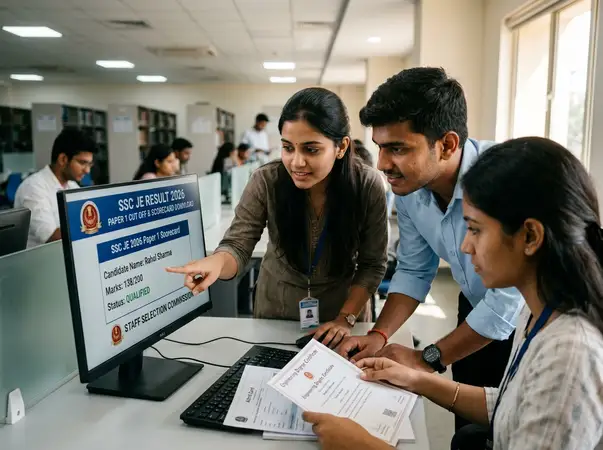
While the initial result declaration provides a list of qualified candidates, the SSC JE Paper 1 scorecard offers a detailed breakdown of your performance. This scorecard is usually released a few days or weeks after the result PDF, allowing candidates to view their raw scores, normalized scores, and sectional marks. Understanding your scorecard is crucial for self-assessment and future preparation.
What to Expect in Your Scorecard:
- Candidate Details: Your name, roll number, registration number, and examination name.
- Raw Score: The actual marks you obtained in Paper 1 before any normalization.
- Normalized Score: Due to the examination being conducted in multiple shifts with varying difficulty levels, SSC uses a normalization formula to ensure fairness. Your normalized score is the adjusted score, which is ultimately used for preparing the merit list. This is the most critical score to look for.
- Sectional Marks: Marks obtained in each section – General Intelligence & Reasoning, General Awareness, and General Engineering (Civil/Structural, Electrical, or Mechanical).
- Qualifying Status: A clear indication of whether you have qualified for Paper 2 based on the cut-off marks.
How to Download Your Scorecard:
To download your SSC JE Paper 1 2026 scorecard, you will typically need your login credentials (Registration Number and Password) used during the application process.
- Visit the SSC Website: Go to ssc.nic.in.
- Login to Your Account: On the homepage, find the 'Login' section. Enter your Registration Number and Password.
- Access Result/Marks Tab: After logging in, look for a tab or link that says 'Result/Marks' or 'Download Scorecard'.
- Select Examination: Choose the 'Junior Engineer (Civil, Mechanical, Electrical and Quantity Surveying & Contracts) Examination, 2026' from the dropdown menu.
- View/Download Scorecard: Your detailed scorecard will be displayed. You can then print or download it for your records.
It is highly recommended to download and save your scorecard, as it serves as an important document for future reference, especially during the Document Verification stage if required.
SSC JE Paper 1 Cut-Off Marks 2026: What to Expect
The cut-off marks are the minimum qualifying scores that candidates must achieve in Paper 1 to be shortlisted for Paper 2. These marks are crucial as they determine who moves forward in the selection process. While specific cut-offs for SSC JE 2026 Paper 1 cannot be predicted, we can discuss the factors that influence them and general trends.
Factors Influencing Cut-Off Marks:
- Number of Vacancies: A higher number of vacancies generally leads to lower cut-off marks, and vice-versa.
- Number of Candidates: A larger pool of candidates appearing for the exam can potentially increase competition and thus the cut-off.
- Difficulty Level of the Exam: If the Paper 1 examination is perceived as more difficult, the cut-off marks tend to be lower. Conversely, an easier paper might result in higher cut-offs.
- Average Performance of Candidates: The overall performance of all candidates who appeared for the exam plays a significant role.
- Normalization Process: Since the exam is conducted in multiple shifts, the normalization process adjusts scores, which can impact the final cut-off for different categories.
- Category-wise Reservation: Cut-offs are declared separately for different categories (UR, OBC, SC, ST, EWS, PwBD), adhering to government reservation policies.
Category-wise Cut-Offs:
SSC releases separate cut-off lists for each engineering discipline (Civil/Structural, Electrical, Mechanical) and for each category:
- Unreserved (UR): For general category candidates.
- Other Backward Classes (OBC): For candidates belonging to OBC (Non-Creamy Layer).
- Scheduled Caste (SC): For SC candidates.
- Scheduled Tribe (ST): For ST candidates.
- Economically Weaker Section (EWS): For candidates from the EWS category.
- Persons with Benchmark Disabilities (PwBD): Separate cut-offs for various sub-categories of PwBD.
Candidates must meet the cut-off for their respective category and discipline to qualify for Paper 2. It is advisable for aspirants to review previous years' cut-off trends to get a general idea of the competitive landscape, but always remember that each year's cut-off is unique based on the factors mentioned above.
The Crucial Stage: SSC JE Document Verification (DV) Guide
Document Verification (DV) is arguably the most critical stage of the SSC JE selection process. It is where the authenticity of all claims made by a candidate in their application form is meticulously checked against original documents. Only candidates who successfully clear both Paper 1 and Paper 2 and whose combined scores fall within the final merit list are called for DV. Failure to present the required documents in the correct format can lead to disqualification, irrespective of your exam performance.
Purpose of Document Verification:
- To verify the candidate's identity.
- To confirm educational qualifications (diploma/degree, mark sheets).
- To ascertain age (Date of Birth proof).
- To validate category claims (SC/ST/OBC/EWS/PwBD certificates).
- To check any other specific eligibility criteria mentioned in the official notification.
Essential Documents Required for SSC JE DV:
Candidates must carry both original documents and self-attested photocopies (typically two sets) of each document. It is highly recommended to arrange them systematically beforehand.
- SSC JE Application Form Printout: A copy of the online application form submitted for the SSC JE 2026 examination.
- Admit Cards: Original admit cards for both Paper 1 and Paper 2.
- Educational Qualification Certificates:
- Matriculation/10th Class Certificate: For Date of Birth proof.
- Intermediate/12th Class Certificate (if applicable): Marksheets and passing certificates.
- Diploma/Degree Certificates: All year/semester mark sheets and the final provisional/original degree/diploma certificate in Civil, Electrical, or Mechanical Engineering.
- Proof of date of acquiring essential qualification: This date should be on or before the crucial cut-off date mentioned in the SSC JE 2026 notification.
- Category Certificates (if applicable):
- OBC (Non-Creamy Layer) Certificate: Must be issued by the competent authority in the prescribed format, not older than three years from the closing date of application.
- SC/ST Certificate: Issued by the competent authority in the prescribed format.
- EWS Certificate: Issued by the competent authority in the prescribed format, valid for the financial year relevant to the application closing date.
- PwBD Certificate: Issued by the competent authority in the prescribed format, indicating the type and percentage of disability.
- No Objection Certificate (NOC): If you are already employed in a government department, PSU, or autonomous body, you must produce an NOC from your current employer.
- Photo Identity Proof: Original and photocopy of any valid photo ID such as Aadhar Card, PAN Card, Voter ID, Passport, Driving License.
- Passport-sized Photographs: Typically 2-4 recent passport-sized photographs (same as uploaded in the application form).
- Domicile Certificate (if required): For specific posts or regions where domicile is a criterion.
- Any Other Relevant Documents: As specified in the official SSC JE 2026 notification.
Important Tips for DV:
- Read Notification Carefully: Always refer to the official SSC JE 2026 notification for the exact list of documents and their prescribed formats.
- Organize Documents: Keep all original documents in a clear file and two sets of self-attested photocopies separately.
- Check Validity: Ensure all certificates, especially category certificates, are valid and issued by the competent authority within the stipulated dates.
- Name Consistency: Ensure your name and your parents' names are consistent across all documents (Matriculation certificate, educational degrees, ID proof, category certificate). Any discrepancy might require an affidavit.
- Be Punctual: Arrive at the DV center well in advance of your scheduled time.
- Stay Calm: The DV process can be stressful, but remain calm and cooperative with the verifying officials.
Remember, the Document Verification stage is not just a formality; it's a crucial step that can make or break your selection. Thorough preparation is key.
Preparing for SSC JE Paper 2 and Beyond
Qualifying Paper 1 is a significant achievement, but the journey to becoming an SSC Junior Engineer doesn't end there. The next crucial step is Paper 2, followed by the final selection process.
SSC JE Paper 2 (Descriptive Examination):
Paper 2 is a conventional descriptive-type paper, carrying 300 marks, and focuses entirely on the General Engineering subject (Civil/Structural, Electrical, or Mechanical) chosen by the candidate. This paper assesses your in-depth knowledge, problem-solving abilities, and clarity of expression. Candidates shortlisted after Paper 1 must immediately shift their focus to preparing for Paper 2.
- Syllabus Mastery: Thoroughly revise the syllabus for your engineering discipline.
- Practice Writing: Since it's a descriptive paper, regular practice of writing answers, solving numerical problems, and drawing diagrams is essential.
- Previous Year Papers: Solve as many previous year's Paper 2 questions as possible to understand the pattern and type of questions asked.
- Time Management: Practice completing the paper within the stipulated time.
For comprehensive study materials and preparation strategies, you can explore resources on /exam-preparation.
Final Selection and Allocation:
The final merit list for SSC JE is prepared based on the combined scores of Paper 1 and Paper 2. Candidates who qualify in both papers and successfully clear the Document Verification stage are then considered for final selection. The allocation of departments/organizations is done based on the candidate's rank in the final merit list and their preferences, subject to the availability of vacancies.
After DV, a medical examination might be required by some departments, and then the final appointment letters are issued. The entire process, from application to final joining, can take a significant amount of time, so patience and continuous follow-up on official updates are essential.
How to follow this exam update
The SSC JE 2026 examination is a multi-faceted selection process, and successfully navigating each stage is key to securing your dream government job. From diligently checking your Paper 1 result and understanding your detailed scorecard to meticulously preparing for the cut-off marks and, most importantly, ensuring all your documents are in perfect
Frequently Asked Questions (FAQs) about SSC JE Result 2026
When will the SSC JE Result 2026 for Paper 1 be declared?
The Staff Selection Commission has not yet announced the official date. Candidates should regularly check the official SSC website and TrueJobs.co.in for the latest updates.
What details are mentioned on the SSC JE Scorecard?
The scorecard typically includes the candidate's name, roll number, category, raw score, normalized score, and qualification status for Paper 2.
How are the SSC JE cut-off marks determined?
The cut-off is determined by the number of vacancies, total candidates, exam difficulty, and reservation policy.
Related Resources
- Latest SSC Job Notifications
- General Document Verification Guide
- SSC JE Syllabus and Exam Pattern
Reader questions: SSC JE
When will the SSC JE Result 2026 for Paper 1 be declared?
The Staff Selection Commission has not yet announced the official date. Candidates should regularly check the official SSC website and TrueJobs.co.in for the latest updates.
What details are mentioned on the SSC JE Scorecard?
The scorecard typically includes the candidate's name, roll number, category, raw score, normalized score, and qualification status for Paper 2.
How are the SSC JE cut-off marks determined?
The cut-off is determined by the number of vacancies, total candidates, exam difficulty, and reservation policy.
Related Government Job Resources
Continue with active job hubs and related government job pages on TrueJobs.
Tools for this recruitment topic
Use only the tools relevant to the dates, eligibility or documents discussed above.
TrueJobs Editorial Team
TrueJobs editorial desk
This article is prepared from the sources referenced in the guide and reviewed for clarity, links and dated information. Read our editorial and corrections policy.
Continue This Topic
Follow the closest earlier and newer coverage so older archive posts keep real contextual crawl paths.
SSC Selection Post Phase XIV Admit Card 2026: Region Links & Status
Get ready for the SSC Selection Post Phase XIV 2026 exam. This guide provides direct links to download your admit card, check your application status, and review essential exam day instructions for all SSC regions.
SSC Stenographer Result 2026: Cut Off, Skill Test & Final Selection Guide
Your complete guide to the SSC Stenographer Result 2026. Understand the cut-off, skill test requirements, and final selection process to secure your government job.
Read Next

SSC Selection Post Phase XIV Admit Card 2026: Region Links & Status

SSC Stenographer Result 2026: Cut Off, Skill Test & Final Selection Guide

SSC Selection Post Result 2026: Cut Off, Scorecard & Final Merit
SSC Stenographer Admit Card 2026: Skill Test Rules, Region Links & Exam Instructions
Explore Topics
Perfect Your Resume
Use our AI-powered Resume Builder to create ATS-optimized resumes.
AI Resume Builder