
Recruitment guide
SSC JE 2026 Notification: Eligibility, Exam & Prep — Explained
The SSC JE 2026 notification is highly anticipated by engineers. This guide covers eligibility, exam pattern, syllabus, and preparation to help you succeed.
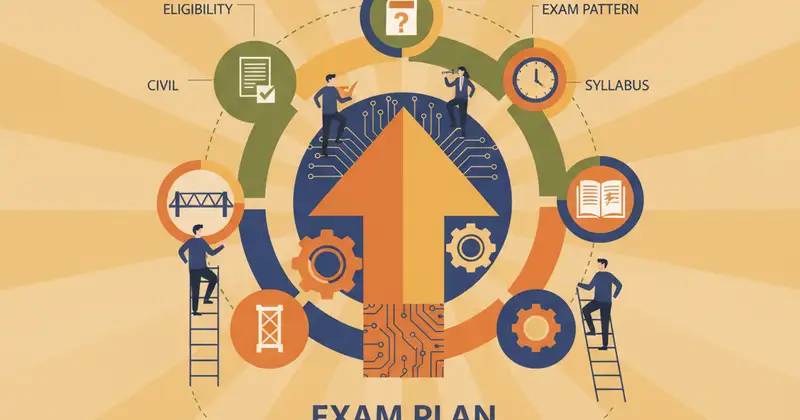
Aspiring engineers seeking a stable and respected career in government departments often set their sights on the Staff Selection Commission Junior Engineer (SSC JE) examination. The SSC JE 2026 notification is highly anticipated, offering a golden opportunity for Civil, Mechanical, and Electrical engineering graduates and diploma holders to secure prestigious positions across various Central Government Ministries and Departments. This guide covers essential eligibility criteria, exam pattern, syllabus, and a robust preparation strategy to help you succeed in the SSC JE 2026 exam.
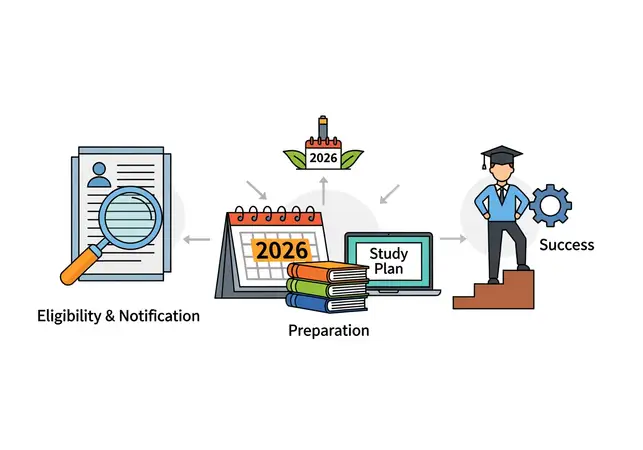
Quick Overview: SSC JE 2026
- Exam Name: Staff Selection Commission Junior Engineer (SSC JE)
- Conducting Body: Staff Selection Commission (SSC)
- Posts: Junior Engineer (Civil, Mechanical, Electrical, Quantity Surveying & Contracts)
- Vacancies: To be announced (Thousands expected based on previous years' trends)
- Notification Release: Expected in early 2026 (typically January-March)
- Application Mode: Online
- Salary: Pay Level-6 (₹35,400 - ₹1,12,400)
- Eligibility: Bachelor's Degree or Diploma in Engineering in relevant discipline
- Official Website: ssc.gov.in
What is the SSC JE Exam, and why is it important for engineers?
The Staff Selection Commission (SSC) conducts the Junior Engineer (JE) examination annually to recruit qualified engineers into various Central Government Ministries, Departments, and Organizations. These include prominent bodies like the Central Public Works Department (CPWD), Border Roads Organization (BRO), Military Engineering Services (MES), Central Water Commission (CWC), and Farakka Barrage Project.
Securing an SSC JE position offers a stable central government job with attractive salary, benefits, and significant opportunities for career growth. Junior Engineers play a crucial role in planning, designing, and executing critical infrastructure projects across the nation, making it a highly respected and impactful career path for civil, mechanical, and electrical engineering professionals.
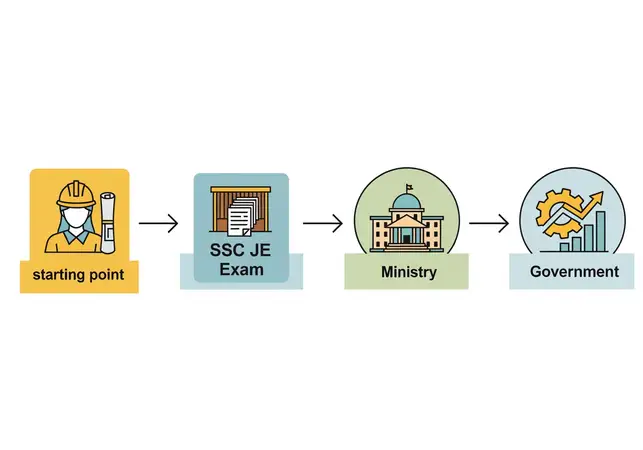
SSC JE 2026 Eligibility Criteria: Do you qualify?
To be eligible for the SSC JE 2026 examination, candidates must meet specific nationality, age, and educational qualification requirements. Understanding these criteria is essential before applying.
Nationality
- A citizen of India, or
- A subject of Nepal, or
- A subject of Bhutan, or
- A Tibetan refugee who came over to India before 1st January 1962 with the intention of permanently settling in India, or
- A person of Indian origin who has migrated from Pakistan, Myanmar, Sri Lanka, East African countries of Kenya, Uganda, the United Republic of Tanzania, Zambia, Malawi, Zaire, Ethiopia, and Vietnam with the intention of permanently settling in India.
Age Limit
The age limits for SSC JE posts generally range from 18 to 30 years for most departments. However, specific departments like CPWD, CWC, and Farakka Barrage Project may have an upper age limit of 32 years. The crucial date for age calculation will be specified in the official SSC JE 2026 notification, typically January 1st of the examination year.
Age Relaxation Categories
The government provides age relaxation for various reserved categories as per rules:
| Category | Age Relaxation |
|---|---|
| Scheduled Caste (SC) / Scheduled Tribe (ST) | 5 years |
| Other Backward Classes (OBC) | 3 years |
| Persons with Benchmark Disabilities (PwBD) | 10 years (UR), 13 years (OBC), 15 years (SC/ST) |
| Ex-Servicemen (ESM) | 3 years after deduction of the military service rendered from the actual age as on the closing date |
| Defence Personnel disabled in operation during hostilities with any foreign country or in a disturbed area and released as a consequence thereof | 3 years (UR), 6 years (OBC), 8 years (SC/ST) |
Educational Qualification
Candidates must possess a Bachelor's Degree (B.E./B.Tech) or a Diploma in the relevant engineering discipline from a recognized University or Institution. Specific requirements vary by post and department:
- Junior Engineer (Civil): Degree or Diploma in Civil Engineering. Some posts may require 2 years of experience for diploma holders.
- Junior Engineer (Mechanical): Degree or Diploma in Mechanical Engineering. Some posts may require 2 years of experience for diploma holders.
- Junior Engineer (Electrical): Degree or Diploma in Electrical Engineering. Some posts may require 2 years of experience for diploma holders.
- Junior Engineer (Quantity Surveying & Contracts): 3-year Diploma in Civil Engineering or Quantity Surveying and 2 years of experience.
Always refer to the official SSC JE 2026 notification for the exact post-wise educational qualifications and experience requirements.
SSC JE Exam Pattern 2026: Understanding Paper-I and Paper-II
The SSC JE selection process involves two stages: Paper-I (Computer Based Examination) and Paper-II (Descriptive Type). Both papers are crucial for final selection.
| Paper | Subject | No. of Questions | Max Marks | Duration | Negative Marking |
|---|---|---|---|---|---|
| Paper-I (CBT) | General Intelligence & Reasoning | 50 | 50 | 2 Hours | 0.25 marks for each wrong answer |
| General Awareness | 50 | 50 | |||
| General Engineering (Civil/Structural OR Electrical OR Mechanical) | 100 | 100 | |||
| Total (Paper-I) | 200 | 200 | |||
| Paper-II (Descriptive) | General Engineering (Civil/Structural OR Electrical OR Mechanical) | 6 questions (attempt 5) | 300 | 2 Hours | No negative marking |
Key Points on Exam Pattern:
- Paper-I: Objective type, multiple-choice questions. It serves as a screening test.
- Paper-II: Conventional (descriptive) type paper, testing in-depth technical knowledge and problem-solving abilities.
- Candidates must qualify in both papers to be considered for final merit.
- The choice of engineering discipline (Civil, Mechanical, or Electrical) made during the application process will determine the technical section in both Paper-I and Paper-II.
SSC JE Syllabus 2026: What to study for Civil, Mechanical, and Electrical Engineering
A thorough understanding of the syllabus is critical for effective preparation. The SSC JE syllabus is divided into non-technical (Paper-I) and technical (Paper-I & Paper-II) sections.
Paper-I Syllabus
- General Intelligence & Reasoning: This section assesses your analytical abilities. Topics include Analogies, Similarities, Differences, Space Visualization, Problem Solving, Analysis, Judgment, Decision Making, Visual Memory, Discrimination, Observation, Relationship Concepts, Arithmetical Reasoning, Verbal and Figure Classification, Arithmetical Number Series, Non-Verbal Series, Coding-Decoding, Statement-Conclusion, Syllogistic Reasoning.
- General Awareness: This section tests your knowledge of current events and general knowledge. Topics cover India and its neighboring countries, History, Culture, Geography, Economic Scene, General Polity, Indian Constitution, and Scientific Research. Focus on recent developments and static GK.
- General Engineering (Common for all branches in Paper-I): This part covers fundamental concepts of your chosen engineering discipline.
Paper-II Syllabus (Branch-specific)
Civil Engineering
- Building Materials: Physical and Chemical properties, classification, standard tests, uses and manufacture/quarrying of materials like building stones, silicate based materials, cement (Portland, High alumina, rapid hardening, etc.), asbestos products, timber, ferrous and non-ferrous metals, paints & varnishes.
- Estimating, Costing and Valuation: Estimate, analysis of rates, methods and unit of measurement, items of work, valuation.
- Surveying: Principles, measurement of distances and directions, chain surveying, compass surveying, traversing, plane table surveying, levelling, contouring, theodolite surveying, curves, advanced surveying equipment.
- Soil Mechanics: Origin of soil, phase diagram, definitions, classification, permeability, effective stress, consolidation, shear strength, compaction.
- Hydraulics: Fluid properties, fluid statics, fluid kinematics, fluid dynamics, flow through pipes, open channel flow, hydraulic machines.
- Irrigation Engineering: Water requirements, canals, dams, weirs, barrages, cross drainage works, water logging, river training.
- Transportation Engineering: Highways (planning, alignment, geometric design, pavement design), railways (permanent way, points and crossings, signals), airports.
- Environmental Engineering: Water supply, wastewater engineering, solid waste management, air and noise pollution.
- Structural Engineering: Theory of Structures (analysis of beams, trusses, frames), Concrete Technology (properties, mix design), RCC Design (beams, slabs, columns, footings), Steel Design (connections, beams, columns, trusses).
Electrical Engineering
- Basic Concepts: Concepts of resistance, inductance, capacitance, various factors affecting them.
- Circuit Law: Kirchhoff's laws, Network theorems (Superposition, Thevenin, Norton, Maximum Power Transfer, Reciprocity).
- Magnetic Circuit: Concepts of flux, MMF, reluctance, different kinds of materials, electromagnetic induction.
- AC Fundamentals: Instantaneous, RMS, average values of alternating waves, R.L.C. series and parallel circuits, resonance, power factor, Q-factor.
- Measurement and Measuring Instruments: Measurement of power, energy, voltage, current, resistance, power factor. Various types of measuring instruments.
- Electrical Machines: DC machines (generators, motors), Transformers, Induction Motors (single-phase, three-phase), Synchronous Machines (generators, motors).
- Generation, Transmission and Distribution: Different types of power stations, load factor, diversity factor, demand factor, transmission and distribution systems, overhead lines, cables, fault analysis.
- Estimation and Costing: Estimation of lighting circuits, heating circuits, motors, and other electrical appliances.
- Utilization and Electrical Energy: Illumination, Electric heating, Welding, Electroplating, Electric drives.
- Basic Electronics: Diodes, Transistors, Rectifiers, Amplifiers, Oscillators.
Mechanical Engineering
- Theory of Machines and Machine Design: Simple mechanisms, velocity and acceleration diagrams, cams, gears, flywheels, governors, balancing of rotating masses, stress and strain, theories of failure, design of machine elements (joints, shafts, bearings).
- Engineering Mechanics and Strength of Materials: Equilibrium of forces, friction, work, power, energy, simple stresses & strains, principal stresses, bending moments and shear force, torsion, columns, springs, thin & thick cylinders.
- Properties of Pure Substances: p-v & P-T diagrams, work & heat transfer, First & Second Law of Thermodynamics.
- Air Standard Cycles: Carnot, Rankine, Otto, Diesel, Brayton cycles.
- Boilers, Fuels & Combustion: Classification of boilers, boiler accessories, properties of fuels, combustion calculations.
- Nozzles & Steam Turbines: Flow through nozzles, impulse & reaction turbines.
- IC Engines: Classification, performance, combustion, fuel systems, cooling & lubrication systems.
- Refrigeration & Air Conditioning: Vapour compression & absorption cycles, refrigerants, psychrometric chart, basic refrigeration & AC systems.
- Fluid Mechanics: Properties of fluids, fluid statics, kinematics, dynamics, flow through pipes.
- Hydraulic Machines: Turbines (Pelton, Francis, Kaplan), pumps (centrifugal, reciprocating).
- Production Engineering: Foundry, forming, welding, machining processes, metrology, jigs and fixtures.
How to Apply for SSC JE 2026?
The application process for SSC JE is entirely online. Follow these steps carefully to ensure a successful application:
- Visit the Official Website: Go to the Staff Selection Commission's official website: ssc.gov.in.
- One-Time Registration: If you are a new user, complete the One-Time Registration process. This involves providing basic details, contact information, and creating a login ID and password.
- Login: Use your Registration Number and Password to log in to the SSC portal.
- Find Application Link: Navigate to the "Apply" section and click on the link for the "Junior Engineer (Civil, Mechanical, Electrical, and Quantity Surveying & Contracts) Examination 2026".
- Fill Application Form: Carefully fill in all required personal, educational, and communication details. Ensure all information is accurate to avoid rejection.
- Upload Documents: Upload scanned copies of your recent passport-sized photograph and signature as per the specifications (size, format, dimensions) mentioned in the official notification.
- Pay Application Fee: Pay the requisite application fee online through various modes like BHIM UPI, Net Banking, Visa, Mastercard, Maestro RuPay Credit/Debit Cards. The application fee is ₹100 for General/OBC male candidates. Women candidates and candidates belonging to Scheduled Castes (SC), Scheduled Tribes (ST), Persons with Benchmark Disabilities (PwBD), and Ex-Servicemen (ESM) are exempted from paying the fee.
- Review and Submit: Before final submission, review your entire application form for any errors. Once satisfied, click on the "Submit" button.
- Print Confirmation: After successful submission, take a printout of your application form for future reference.
SSC JE Preparation Strategy: How to crack the exam in your first attempt?
Cracking the SSC JE exam requires a structured approach and consistent effort. Here's a preparation strategy to guide you:
- Understand the Syllabus & Exam Pattern: Begin by thoroughly analyzing the detailed syllabus for both Paper-I and Paper-II, and understand the weightage of each section.
- Create a Realistic Study Plan: Allocate dedicated time for General Intelligence & Reasoning, General Awareness, and your chosen technical subject. Ensure a balance between theory and practice.
- Strengthen Fundamentals: For technical subjects, focus on building a strong foundation of core engineering concepts. Refer to standard textbooks and your engineering notes.
- Practice Reasoning & General Awareness: These sections are scoring. Solve a variety of reasoning puzzles daily. Stay updated with current affairs by reading newspapers and monthly magazines.
- Technical Subject Mastery: Dedicate significant time to your engineering discipline. Solve numerical problems and practice descriptive answers for Paper-II.
- Solve Previous Year Papers: Work through at least the last 5-7 years of SSC JE question papers for both Paper-I and Paper-II. This familiarizes you with the exam pattern, question types, and time management.
- Regular Mock Tests: Take full-length mock tests regularly to simulate exam conditions. Analyze your performance to identify weak areas and improve speed and accuracy.
- Revision is Key: Consistently revise all subjects, especially formulas, key concepts, and important facts. Make short notes for quick revision.
- Time Management: Develop effective time management skills during practice and mock tests. Learn to allocate time wisely to each section and question.
- Stay Healthy & Positive: Maintain a healthy lifestyle, get adequate sleep, and stay positive throughout your preparation journey. For more detailed preparation tips, explore our /ssc-je-preparation-strategy">SSC JE Preparation Strategy guide.
SSC JE Salary & Career Growth: What to expect after selection?
A position as a Junior Engineer through SSC JE is a highly sought-after central government job, offering an attractive salary package and promising career progression.
Salary Structure
Junior Engineer (JE) is a Group 'B' (Non-Gazetted) post. The salary structure is based on the 7th Central Pay Commission:
- Pay Level: Pay Level-6
- Pay Scale: ₹35,400 - ₹1,12,400
- Basic Pay: ₹35,400 (starting)
- Gross Salary: The initial gross salary for an SSC JE, including Dearness Allowance (DA), House Rent Allowance (HRA), Transport Allowance (TA), and other allowances, typically ranges from ₹45,000 to ₹55,000 per month. This amount varies based on the city of posting (X, Y, or Z category cities) and prevailing allowance rates.
Additionally, JEs receive various benefits such as medical facilities, leave travel concession, pension scheme (NPS), and government accommodation (subject to availability).
Career Progression
The career path for an SSC JE offers significant opportunities for promotion and professional development:
- Junior Engineer (JE): Entry-level position.
- Assistant Engineer (AE) / Executive Engineer (EE): After approximately 5-7 years of service, JEs can be promoted to Assistant Engineer or Executive Engineer roles through departmental examinations or seniority-based promotions.
- Higher Positions: Further promotions to Superintending Engineer, Chief Engineer, and other senior administrative and technical roles are possible based on experience, performance, and departmental policies.
Frequently Asked Questions (FAQs)
Q1: When is the SSC JE 2026 notification expected?
A1: The official SSC JE 2026 notification is generally expected in the early months of 2026, typically between January and March, based on previous recruitment cycles. Candidates should regularly check the official SSC website for updates.
Q2: Is a diploma holder eligible for SSC JE without experience?
A2: Yes, a three-year diploma in Civil, Mechanical, or Electrical Engineering makes you eligible for most SSC JE posts. However, some specific posts might require two years of work experience, so always check the official notification for exact post-wise requirements.
Q3: Is there negative marking in SSC JE Paper-I?
A3: Yes, there is a negative marking of 0.25 marks for each incorrect answer in SSC JE Paper-I. There is no negative marking in Paper-II.
Q4: Can I apply for both Civil and Mechanical Engineering posts?
A4: No, candidates must choose one engineering discipline (Civil, Mechanical, or Electrical) during the application process. Your Paper-I and Paper-II will be based on that chosen discipline.
Q5: What is the minimum qualifying mark for SSC JE?
A5: SSC usually sets minimum qualifying marks for both Paper-I and Paper-II. For Paper-I, it's typically around 30% for UR, 25% for OBC/EWS, and 20% for other categories, but the final cut-off depends on various factors and is usually much higher. The minimum marks for Paper-II are also specified in the notification.
Q6: Where can I find the official SSC JE 2026 notification?
A6: The official notification will be released on the Staff Selection Commission's website, ssc.gov.in. TrueJobs will also update all details promptly once the notification is out, along with a direct link to the official PDF.
The SSC JE 2026 examination presents a significant opportunity for engineers to join the Central Government. Understanding the eligibility, exam pattern, and syllabus is the first step towards success. Start your preparation early, focus on core concepts, practice consistently, and utilize resources like mock tests and previous year papers. Register on TrueJobs today to receive timely updates and personalized alerts for SSC JE 2026 and other government job opportunities. Your dedication today will pave the way for a rewarding career tomorrow. /government-jobs-2026">Explore more government job openings for 2026.
SSC JE 2026 Notification: Eligibility, Exam Pattern & Prep Guide
Related: SSC Exam Calendar | Engineering Govt Jobs
SSC JE 2026 FAQs
Related Resources
- SSC Jobs 2026
- Engineering Govt Jobs
- SSC JE Previous Year Papers
- Latest Government Jobs
Checks to complete before you apply
Start your SSC JE 2026 preparation early with a disciplined study plan. Stay updated on the official notification and focus on mastering the core syllabus. A government engineering career offers immense stability and growth.
Reader questions: SSC JE
What's SSC JE eligibility?
Diploma/Degree in Engineering
What's the exam pattern?
Paper-I (MCQ), Paper-II (descriptive)
Best preparation strategy?
Follow syllabus + mock tests
Related Government Job Resources
Continue with active job hubs and related government job pages on TrueJobs.
Tools for this recruitment topic
Use only the tools relevant to the dates, eligibility or documents discussed above.
TrueJobs Editorial Team
TrueJobs editorial desk
This article is prepared from the sources referenced in the guide and reviewed for clarity, links and dated information. Read our editorial and corrections policy.
Continue This Topic
Follow the closest earlier and newer coverage so older archive posts keep real contextual crawl paths.
SSC CPO 2026: दिल्ली पुलिस SI और CAPF भर्ती, योग्यता व PET नियम
SSC CPO 2026 भर्ती के माध्यम से दिल्ली पुलिस और CAPF में SI पदों पर आवेदन करें। जानें योग्यता, आयु सीमा, सैलरी और चयन प्रक्रिया की पूरी जानकारी।
SSC Stenographer 2026: योग्यता, स्किल टेस्ट और आवेदन प्रक्रिया की पूरी जानकारी
SSC Stenographer 2026 भर्ती जल्द ही आने वाली है, जो 12वीं पास उम्मीदवारों के लिए एक शानदार अवसर है। इस लेख में योग्यता, चयन प्रक्रिया और आवेदन से जुड़ी पूरी जानकारी पाएं।
Read Next
RRB ALP 2026 Notification: Eligibility, Exam Stages, Salary & Application Guide

SSC JE 2026: जूनियर इंजीनियर बनने की पूरी तैयारी गाइड
SBI PO 2026 नोटिफिकेशन: पात्रता, चयन प्रक्रिया, सैलरी और तैयारी रणनीति

SSC JE 2026: जूनियर इंजीनियर बनने की पूरी तैयारी गाइड
Explore Topics
Perfect Your Resume
Use our AI-powered Resume Builder to create ATS-optimized resumes.
AI Resume Builder