
Exam update
JNVST Class 6 Result 2026: PDF, Cut Off & Waiting List — Explained
NVS will soon release the JNVST Class 6 Result 2026. This guide covers checking the region-wise PDF list, cut-off marks, and the waiting list process for admission.
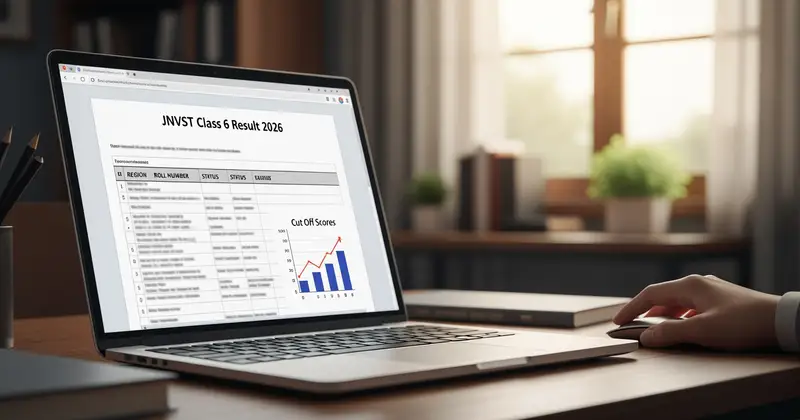
Navodaya Vidyalaya Samiti (NVS) is preparing to announce the JNVST Class 6 Result 2026 for over 20 lakh participating students across India. This highly anticipated examination is a gateway to quality, free residential education for talented rural children. With the Phase 1 (Winter-bound) and Phase 2 (Summer-bound) entrance examinations concluded, parents can expect the region-wise selection list PDF to be published on navodaya.gov.in by late March or early April 2026. Securing one of the approximately 50,000 seats across 661 Jawahar Navodaya Vidyalayas requires meeting specific cut-off marks based on category, gender, and the strict rural/urban quota system. The competition is intense, reflecting the aspiration of countless families for a brighter future for their children through the esteemed JNV system.

JNVST Class 6 Result 2026: Quick Overview
For parents and guardians eagerly awaiting the results, here are the most critical details regarding the upcoming Navodaya Class 6 selection process for the 2026-27 academic session. This table provides a snapshot of key information to help you stay informed and prepared.
| Specification | Details |
|---|---|
| Exam Name | Jawahar Navodaya Vidyalaya Selection Test (JNVST) 2026 |
| Conducting Body | Navodaya Vidyalaya Samiti (NVS) |
| Total Available Seats | Approximately 50,000+ seats across India |
| Total JNV Schools | 661 Functional Schools |
| Expected Result Date | March/April 2026 |
| Result Format | Region-wise PDF Selection List & Online Roll No. Search |
| Official Website | navodaya.gov.in |
When and Where to Check JNVST Class 6 Result 2026?
NVS conducts the Class 6 entrance exam in two distinct phases to accommodate different geographical and climatic zones in India. This staggered approach ensures that students from all regions, especially those in remote and hilly areas, have an equal opportunity to participate without being hindered by adverse weather conditions. The results for both phases are typically compiled and released simultaneously to ensure a uniform academic calendar and admission process across all JNVs.

- Phase 1 Exams: Conducted for winter-bound regions, which primarily include the hilly areas of Jammu & Kashmir, Ladakh, Himachal Pradesh, Uttarakhand, and the North-Eastern states. These regions often experience heavy snowfall, making early examinations necessary.
- Phase 2 Exams: Conducted for summer-bound regions, covering the rest of India, including populous states like Uttar Pradesh, Bihar, Madhya Pradesh, Rajasthan, Maharashtra, and many others.
The primary platform to check the selection status is the official NVS portal at navodaya.gov.in. Given the massive number of applicants, NVS also utilizes a dedicated CBSE ITMS portal (cbseitms.rcil.gov.in) to handle heavy server traffic on the result declaration day. This secondary portal acts as a crucial backup, ensuring that parents can access results even during peak load. Parents should keep the student's Roll Number and Date of Birth ready, as these are mandatory credentials for the online search and are essential for retrieving individual results.
Receiving SMS Notifications
In addition to online and offline result declarations, NVS endeavors to send individual notifications. Selected candidates, or their parents/guardians, whose mobile numbers were registered during the application process, will receive an SMS alert confirming their selection. This serves as an immediate intimation, but it is always advisable to cross-verify the status through the official website or offline lists.
How to Download the NVS Region-Wise Selection List PDF?
NVS publishes the results in two formats: an individual scorecard search where you input your roll number, and a complete region-wise merit list PDF. The PDF format is particularly useful for checking the names of all selected candidates in a specific district, allowing for easy verification and comprehensive viewing. Follow these exact steps to download the list:
- Visit the official website: navodaya.gov.in. This is the central hub for all NVS-related announcements.
- Look for the prominent pop-up box on the homepage. This box is usually hard to miss and will be specifically titled "Click here to view the Roll Number wise Result of Class VI Jawahar Navodaya Vidyalaya Selection Test-2026" or similar. Click on it to proceed to the individual result search page.
- To view the full region-wise PDF selection lists, navigate to the "Admission" tab usually found in the main menu. From the drop-down menu, select "Admission Notifications". This section is where NVS publishes all official documents related to admissions, including selection lists.
- Locate the link corresponding to your specific NVS Region. The NVS regions are: Bhopal, Chandigarh, Hyderabad, Jaipur, Lucknow, Patna, Pune, Shillong. Ensure you select the correct region to access the relevant list.
- Click the download icon or link next to your region's name. This will initiate the download of the PDF file to your device.
- Once the PDF is open, press Ctrl+F (if you are on a desktop or laptop) or use the search icon/functionality on your mobile device to find your child's Roll Number or Name quickly. This will highlight their entry if they are on the list.
Troubleshooting Common Issues
- Website Slow/Unresponsive: Due to high traffic, the website might be slow. Try refreshing the page, clearing your browser's cache, or accessing the site during off-peak hours. The alternate CBSE ITMS portal (cbseitms.rcil.gov.in) is also a good option.
- Incorrect Region Selection: Double-check that you have selected the correct NVS region. Selecting the wrong region will result in you not finding your child's name even if they are selected.
- PDF Not Opening: Ensure you have a PDF reader installed on your device. Most modern browsers have built-in PDF viewers, but sometimes a dedicated application might be needed.
How to Check Navodaya Result 2026 Offline?
Recognizing the digital divide and connectivity challenges in many rural parts of India, NVS provides robust offline mechanisms for result checking. This ensures that no deserving candidate is left unaware of their selection due to lack of internet access. NVS mandates that the selection lists be physically displayed at key government offices in every district. You can check the offline result at the following locations:
- The notice board of the Jawahar Navodaya Vidyalaya (JNV) in your district. This is often the first place to check, as the JNV is directly involved in the admission process.
- The office of the District Education Officer (DEO). The DEO's office supervises all educational activities in the district and maintains official records.
- The office of the District Magistrate (DM) / Deputy Commissioner. The DM's office is the highest administrative authority in the district and ensures transparency in the selection process.
- The office of the Deputy Director, Navodaya Vidyalaya Samiti of the respective region. This regional office oversees multiple JNVs and will have comprehensive lists.
Additionally, the Principal of the concerned JNV will send an official notification via Speed Post to the residential address provided during the application process. This letter will contain detailed instructions regarding the document verification process and admission formalities. An SMS will also be sent to the registered mobile numbers of all selected candidates, providing an immediate alert. If you do not receive the speed post within a reasonable time after the result declaration, it is advisable to contact the concerned JNV directly.
What is the Expected JNVST Class 6 Cut Off 2026?
NVS strictly maintains confidentiality regarding the exact cut-off marks. They do not publish an official cut-off list to avoid speculation and to ensure that the focus remains on the overall merit and specific reservation criteria. However, based on the difficulty level of the 2026 question paper (covering Mental Ability, Arithmetic, and Language sections) and historical admission trends across various districts, we can project the minimum safe scores required for selection. Several factors influence the cut-off, including the total number of applicants, the number of available seats in a particular JNV, the performance of the candidates, and the specific reservation policies applicable to that district.
The cut-off varies significantly between rural and urban candidates due to the 75% seat reservation for rural students, reflecting NVS's core mission. Below is the expected cut-off percentage for 2026, which should be considered as a general guideline:
| Category | Area | Expected Cut Off (Boys) | Expected Cut Off (Girls) |
|---|---|---|---|
| General (UR) | Urban | 93% - 95% | 91% - 93% |
| General (UR) | Rural | 90% - 92% | 88% - 90% |
| OBC | Urban | 91% - 93% | 89% - 91% |
| OBC | Rural | 88% - 90% | 86% - 88% |
| SC | Urban | 85% - 87% | 83% - 85% |
| SC | Rural | 82% - 84% | 80% - 82% |
| ST | Urban | 81% - 83% | 79% - 81% |
| ST | Rural | 78% - 80% | 76% - 78% |
Note: A district with high competition (like Sikar in Rajasthan or Patna in Bihar) will naturally see cut-offs on the higher end of this spectrum, while districts with lower application volumes may see slightly lower cut-offs. These figures are indicative and not official. The actual cut-off depends on the performance of all candidates in a specific district.
Understanding Cut-off Variations
The cut-off marks are not static and can fluctuate significantly from year to year and district to district. Factors such as the overall difficulty of the exam paper (a tougher paper might lead to lower cut-offs), the number of students appearing from a particular district, and the demographic composition of applicants all play a role. Therefore, while the table above provides a useful benchmark, candidates and parents should understand that it is an estimation based on historical trends and expert analysis.
Rural vs Urban Quota: How Are Navodaya Seats Distributed?
Understanding the seat matrix is crucial, as the JNVST result is heavily influenced by NVS reservation policies, which are designed to achieve social equity and fulfill the mission of providing quality education to rural talent. Each JNV typically has an intake capacity of 80 students per year for Class 6. These 80 seats are divided using a strict formula:
- Rural Quota (75%): Exactly 60 out of 80 seats are reserved for candidates who have studied in recognized schools located in rural areas for the entirety of Classes 3, 4, and 5. This policy is fundamental to NVS's objective of uplifting rural communities. A certificate from the Head Master of the school confirming rural schooling is mandatory.
- Urban Quota (25%): The remaining 20 seats are open to candidates from urban areas. It's important to note that even a single day of schooling in an urban area during Classes 3, 4, or 5 classifies the student as an urban candidate, irrespective of their current residence. This strict definition ensures the integrity of the rural quota.
- Gender Reservation: A minimum of 1/3rd of the total seats (approximately 27 seats) are strictly reserved for girl students across all categories (General, OBC, SC, ST, Rural, Urban). This affirmative action aims to promote girls' education and ensure equitable representation within the JNV system.
- Caste Reservation: Seats are reserved for Scheduled Caste (SC) and Scheduled Tribe (ST) candidates in proportion to their population in the district concerned. However, this reservation will not be less than the national average (15% for SC and 7.5% for ST) and cannot exceed a combined maximum of 50% for both categories. This ensures that socially disadvantaged groups receive adequate representation.
- Divyang (PwD) Reservation: 3% of seats are reserved for children with special needs (Orthopedically Handicapped, Hearing Impaired, and Visually Handicapped). This reservation promotes inclusive education and provides opportunities for children with disabilities to access quality residential schooling.
Implications of Reservation Policies
These reservation policies mean that a candidate's selection is not solely based on their test score but also on their category, gender, and the area (rural/urban) from which they applied. It's possible for a candidate with a slightly lower score from a reserved category or rural area to be selected over a general or urban candidate with a higher score, provided they meet the respective cut-offs for their specific sub-category. Parents must ensure all claims regarding rural status, caste, or disability are accurately documented and verifiable, as any discrepancy can lead to disqualification during the document verification stage.
What Documents are Required for JNV Admission 2026?
Finding your child's name on the JNVST Class 6 Result 2026 list is only the first step. The actual admission is provisional and entirely dependent on rigorous document verification. Parents are given approximately 15 to 20 days after the result declaration to submit the following documents to the JNV Principal. It is crucial to gather these well in advance to avoid last-minute complications.
- Proof of Date of Birth: This typically includes a Birth Certificate issued by the competent government authority. In some cases, a transfer certificate from the previous school, duly signed by the Head of the Institution, might also be accepted if it clearly mentions the date of birth.
- Proof of Residence/Domicile Certificate: This document is essential to confirm the candidate's residence in the district where the JNV is located. It is crucial for verifying eligibility, especially for rural and urban quotas. Issued by the Tehsildar/Collector/District Magistrate.
- Rural Area Study Certificate: For candidates applying under the 75% rural quota, a certificate from the Head Master of the school(s) where the child studied Classes 3, 4, and 5, explicitly stating that the school is located in a rural area, is mandatory. This certificate must cover all three academic years.
- Caste/Category Certificate (SC/ST/OBC): If the candidate belongs to Scheduled Caste (SC), Scheduled Tribe (ST), or Other Backward Classes (OBC), a valid caste certificate issued by a competent authority (e.g., Tehsildar, Sub-Divisional Magistrate) is required. For OBC candidates, a Non-Creamy Layer certificate is often necessary, and it must be issued in the prescribed Central Government format.
- Disability Certificate (for Divyang candidates): Candidates applying under the Divyang (PwD) quota must furnish a medical certificate from a government hospital/medical board indicating the type and percentage of disability (Orthopedically Handicapped, Hearing Impaired, or Visually Handicapped).
- Mark Sheets/Report Cards of Class 3, 4, and 5: These documents are required to confirm that the student has successfully passed these classes and to
Related Resources
- Navodaya Vidyalaya Admission Guide
- Sainik School Class 6 Entrance Exam
- Sarkari Result
Frequently Asked Questions (FAQs)
Reader questions: JNVST Class Result
When will the JNVST Class 6 result 2026 be declared?
The Navodaya Class 6 result 2026 is expected to be announced by late March or early April 2026 on the official website, navodaya.gov.in.
What details are needed to check the Navodaya result online?
To check the result online, you will need the student's Roll Number and Date of Birth as mentioned on their JNVST admit card.
Is there a negative marking in the JNVST Class 6 exam?
No, there is no negative marking for incorrect answers in the Jawahar Navodaya Vidyalaya Selection Test (JNVST) for Class 6.
How is the JNVST cut-off determined?
The cut-off is determined based on several factors, including the candidate's category (General, OBC, SC, ST), area (Rural/Urban), gender, and the overall difficulty of the exam.
What happens after being selected in the JNVST result?
Selected candidates must complete the document verification process at their allotted Jawahar Navodaya Vidyalaya. Admission is confirmed only after successful verification of all required documents.
Related Government Job Resources
Continue with active job hubs and related government job pages on TrueJobs.
Tools for this recruitment topic
Use only the tools relevant to the dates, eligibility or documents discussed above.
TrueJobs Editorial Team
TrueJobs editorial desk
This article is prepared from the sources referenced in the guide and reviewed for clarity, links and dated information. Read our editorial and corrections policy.
Continue This Topic
Follow the closest earlier and newer coverage so older archive posts keep real contextual crawl paths.
JNVST Class 6 Answer Key 2026: Download PDF, Expected Cut Off & Score Estimate
Download the official JNVST Class 6 Answer Key 2026 PDF to estimate your score. This guide provides direct links, step-by-step score calculation instructions, and the expected category-wise cut-off marks for admission into Jawahar Navodaya Vidyalayas.
ISC Result 2026: Official Website, Recheck, Improvement & DigiLocker Guide
The Council for the Indian School Certificate Examinations (CISCE) is expected to declare the ISC Result 2026 in May 2026. This guide covers the steps to check scores on cisce.org, apply for rechecking, use DigiLocker, and understand the improvement exam process.
Read Next

JNVST Class 6 Answer Key 2026: Download PDF, Expected Cut Off & Score Estimate

ISC Result 2026: Official Website, Recheck, Improvement & DigiLocker Guide

CLAT 2026 Counselling: Provisional Allotment Lists, Freeze/Float Rules & Fee Process

ICSE Result 2026: Official Website, Recheck, Improvement & DigiLocker Guide
Explore Topics
Perfect Your Resume
Use our AI-powered Resume Builder to create ATS-optimized resumes.
AI Resume Builder