
Recruitment guide
Latest IBPS Clerk 2026: Salary, Job Profile — Explained
Your complete guide to the IBPS Clerk 2026 role. Understand the detailed salary structure, daily job responsibilities, and clear promotion path to make an informed career decision.

A career in public sector banks offers stability, respect, and a clear growth trajectory. The IBPS Clerk examination is your gateway to this rewarding sector, drawing thousands of applicants each year. Understanding the salary structure, daily responsibilities, and future promotion prospects is crucial for any aspiring candidate. This guide provides a detailed look into what an IBPS Clerk role entails, helping you make an informed decision about your banking career.
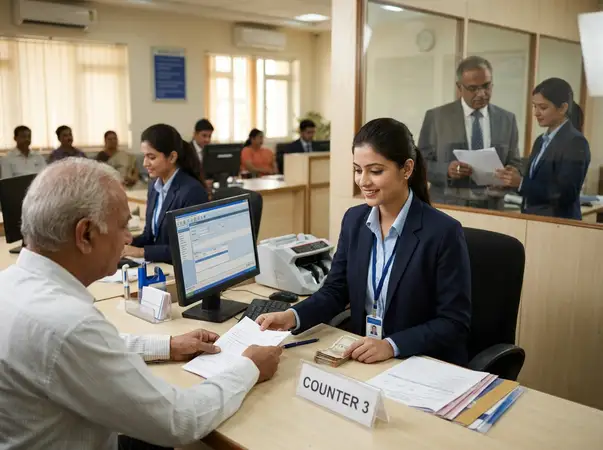
Quick Overview: IBPS Clerk 2026
- Expected Basic Pay: ₹19,900 (as per 12th BPS, to be updated)
- Estimated In-hand Salary: ₹32,000 - ₹35,000 per month (initial, city-dependent)
- Job Role: Customer service, cash handling, back-office operations
- Career Growth: Clear path to Officer Scale I (PO) and higher management
- Eligibility (Expected): Graduation in any discipline; 20-28 years (General category)
- Selection Process: Preliminary Exam, Main Exam, Language Proficiency Test (LPT)
What is the IBPS Clerk 2026 Salary Structure?
The IBPS Clerk salary is determined by the 12th Bipartite Settlement (BPS) and is subject to revisions. The initial basic pay is attractive, complemented by various allowances that significantly increase the gross and in-hand salary. Understanding each component helps in assessing the total compensation package.
The basic pay for an IBPS Clerk is typically ₹19,900. This forms the foundation upon which other allowances are calculated. These allowances vary based on the city of posting and other factors.
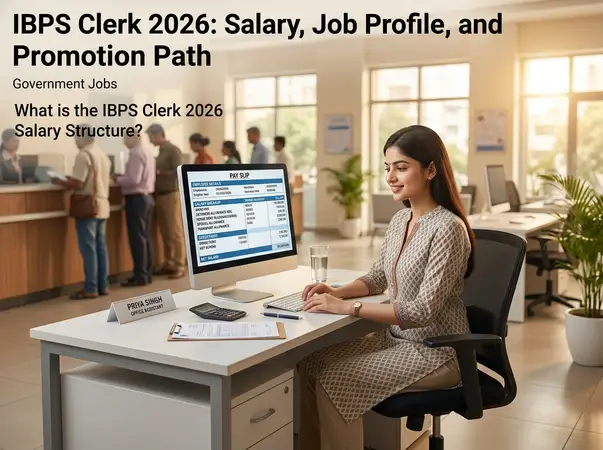
Key Salary Components and Allowances:
- Dearness Allowance (DA): This is a cost-of-living adjustment, revised quarterly based on the Consumer Price Index (CPI). It currently stands at a significant percentage of the basic pay.
- House Rent Allowance (HRA): Provided to cover housing expenses, HRA varies by city category (X, Y, Z cities). For example, it can be 10% of basic pay in X cities, 9% in Y cities, and 7% in Z cities.
- Special Allowance: An additional allowance, currently around ₹3,263.48, added to the basic pay.
- Transport Allowance (TA): A fixed amount to cover commuting costs, which also varies by city.
- Medical Aid: A fixed annual amount for medical expenses, usually around ₹2,000.
- Conveyance Allowance: For official travel, if applicable.
- New Pension Scheme (NPS): A contribution from both the employee and the employer towards the pension fund.
Considering these components, the initial gross salary of an IBPS Clerk can range from ₹36,000 to ₹40,000 per month. After deductions like NPS contribution, income tax, and professional tax, the in-hand salary typically falls between ₹32,000 and ₹35,000 per month. This figure can slightly vary based on the bank and specific city of posting.
| Salary Component | Amount (Approx.) |
|---|---|
| Basic Pay | ₹19,900.00 |
| Dearness Allowance (DA) | ₹8,556.70 (approx. 46.5% of Basic Pay) |
| House Rent Allowance (HRA) | ₹2,000.00 - ₹2,500.00 (City-dependent) |
| Special Allowance | ₹3,263.48 |
| Transport Allowance | ₹750.00 - ₹1,000.00 |
| Gross Salary | ₹36,000.00 - ₹40,000.00 |
| Deductions (NPS, Tax, etc.) | ₹4,000.00 - ₹5,000.00 |
| Net In-hand Salary | ₹32,000.00 - ₹35,000.00 |
What Does an IBPS Clerk Do Daily? (Job Profile)
The IBPS Clerk job profile is dynamic, involving direct interaction with customers and critical back-office operations. Clerks are the first point of contact for many customers, playing a vital role in maintaining the bank's reputation and efficiency.
Key Responsibilities of an IBPS Clerk:
- Customer Service: Assisting customers with account opening, deposits, withdrawals, fund transfers, and resolving basic queries. This includes issuing demand drafts, fixed deposit receipts, and managing passbook updates.
- Cash Handling: Managing cash counters, which involves receiving cash, making payments, verifying currency, and ensuring accurate cash balances.
- Document Verification: Scrutinizing KYC (Know Your Customer) documents, processing loan applications, and verifying various forms submitted by customers.
- Back-Office Operations: Data entry, maintaining ledgers, processing cheques, managing inward and outward mail, and assisting in general administrative tasks.
- Marketing and Sales: Occasionally, clerks are involved in cross-selling bank products like insurance, mutual funds, and credit cards to existing customers.
- Reporting: Preparing various reports as required by the branch manager or higher authorities.
The specific duties can vary slightly depending on the branch size, location (urban/rural), and the department assigned. IBPS Clerks are crucial for the smooth functioning of bank branches, ensuring customer satisfaction and operational efficiency.
How Does an IBPS Clerk Get Promoted? (Promotion Path)
One of the significant advantages of a public sector banking job is the clear and structured promotion path. An IBPS Clerk has multiple opportunities to advance their career, leading to higher positions and improved salary packages. Promotions are generally based on performance, experience, and qualifying internal examinations.
Typical Promotion Hierarchy:
- Clerk: The entry-level position, responsible for day-to-day banking operations.
- Officer Scale I (Probationary Officer - PO): After serving as a clerk for a few years (typically 2-3 years) and clearing internal promotional exams, a clerk can become a PO. This role involves more decision-making, supervision, and specialized banking functions.
- Officer Scale II (Manager): With further experience and successful performance as a PO (usually 5-7 years), an officer can be promoted to Scale II, often taking on managerial roles within a branch or department.
- Officer Scale III (Senior Manager): This level involves greater responsibility, managing larger teams or specialized units.
- Senior Management (AGM, DGM, GM, Executive Director): Through continued dedication, performance, and leadership, individuals can rise to top management positions within the bank.
To accelerate promotions, clerks often pursue professional certifications like JAIIB (Junior Associate of the Indian Institute of Bankers) and CAIIB (Certified Associate of the Indian Institute of Bankers). These certifications enhance banking knowledge and are highly valued during promotion processes.
What are the Eligibility Criteria for IBPS Clerk 2026?
Meeting the eligibility criteria is the first step towards an IBPS Clerk career. These criteria ensure that candidates possess the necessary educational background, age, and other qualifications required for the role. The criteria for IBPS Clerk 2026 are expected to remain consistent with previous years.
Key Eligibility Requirements:
- Nationality: Candidate must be a citizen of India, a subject of Nepal or Bhutan, or a Tibetan refugee who came to India before January 1, 1962, with the intention of permanently settling in India.
- Educational Qualification: A Bachelor's degree (Graduation) in any discipline from a recognized University or any equivalent qualification recognized by the Central Government. The candidate must possess a valid mark-sheet/degree certificate and should have indicated the percentage of marks obtained in Graduation while registering online.
- Computer Literacy: Operating and working knowledge in computer systems is mandatory, meaning candidates should have a Certificate/Diploma/Degree in computer operations/Language/ have studied Computer/ Information Technology as one of the subjects in the High School/College/Institute.
- Language Proficiency: Candidates should have proficiency in the official language of the State/UT for which they are applying (ability to read, write, and speak the language).
Age Limit (as of a specified date, usually August 1st of the notification year):
| Category | Age Limit | Age Relaxation |
|---|---|---|
| General / EWS | 20-28 years | N/A |
| OBC (Non-creamy layer) | 20-28 years | 3 years |
| SC / ST | 20-28 years | 5 years |
| Persons with Benchmark Disabilities (PwBD) | 20-28 years | 10 years |
| Ex-Servicemen / Disabled Ex-Servicemen |