
Recruitment guide
Govt In-Hand Salary Calculation – Complete Guide — Explained
How to Calculate In-Hand Salary for Government Jobs — Complete Guide Embarking on a career in the Indian government sector is a dream for millions,...
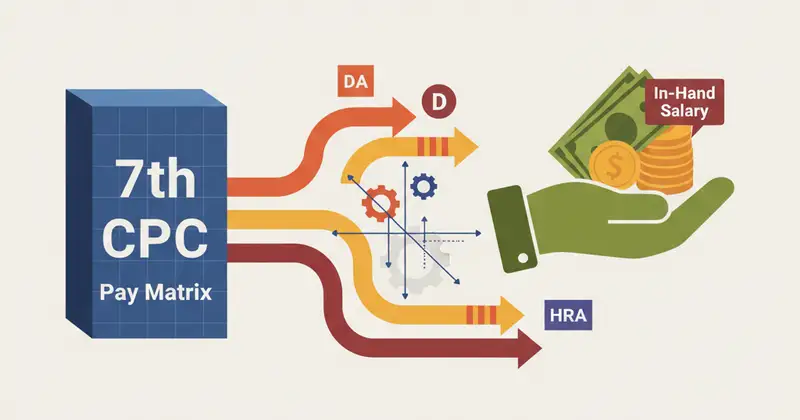
Understanding your in-hand salary is crucial for any government job aspirant. This guide breaks down the 7th CPC pay matrix, allowances, and deductions. Learn to calculate your exact take-home pay for any central or state government post.
How to Calculate In-Hand Salary for Government Jobs — Complete Guide
A career in the Indian government sector is highly sought after, offering job security, prestige, and comprehensive benefits. While gross salary figures in recruitment notifications are appealing, understanding the actual "in-hand" salary is crucial for financial planning, informed career choices, and realistic expectations. Government jobs provide long-term financial stability, healthcare, and retirement security, making a clear understanding of the salary structure essential.
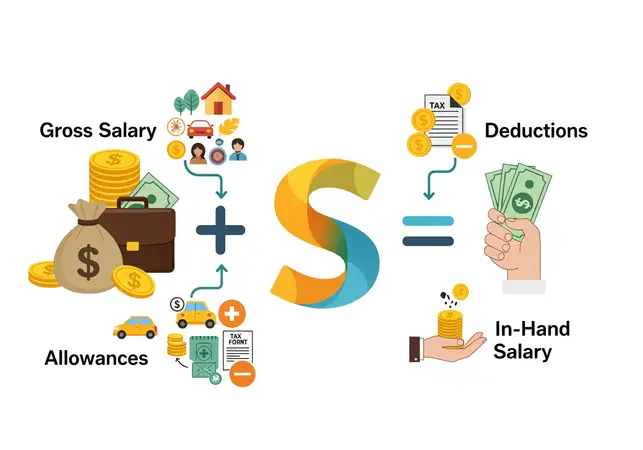
At TrueJobs, India's leading government job portal, we aim to empower aspirants with clear information. This comprehensive guide demystifies government salary calculation, breaking down every component and deduction. Whether you're aiming for SSC CGL, IBPS PO, Railways, or UPSC Civil Services, this guide will help you accurately estimate your take-home pay and plan your finances effectively.
This resource covers Basic Pay, various allowances, mandatory deductions, and the impact of the 7th Central Pay Commission (CPC) Pay Matrix. By the end, you'll confidently calculate your in-hand salary and appreciate the comprehensive nature of government remuneration, enabling better financial foresight and strategic career planning.
Navigating the complexities of government salary structures can seem daunting, but with a clear understanding of its components, you can accurately project your take-home pay. This guide will meticulously break down each element, from basic pay to various allowances and mandatory deductions, providing you with the tools to calculate your in-hand salary for any central or state government position.
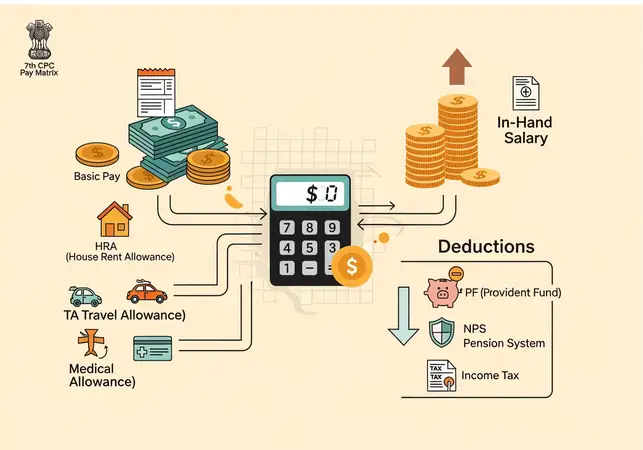
Understanding the Foundation: Basic Pay and the 7th CPC Pay Matrix
The cornerstone of any government employee's salary is the Basic Pay. This is the fixed component of your salary, determined by your post, grade, and the recommendations of the latest Pay Commission. Currently, the 7th Central Pay Commission (CPC) recommendations govern the salary structure for central government employees, and many state governments also adopt similar models.
What is the 7th CPC Pay Matrix?
The 7th CPC introduced a revolutionary Pay Matrix, replacing the earlier system of Pay Bands and Grade Pays. This matrix is a clear, tabular representation that defines the pay levels for various government positions. It consists of horizontal rows representing different pay levels (e.g., Level 1 to Level 18) and vertical columns representing annual increments within each level. Each cell in the matrix corresponds to a specific Basic Pay amount.
- Levels: These correspond to the hierarchy of posts. Higher levels indicate higher positions and responsibilities, and consequently, higher Basic Pay.
- Cells: Moving horizontally across a level signifies annual increments. An employee typically receives an annual increment, moving to the next cell in the same level, which results in an increase in their Basic Pay.
- Entry Pay: For each level, there's a defined entry pay, which is the starting Basic Pay for a new recruit in that level.
To find your Basic Pay, you first need to identify the Pay Level of your specific post. This information is usually provided in the recruitment notification or can be found in the relevant government pay rules. Once you know the level, you can locate the corresponding Basic Pay in the 7th CPC Pay Matrix.
How Basic Pay Impacts Other Allowances
It's crucial to understand that Basic Pay isn't just a standalone figure. Many other allowances are calculated as a percentage of your Basic Pay. This means that an increase in your Basic Pay (due to increments or promotions) will automatically lead to an increase in several other components of your salary, significantly impacting your overall gross and in-hand salary.
Key Allowances: Boosting Your Gross Salary
Beyond Basic Pay, government employees receive a variety of allowances designed to compensate for various factors such as inflation, cost of living, and specific job requirements. These allowances significantly contribute to the gross salary.
1. Dearness Allowance (DA)
Dearness Allowance (DA) is provided to government employees and pensioners to offset the impact of inflation. It is revised periodically (usually twice a year, in January and July) by the government based on the Consumer Price Index for Industrial Workers (CPI-IW). DA is calculated as a percentage of the Basic Pay. For example, if the DA is 42% and your Basic Pay is ₹35,400, your DA would be ₹14,868.
Calculation: DA = (Percentage of DA / 100) * Basic Pay
2. House Rent Allowance (HRA)
House Rent Allowance (HRA) is provided to employees who do not reside in government-provided accommodation. The HRA rates vary based on the classification of the city where the employee is posted. Cities are typically categorized into X, Y, and Z classes, with X cities having the highest HRA, followed by Y and Z. The HRA is also calculated as a percentage of the Basic Pay.
- X Class Cities: Metropolitan cities (e.g., Delhi, Mumbai, Chennai, Kolkata, Bengaluru, Hyderabad, Ahmedabad, Pune). HRA is typically higher.
- Y Class Cities: Other large cities. HRA is moderate.
- Z Class Cities: Small towns and rural areas. HRA is the lowest.
The 7th CPC recommended HRA rates of 24%, 16%, and 8% of Basic Pay for X, Y, and Z class cities, respectively, when DA crosses 25%. These rates are further revised when DA crosses 50%.
Calculation: HRA = (Percentage of HRA based on city class / 100) * Basic Pay
3. Transport Allowance (TA) / Travel Allowance (TRA)
Transport Allowance (TA) is provided to cover the cost of commuting between residence and workplace. The amount of TA varies based on the employee's pay level and the class of the city. Employees in higher pay levels and those posted in larger cities generally receive a higher TA. This allowance might also be referred to as Travel Allowance.
For example, employees in Level 9 and above might receive a higher fixed TA amount compared to those in lower levels, with further differentiation for 'higher TPTA cities' (typically the 8 X-class cities) versus 'other places'.
4. Other Specific Allowances
Depending on the nature of the job, department, and posting location, government employees may be eligible for several other allowances. These can include:
- Special Duty Allowance (SDA): For employees posted in specific difficult or remote areas (e.g., North-Eastern Region, Ladakh).
- Children Education Allowance (CEA): To assist with the education expenses of up to two children.
- Hostel Subsidy: For children residing in hostels.
- Medical Allowance: To cover medical expenses, though many government employees are covered under schemes like CGHS.
- Uniform Allowance / Washing Allowance: For employees required to wear uniforms.
- Hardship Allowance: For employees working in challenging or hazardous conditions.
- Night Duty Allowance (NDA): For employees performing duties during night hours.
The eligibility and rates for these allowances are specific to each allowance and often depend on the employee's grade, location, and specific duties.
Mandatory Deductions: What Reduces Your Take-Home Pay
While allowances add to your gross salary, several mandatory deductions are made before you receive your final "in-hand" amount. Understanding these deductions is crucial for accurate financial planning.
1. Provident Fund (PF) Contributions
For central government employees recruited on or after January 1, 2004, the National Pension System (NPS) has replaced the old General Provident Fund (GPF) scheme. Under NPS, a mandatory contribution is made by the employee, and a matching or higher contribution is made by the employer.
- Employee Contribution: 10% of (Basic Pay + Dearness Allowance).
- Employer Contribution: Currently 14% of (Basic Pay + Dearness Allowance) for central government employees.
For employees recruited before January 1, 2004, the General Provident Fund (GPF) scheme is applicable, where a fixed percentage of Basic Pay (or a fixed amount) is contributed by the employee. There is no employer contribution under GPF.
2. Income Tax (TDS)
Income Tax is deducted at source (TDS) from your salary based on the prevailing income tax slabs and any declarations you make regarding investments (e.g., under Section 80C, 80D). Your employer calculates the estimated annual tax liability and deducts it in equal monthly installments.
It's advisable to submit your investment proofs and declarations to your DDO (Drawing and Disbursing Officer) at the beginning of the financial year to ensure accurate TDS deductions and avoid paying excess tax or facing a large deduction at the end of the year.
3. Central Government Employees Group Insurance Scheme (CGEGIS)
The Central Government Employees Group Insurance Scheme (CGEGIS) provides a combination of insurance cover and a savings fund. A fixed monthly amount is deducted from the employee's salary, a portion of which goes towards insurance cover and the rest accumulates in a savings fund, payable upon retirement or cessation of service.
The deduction amount varies based on the employee's pay level. For example, employees in Level 1-5 might have a lower deduction than those in Level 6-11, and so on.
4. Professional Tax (PT)
Professional Tax (PT) is levied by certain state governments and is deducted from the salary of employees working in those states. The amount of professional tax varies from state to state and is usually a fixed amount or a slab-based deduction, subject to a maximum limit per annum (e.g., ₹2,500 per annum in many states).
5. Other Deductions (If Applicable)
There might be other deductions depending on individual circumstances or specific departmental rules:
- GPF/NPS Arrears: If there are any pending contributions.
- Loan Recoveries: For housing loans, vehicle loans, or personal loans taken from the government.
- Union/Association Subscriptions: For membership in recognized employee unions or associations.
- Festival Advance Recovery: If an employee has taken a festival advance.
Step-by-Step Calculation of In-Hand Salary
Now that we've covered all the components, let's put it all together to calculate your estimated in-hand salary. Follow these steps:
Step 1: Determine Your Basic Pay
Identify your Pay Level from the recruitment notification or official sources. Then, locate the corresponding Basic Pay in the 7th CPC Pay Matrix. This is your starting point.
Step 2: Calculate Dearness Allowance (DA)
Find the current DA percentage announced by the government. Calculate DA as a percentage of your Basic Pay.
Example: If Basic Pay = ₹44,900 and DA = 46%, then DA = 0.46 * 44,900 = ₹20,654
Step 3: Calculate House Rent Allowance (HRA)
Determine the HRA percentage applicable to your city classification (X, Y, or Z). Calculate HRA as a percentage of your Basic Pay.
Example: If Basic Pay = ₹44,900 and HRA for Y-class city = 18%, then HRA = 0.18 * 44,900 = ₹8,082
Step 4: Add Transport Allowance (TA)
Find the fixed TA amount applicable to your Pay Level and city type (higher TPTA cities vs. other places). Remember that DA is also paid on TA, so you'll add the TA amount plus DA on TA.
Example: If TA for your level and city is ₹3,600, and DA is 46%, then DA on TA = 0.46 * 3,600 = ₹1,656. Total TA = ₹3,600 + ₹1,656 = ₹5,256
Step 5: Include Other Applicable Allowances
Add any other allowances you are eligible for, such as Children Education Allowance, Special Duty Allowance, etc., based on their specific rates.
Step 6: Calculate Gross Salary
Sum up all the components: Basic Pay + DA + HRA + TA + Other Allowances = Gross Salary.
Example (continuing from above):
Basic Pay: ₹44,900
DA: ₹20,654
HRA: ₹8,082
TA: ₹5,256
Gross Salary = 44,900 + 20,654 + 8,082 + 5,256 = ₹78,892
Step 7: Calculate Mandatory Deductions
Calculate each mandatory deduction:
- NPS Contribution: 10% of (Basic Pay + DA).
- CGEGIS: Fixed amount based on Pay Level.
- Professional Tax: Fixed amount as per state rules.
- Income Tax (TDS): Estimated monthly amount based on your annual taxable income and declarations.
Example (continuing):
NPS = 10% of (44,900 + 20,654) = 10% of 65,554 = ₹6,555
CGEGIS (e.g., for Level 7) = ₹60 (example fixed amount)
Professional Tax (e.g., in Maharashtra) = ₹200 (example fixed amount)
Income Tax (estimated monthly) = ₹3,000 (example, highly variable)
Total Deductions = 6,555 + 60 + 200 + 3,000 = ₹9,815
Step 8: Calculate In-Hand Salary
Subtract the total deductions from your Gross Salary.
In-Hand Salary = Gross Salary - Total Deductions
In-Hand Salary = ₹78,892 - ₹9,815 = ₹69,077
This step-by-step process provides a robust framework for estimating your take-home pay. Remember that the exact figures for DA, HRA, TA, and other allowances can change based on government notifications, and your TDS will depend on your individual tax planning.
Checks to complete before you apply
Understanding your in-hand salary for a government job is more than just knowing a number; it's about gaining financial clarity and making informed career decisions. The structured nature of government remuneration, governed by frameworks like the 7th CPC Pay Matrix, provides stability and predictability. By meticulously calculating your Basic Pay, factoring in various allowances like DA, HRA, and TA, and accounting for mandatory deductions such as NPS, CGEGIS, and Income Tax, you can arrive at a realistic estimate of your take-home pay.
This comprehensive guide from TrueJobs aims to equip you with the knowledge to navigate these calculations confidently. Remember that while gross salary figures might initially catch your eye, the in-hand salary is what truly impacts your monthly budget and financial planning. Armed with this understanding, you can better appreciate the holistic benefits of a government career and plan your future with greater precision.
FAQ
What is the difference between Gross Salary and In-Hand Salary?
Gross Salary is the total salary an employee receives before any deductions are made. It includes Basic Pay, Dearness Allowance, House Rent Allowance, Transport Allowance, and any other special allowances. In-Hand Salary (or Net Salary) is the amount an employee receives after all mandatory and voluntary deductions (like NPS/GPF, Income Tax, CGEGIS, Professional Tax, loan recoveries, etc.) have been subtracted from the Gross Salary. It's the actual money credited to your bank account.
How often are Dearness Allowance (DA) and House Rent Allowance (HRA) revised?
Dearness Allowance (DA) is typically revised twice a year by the central government, usually in January and July, based on the Consumer Price Index for Industrial Workers (CPI-IW). House Rent Allowance (HRA) rates are linked to the DA. The 7th CPC recommended that HRA rates be revised when DA crosses 25% and again when it crosses 50% of Basic Pay. However, the specific timing of these revisions depends on government notifications.
Does the 7th CPC Pay Matrix apply to all government jobs?
The 7th CPC Pay Matrix primarily applies to central government employees. Many state governments often adopt similar pay structures and recommendations, sometimes with modifications, but they have their own specific pay commissions and rules. Therefore, while the principles are similar, the exact pay matrix and allowance rates might differ for state government jobs. Always refer to the specific state government's pay rules for precise calculations.
How to Calculate Government Job In-Hand Salary
Explore: Government Job Perks | Current Vacancies
Wonder about your actual take-home pay? Learn the real in-hand salary calculations for government positions.
Related Government Job Resources
Continue with active job hubs and related government job pages on TrueJobs.
Tools for this recruitment topic
Use only the tools relevant to the dates, eligibility or documents discussed above.
TrueJobs Editorial Team
TrueJobs editorial desk
This article is prepared from the sources referenced in the guide and reviewed for clarity, links and dated information. Read our editorial and corrections policy.
Continue This Topic
Follow the closest earlier and newer coverage so older archive posts keep real contextual crawl paths.
Best Government Jobs for Graduates by Stream — Complete Guide 2026
Best Government Jobs for Graduates by Stream — Complete Guide 2026 Landing a government job in India is a dream for millions of graduates. The allure...
UPSC vs SSC — Which is Right for You? A Complete Comparison
UPSC vs SSC — Which is Right for You? Embarking on a career in the Indian government sector is a dream for millions, offering unparalleled stability,...
Read Next

Best Government Jobs for Graduates by Stream — Complete Guide 2026

UPSC vs SSC — Which is Right for You? A Complete Comparison

NDA Preparation Strategy for Beginners — Complete Guide 2026

Railway Jobs in India — Complete Career Guide 2026
Explore Topics
Perfect Your Resume
Use our AI-powered Resume Builder to create ATS-optimized resumes.
AI Resume Builder