
Recruitment guide
Govt Jobs After 12th Arts 2026: SSC, Police, State — Explained
Looking for government jobs after completing 12th Arts? This guide covers the best options in SSC, Police, State, and Clerical roles for 2026, along with eligibility, exam patterns, and effective preparation strategies.

Completing your 12th standard, especially in the Arts stream, opens up a world of possibilities. While many consider higher education, a significant number of students also aspire to secure a stable and respected government job. The year 2026 might seem a little far off, but it's the perfect time to start planning your career path. Government jobs in India are highly sought after due to their unparalleled job security, attractive perks, and opportunities for growth. If you're an Arts student wondering about your prospects in the public sector, you're in the right place!
This comprehensive guide from TrueJobs.co.in will walk you through the best government job options available after 12th Arts, focusing on opportunities in SSC, Police, State, and Clerical roles, and equip you with the knowledge to prepare effectively for 2026 and beyond.

Why Choose Government Jobs After 12th Arts?
For many Indian families, a 'Sarkari Naukri' (government job) is not just a career; it's a symbol of stability, respect, and a secure future. After completing 12th standard with an Arts background, opting for a government job can offer numerous advantages:
- Job Security: Government jobs are renowned for their high job security. Once you're in, it's generally a job for life, provided you perform your duties diligently. This stability is a huge relief in an otherwise competitive job market.
- Attractive Salary & Benefits: Government employees receive competitive salaries, regular increments, and a host of benefits including Dearness Allowance (DA), House Rent Allowance (HRA), medical facilities, provident fund, and gratuity. These benefits often surpass what's offered in the private sector for entry-level positions.
- Work-Life Balance: Most government jobs maintain a standard work schedule, allowing for a better work-life balance compared to many private sector roles. This means more time for family, hobbies, and personal development.
- Respect & Social Status: Holding a government position often comes with a certain level of respect and social status within society.
- Opportunities for Growth: While entry-level, government departments offer clear promotion channels based on performance, experience, and departmental exams. You can climb the ladder and take on more challenging roles over time.
- Pension & Retirement Benefits: A significant advantage is the pension scheme (or NPS - National Pension System) and other retirement benefits, ensuring financial security even after you stop working.
- Diverse Roles: The Arts stream equips you with strong communication, analytical, and critical thinking skills, which are highly valued in various administrative, clerical, and public-facing government roles.
Key Eligibility Criteria for 12th Arts Pass-outs
Before diving into specific job roles, it's crucial to understand the general eligibility requirements. While criteria can vary slightly for different positions and departments, here are the common prerequisites for government jobs after 12th Arts:
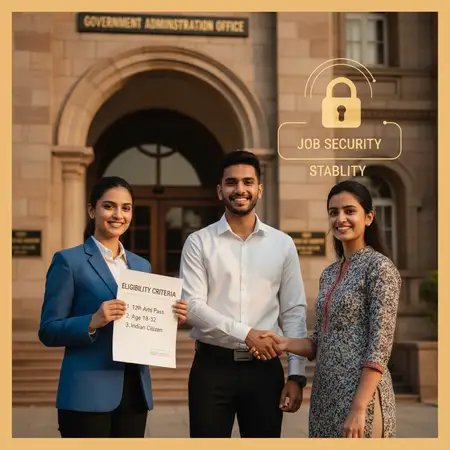
Educational Qualification
- 12th Pass: The most fundamental requirement is having successfully completed your 12th standard (or equivalent) from a recognized board or university in India.
- Minimum Marks: Some exams might specify a minimum percentage in 12th grade, though many only require a pass.
- Arts Stream: For the roles discussed here, having an Arts stream background is perfectly acceptable. There's no discrimination based on your stream for most entry-level government jobs.
Age Limit
- General Range: Typically, the age limit for most 12th-pass government jobs ranges from 18 to 27 years. However, this can extend to 30 or even 32 years for certain posts.
- Age Relaxation: Significant age relaxations are provided for candidates belonging to reserved categories (SC/ST/OBC), Persons with Benchmark Disabilities (PwBD), Ex-servicemen, and sometimes for government employees. For example, OBC candidates usually get 3 years, and SC/ST candidates get 5 years of relaxation.
Nationality
- Candidates must be a citizen of India.
- In some cases, subjects of Nepal or Bhutan, or Tibetan refugees who came to India before a certain date, may also be eligible, provided they meet specific conditions.
Other Requirements
- Physical Standards: For roles in the Police, Defence, and some paramilitary forces, specific physical standards (height, chest, vision) are mandatory.
- Computer Proficiency: Many clerical and administrative roles now require basic computer literacy, including typing skills.
- Language Proficiency: For state-level jobs, proficiency in the local language is often a crucial requirement.
Always refer to the official notification for the exact and most up-to-date eligibility criteria for any specific examination you plan to apply for.
Top Government Job Options After 12th Arts
The government sector offers a wide array of opportunities for 12th Arts pass-outs. Here are some of the most popular and promising avenues:
Staff Selection Commission (SSC) Opportunities
The Staff Selection Commission (SSC) is one of the largest recruiting bodies for various Group 'B' (non-gazetted) and Group 'C' (non-technical) posts in the central government ministries, departments, and subordinate offices. Several SSC exams are perfectly suited for 12th Arts students.
SSC Combined Higher Secondary Level (CHSL) Exam
This is arguably the most popular and sought-after exam for 12th pass students, regardless of stream. It recruits for:
- Lower Division Clerk (LDC): Handles routine office work, data entry, file management, and correspondence.
- Junior Secretariat Assistant (JSA): Similar to LDC, often involves more secretarial duties.
- Postal Assistant (PA)/Sorting Assistant (SA): Works in post offices, handling mail, customer service, and other postal operations.
- Data Entry Operator (DEO): Primarily involves data entry and computer-related tasks.
Selection Process: Typically involves Tier-I (Computer Based Examination), Tier-II (Descriptive Paper), and Tier-III (Skill Test/Typing Test).
SSC Multi-Tasking Staff (MTS) Exam
While often associated with 10th pass, MTS also accepts 12th pass candidates. These are non-technical Group 'C' posts in various Central Government Ministries/Departments/Offices. Roles are diverse, including peon, daftary, jamadar, junior gestetner operator, watchman, safaiwala, malis, etc.
Selection Process: Usually consists of a Computer-Based Examination (Paper-I) and a Descriptive Paper (Paper-II).
SSC Stenographer Grade 'C' & 'D' Exam
If you have an aptitude for shorthand and typing, this is an excellent option. Stenographers work as personal assistants, transcribing speeches, preparing reports, and assisting senior officers.
Selection Process: Computer-Based Examination followed by a Skill Test in Stenography (shorthand and typing).
Police & Defence Sector Roles
For those aspiring to serve the nation and maintain law and order, various police and paramilitary forces recruit 12th pass candidates.
State Police Constable
Each state police force (e.g., UP Police, Delhi Police, Maharashtra Police) regularly recruits Constables. These roles involve patrolling, maintaining public order, crime investigation support, and community policing.
Selection Process: Written Exam, Physical Standard Test (PST), Physical Efficiency Test (PET), Medical Examination, and Document Verification.
Constable (GD) in Central Armed Police Forces (CAPFs)
Recruitment for forces like CRPF, BSF, CISF, ITBP, SSB, Assam Rifles, and NIA/SSF is often conducted by SSC (SSC GD Constable). These roles involve border guarding, internal security, industrial security, and counter-insurgency operations.
Selection Process: Similar to State Police: Written Exam, PST, PET, Medical, and Document Verification.
Head Constable (Ministerial) in various forces
Forces like Delhi Police, CISF, CRPF, etc., also recruit Head Constables (Ministerial) who handle administrative and clerical duties within the force. This role typically requires strong typing skills.
Selection Process: Written Exam, PST, PET (often less stringent than GD Constable), Typing Test, Medical.
State Government Jobs
State governments across India offer numerous clerical and administrative roles that require a 12th pass qualification. These jobs often require proficiency in the local language.
Lower Division Clerk (LDC)/Upper Division Clerk (UDC)
Similar to SSC LDC, these roles are available in various state government departments, secretariats, and directorates. They involve routine office work, data entry, and file management.
Patwari/Lekhpal
These are revenue department positions, primarily responsible for maintaining land records, collecting land revenue, and assisting in various administrative tasks at the village level. Eligibility often includes 12th pass and sometimes a computer diploma.
Forest Guard
Recruited by state forest departments, Forest Guards protect forests, wildlife, and natural resources. Physical fitness is a key requirement.
Panchayat Secretary/Gram Sevak
These roles are crucial for local governance, assisting in the implementation of government schemes and managing administrative tasks at the Gram Panchayat level.
Court Clerk/Process Server
District courts and high courts often recruit 12th pass candidates for clerical and process-serving duties.
Railway Recruitment Board (RRB) Posts
The Indian Railways, being one of the largest employers in the world, frequently releases notifications for various posts. While many require specific technical qualifications, some entry-level posts are open to 12th Arts pass-outs.
RRB Group D (Various Posts)
Posts like Assistant Pointsman, Track Maintainer Grade-IV, Hospital Assistant, Assistant Loco Shed (Diesel/Electrical), etc., often have a minimum qualification of 10th pass or ITI, but 12th pass candidates are also eligible. These are manual labor or semi-skilled roles.
Selection Process: Computer Based Test (CBT), Physical Efficiency Test (PET), Document Verification, and Medical Examination.
Junior Clerk cum Typist / Accounts Clerk cum Typist
These are clerical positions within the railways that require 12th pass and good typing skills. They fall under the Non-Technical Popular Categories (NTPC) exams, which typically require graduation, but specific 12th pass posts are occasionally advertised.
Other Central Government Departments
Indian Post Office (Postal Assistant/Sorting Assistant)
As mentioned under SSC CHSL, these roles are for the Department of Posts. They involve customer service, mail handling, and administrative tasks within post offices.
Various Ministries and Departments
Many other central government ministries and departments may have direct recruitment for 12th pass candidates for specific clerical or support staff roles, though these are less frequent than SSC or state-level recruitments.
Understanding the Application and Selection Process
Navigating the government job application and selection process can seem daunting, but understanding the general steps will make it much easier.
Common Exam Patterns
Most government job exams for 12th pass candidates follow a similar pattern, typically involving a written examination, followed by skill tests, physical tests (where applicable), and document verification.
Tier-I: Computer Based Examination (CBE)
This is the initial screening stage for most exams. It's usually objective type (Multiple Choice Questions) and covers subjects like:
- General Intelligence & Reasoning: Analytical ability, problem-solving, decision-making.
- General Awareness/General Knowledge: Current affairs, history, geography, polity, economy, science.
- Quantitative Aptitude: Basic arithmetic, algebra, geometry, trigonometry, data interpretation.
- English Language: Grammar, vocabulary, comprehension.
The difficulty level is generally up to the 10th or 12th standard. There is often negative marking, so accuracy is key.
Tier-II: Descriptive Paper / Mains Exam
Some exams, like SSC CHSL, include a descriptive paper (essay writing, letter writing, précis writing) to test language proficiency and writing skills. Other exams might have a more advanced objective-type 'Mains' exam covering similar or more in-depth subjects.
Skill Test / Typing Test / Stenography Test
For clerical, DEO, and stenographer roles, a skill test is mandatory. This assesses your typing speed and accuracy (often 30-35 WPM in English or 25-30 WPM in Hindi) or shorthand proficiency.
Physical Standard Test (PST) & Physical Efficiency Test (PET)
Mandatory for police and defence roles. PST measures physical attributes like height, chest, and weight. PET assesses physical endurance through tasks like running, long jump, and high jump.
Document Verification (DV) & Medical Examination
The final stages involve verifying all original documents (educational certificates, age proof, caste certificates, etc.) and a thorough medical check-up to ensure you are fit for the post.
Application Process
The application process for most government jobs is now entirely online:
- Notification Release: Keep an eye on official websites of recruiting bodies (e.g., SSC, State PSCs, RRB) and reputable job portals like TrueJobs.co.in for official notifications. You can check our /sarkari-result">Sarkari Result section for updates.
- Online Registration: Create an account on the respective recruitment portal.
- Fill Application Form: Carefully fill in all personal, educational, and contact details.
- Upload Documents: Upload scanned copies of your photograph, signature, and sometimes educational certificates as per specifications.
- Pay Application Fee: Fees can be paid online via debit/credit card, net banking, or UPI. Reserved categories and female candidates often receive fee exemptions.
- Submit & Print: Review your application, submit it, and take a printout for future reference.
Remember to apply well before the deadline and avoid last-minute rush.
Effective Preparation Strategy for 2026 Exams
Success in government job exams requires dedication, a strategic approach, and consistent effort. Here’s how you can start preparing effectively for 2026:
1. Understand the Syllabus and Exam Pattern
- Official Notification: Always refer to the official notification for the detailed syllabus and exam pattern of the specific exam you're targeting.
- Subject Weightage: Identify which sections carry more weightage and plan your study time accordingly.
- Previous Year Papers: Analyze previous year question papers to understand the type of questions asked, difficulty level, and important topics.
2. Build Strong Fundamentals
- NCERT Books: For General Knowledge, History, Geography, Polity, and basic Science, NCERT books from Class 6 to 10 (and sometimes 11-12 for specific subjects) are an excellent starting point. They provide clear, concise, and accurate information.
- Basic Maths: Brush up on your arithmetic fundamentals (percentages, ratios, profit & loss, time & work, etc.). Even if you're an Arts student, basic quantitative aptitude is crucial.
- English Grammar & Vocabulary: Focus on improving grammar rules, sentence structure, comprehension, and building a strong vocabulary.
- Reasoning: Practice various types of reasoning questions (verbal and non-verbal) to enhance your logical thinking and problem-solving skills.
3. Choose the Right Study Material & Resources
- Standard Reference Books: Invest in a few good quality reference books for each subject. Don't hoard too many books; focus on mastering a few.
- Online Resources: Utilize online platforms, educational websites, and YouTube channels that offer free tutorials, practice questions, and current affairs updates.
- Current Affairs: Read newspapers daily (The Hindu, Indian Express), follow news channels, and refer to monthly current affairs magazines or online compilations. This is vital for the General Awareness section.
4. Create a Study Schedule and Stick to It
- Daily Targets: Set realistic daily, weekly, and monthly study targets.
- Time Management: Allocate dedicated time slots for each subject based on your strengths and weaknesses.
- Regular Breaks: Incorporate short breaks to avoid burnout and maintain focus.
- Consistency is Key: Regular study, even for shorter durations, is more effective than sporadic long study sessions.
5. Practice with Mock Tests and Previous Year Papers
- Regular Mock Tests: Start taking full-length mock tests regularly once you've covered a significant portion of the syllabus. This helps in time management, identifying weak areas, and getting accustomed to the exam environment. Many platforms offer free and paid mock tests.
- Analyze Performance: Don't just take tests; analyze your performance. Understand where you went wrong and work on improving those areas.
- Previous Year Papers: Solve as many previous year papers as possible. This gives you a real feel for the exam and helps you prioritize topics.
6. Focus on Skill Development (Typing/Stenography)
- If you're aiming for roles requiring typing or stenography, start practicing early. Daily practice is essential to achieve the required speed and accuracy. Use online typing tutors or software.
7. Maintain Physical Fitness (for Police/Defence Roles)
- If you're targeting police or paramilitary jobs, start working on your physical fitness well in advance. Regular running, exercises, and maintaining a healthy diet are crucial.
8. Stay Updated and Motivated
- Notifications: Keep checking official websites and TrueJobs.co.in for the latest job notifications and updates.
- Stay Positive: The journey can be long and challenging, but staying positive and motivated is crucial. Connect with fellow aspirants, join study groups, and celebrate small achievements.
For more detailed preparation strategies and resources, visit our /exam-preparation">Exam Preparation section.
Frequently Asked Questions
Q1: Can an Arts student apply for all government jobs after 12th?
A1: No, not all. While many entry-level clerical, administrative, and police/defence roles are open to 12th Arts pass-outs, jobs requiring specific science, commerce, or technical qualifications (e.g., engineering, medical, specific accounting roles) will not be accessible. However, the options discussed in this article (SSC CHSL, MTS, Stenographer, various state government clerical posts, police constable, etc.) are perfectly suitable for Arts students.
Q2: Is a graduation degree mandatory for government jobs?
A2: No, not for all. Many government jobs, particularly those at the entry-level, only require a 10th or 12th pass qualification. Examples include SSC CHSL, SSC MTS, SSC Stenographer, State Police Constable, various State LDC/UDC posts, and some Railway Group D posts. However, for higher-level positions (like UPSC Civil Services, SSC CGL, Bank POs), a graduation degree is typically mandatory.
Q3: What are the best resources for current affairs preparation?
A3: For current affairs, a combination of resources works best. Regularly read reputable newspapers like 'The Hindu' or 'Indian Express'. Follow monthly current affairs magazines (e.g., Lucent's General Knowledge, Pratiyogita Darpan, Chronicle). Utilize online news portals, government websites (like PIB), and educational YouTube channels that provide daily or weekly current affairs summaries. Consistent revision is key.
Q4: How important is computer knowledge for government jobs after 12th Arts?
A4: Very important. Most modern government offices are digitized. Basic computer literacy, including knowledge of MS Office (Word, Excel, PowerPoint), internet usage, and email communication, is often a prerequisite or a highly desirable skill. For many clerical and data entry roles, a typing test is a mandatory part of the selection process, so developing good typing speed and accuracy is crucial.
Q5: What is the age limit for government jobs after 12th Arts?
A5: The general age limit for most 12th pass government jobs is between 18 and 27 years. However, this can vary significantly depending on the specific post and recruiting agency. Some posts might have an upper age limit of 30 or 32 years. Additionally, there are age relaxations for candidates belonging to reserved categories (SC/ST/OBC), PwBD, and Ex-servicemen as per government rules. Always check the official notification for precise age criteria.
The journey to securing a government job after 12th Arts is a rewarding one, filled with opportunities for personal and professional growth. While the competition is undeniable, with a clear understanding of the options, diligent preparation, and a positive mindset, you can definitely achieve your goal. Start early, stay consistent, and leverage resources like TrueJobs.co.in to stay informed about the latest notifications and preparation strategies. Your dream of a stable and respectable government career in 2026 is well within reach!
Related Resources
- SSC CHSL Exam 2026
- Police Constable Recruitment
- Government Exam Preparation Guide
Conclusion: Your Path to a Secure Future
Securing a government job after 12th Arts is an achievable goal with the right plan. Opportunities in 2026 across SSC, Police, and State sectors are plentiful. By starting early and staying focused, you can build a stable and rewarding career. TrueJobs.co.in is here to support your journey to a 'Sarkari Naukri'. Good luck!
Related Government Job Resources
Continue with active job hubs and related government job pages on TrueJobs.
Tools for this recruitment topic
Use only the tools relevant to the dates, eligibility or documents discussed above.
TrueJobs Editorial Team
TrueJobs editorial desk
This article is prepared from the sources referenced in the guide and reviewed for clarity, links and dated information. Read our editorial and corrections policy.
Continue This Topic
Follow the closest earlier and newer coverage so older archive posts keep real contextual crawl paths.
Government Jobs After Economics Degree in 2026: Your Career Roadmap
Discover top government jobs for economics graduates in 2026. This guide covers roles in RBI, IES, SEBI, and NABARD with a complete career roadmap.
Government Jobs After 12th Science in 2026: Your Career Launchpad
Completed 12th Science and aiming for a secure government job in 2026? Discover top career paths in Defence, Railways, SSC, and more. This guide covers eligibility, salary, and preparation tips to launch your career.
Read Next
नर्सिंग ऑफिसर सरकारी नौकरी 2026: AIIMS, ESIC, रेलवे और राज्य अस्पताल गाइड

Quiet Careers: Top Government Jobs with Minimal Public Dealing (2026)
NIC वैज्ञानिक बी 2026: पात्रता, सिलेबस, वेतन और तकनीकी करियर स्कोप
Government Jobs for Ex-Agniveers in 2026: Priority, Reservations & Career Paths
Explore Topics
Perfect Your Resume
Use our AI-powered Resume Builder to create ATS-optimized resumes.
AI Resume Builder