
Recruitment guide
CBSE Passing Marks & Grace Marks Policy 2026: Class 10 — Explained
CBSE Class 10 & 12 students need 33% to pass in 2026, but calculation methods differ. Understand the rules for theory, internal marks, and grace marks policy.

CBSE Class 10 and 12 students must secure a minimum of 33% marks to qualify for the 2026 board examinations. While the headline figure remains the same, the calculation method differs significantly between the two classes. Understanding these nuances is critical for students in Patna, Lucknow, or Jaipur who are planning their higher studies or preparing for future competitive exams like SSC or Railway recruitment, where board percentages often act as a basic eligibility filter.
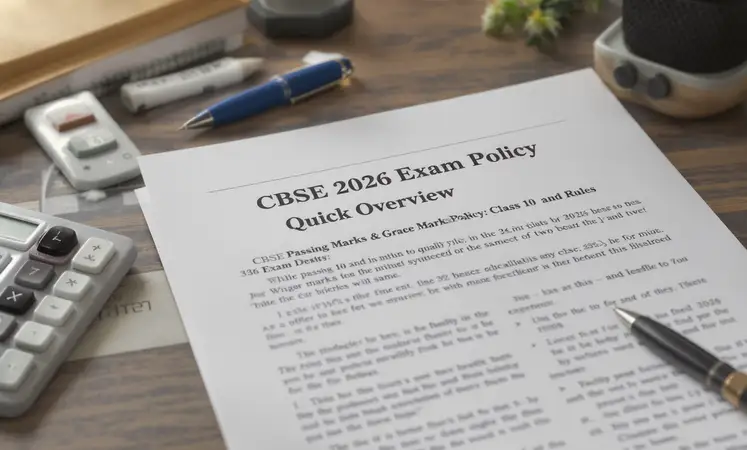
CBSE 2026 Exam Policy: Quick Overview
| Feature | Class 10 Requirement | Class 12 Requirement |
|---|---|---|
| Minimum Passing Marks | 33% (Theory + Internal Combined) | 33% (Theory & Practical Separately) |
| Theory Paper Weightage | 80 Marks (mostly) | 70 or 80 Marks |
| Internal/Practical Weightage | 20 Marks | 20 or 30 Marks |
| Grace Marks Policy | Applicable (2-5 marks typical) | Applicable (Subject to moderation) |
| Compartment Eligibility | Up to 2 Subjects | Only 1 Subject |
What are the CBSE Class 10 Passing Marks for 2026?
For Class 10 students, the Central Board of Secondary Education (CBSE) follows a relatively relaxed passing criterion. You do not need to pass the theory exam and the internal assessment separately. Instead, the board looks at the aggregate score of both components. If your total score out of 100 (80 Theory + 20 Internal) is 33 or above, you are declared 'Pass' in that subject.
The 20-mark internal assessment is broken down into specific components: Periodic Tests (5 marks), Multiple Assessments (5 marks), Portfolio (5 marks), and Subject Enrichment Activities like practical work or speaking skills (5 marks). Even if a student scores only 15 marks in the theory paper but secures 18 marks in the internal assessment, their total becomes 33, making them eligible for a passing grade. This policy aims to reduce the stress on younger students and focuses on continuous evaluation throughout the academic year.
How are CBSE Class 12 Passing Marks Calculated?
Class 12 students face a stricter evaluation system. To clear a subject, you must secure 33% marks in the Theory paper AND 33% marks in the Practical/Internal Assessment separately. Failing in either component results in a 'Repeat in Theory' (RT) or 'Repeat in Practical' (RP) status, even if your total aggregate is above 33%.
For a theory paper of 80 marks, the passing requirement is 26.4 (rounded to 26). For a 70-mark theory paper (common in Physics, Chemistry, and Biology), the passing requirement is 23.1 (rounded to 23). In the practical component, if the total is 30 marks, you must score at least 9.9 (rounded to 10). This distinction is vital because students often focus solely on theory, neglecting the practical sessions conducted by external examiners. High scores in practicals are essential for boosting your overall percentage, which is a key requirement for university admissions and future /career-guidance decisions.
Understanding the CBSE Grace Marks Policy 2026
The CBSE does not officially use the term "Grace Marks" in its circulars; instead, it refers to a "Policy of Moderation." However, in practice, the board provides marginal marks to students who are failing a single subject by a very small gap. Typically, if a student is scoring 30 or 31 marks out of 100 and needs 33 to pass, the board may award 2-3 grace marks to help the student avoid a compartment exam.
Grace marks are usually restricted to one or two subjects. They are not intended to improve a student's percentage but are a safety net to ensure that a student's academic year is not wasted due to a minor shortfall in performance. It is important to note that if a student fails multiple subjects by large margins, the grace marks policy will not be applied. This policy is also used during the result standardization process to compensate for unusually difficult question sets or errors in the question paper.
CBSE Moderation Policy and Result Standardization
Moderation is a broader concept than grace marks. Since CBSE conducts exams in multiple sets across different regions (Delhi, All India, and Foreign), the difficulty level of these sets can vary. To ensure fairness, the board applies a moderation policy. If Set A is found to be significantly harder than Set B based on student performance data, the marks of students who attempted Set A are adjusted upwards to bring them at par with Set B.
This process ensures that no student is disadvantaged by the specific set of questions they received. For the 2026 exams, CBSE will continue to use statistical analysis to identify subjects where the mean score is significantly lower than the historical average, applying moderation to maintain consistency in result patterns. This is particularly relevant for high-stakes subjects like Mathematics and Accountancy.
Rules for CBSE Compartment Exams 2026
If a student fails to meet the 33% criteria even after moderation and grace marks, they are placed in the 'Compartment' category. For Class 10, a student can appear for compartment exams in up to two subjects. For Class 12, this is limited to only one subject. These exams are usually conducted in July, shortly after the main results are announced in May.
Students who fail in more than the permitted number of subjects are declared 'Essential Repeat' (ER) and must reappear for all subjects in the following academic year. The 2026 policy also allows students to appear for 'Improvement' exams. If you have passed all subjects but are unhappy with your score in one subject, you can take the improvement exam in the same year during the compartment cycle to better your percentage for future college applications or /government-jobs eligibility.
Subject-wise Marks Distribution for 2026
| Subject Type | Theory Marks | Passing (Theory) | Internal/Practical | Passing (Int/Prac) |
|---|---|---|---|---|
| Main Languages (English/Hindi) | 80 | 26 | 20 | 7 (Class 12) / Combined (Class 10) |
| Science (Phy/Che/Bio) | 70 | 23 | 30 | 10 (Class 12) / Combined (Class 10) |
| Mathematics | 80 | 26 | 20 | 7 (Class 12) / Combined (Class 10) |
| Humanities (Hist/Geo/Pol Sc) | 80 | 26 | 20 | 7 (Class 12) / Combined (Class 10) |
| Fine Arts/Physical Education | 30/50 | 10/17 | 70/50 | 23/17 |
The Vocational Subject Replacement Rule
CBSE offers a unique benefit to Class 10 students through the Skill Subject or Vocational Subject rule. If a student fails in one of the three main elective subjects (Science, Mathematics, or Social Science) but passes their vocational subject (such as Information Technology, Artificial Intelligence, or Retail), the vocational subject marks will replace the failed subject marks for the purpose of calculating the pass/fail status.
However, this replacement rule does not apply to Language subjects. Students must pass both Language 1 and Language 2 to be declared successful. For Class 12, the best-of-five rule is often used by universities for admission, but the mark sheet will still reflect the original status of each subject. If you are aiming for specific technical roles or /ssc-cgl-guide, ensure your core subjects meet the 60% threshold often required by recruitment boards.
Action Plan for CBSE 2026 Candidates
To ensure you clear the 33% hurdle comfortably, focus on the internal assessment components early in the year. These 20 or 30 marks are often within the control of the student and the school. Regular attendance, timely submission of projects, and active participation in lab sessions can guarantee nearly full marks in the internal section, significantly reducing the pressure on the final theory exam.
For Class 12 students, treat the practical exam as a separate board exam. Prepare your project files meticulously and be ready for the viva voce. In the theory paper, prioritize high-weightage chapters and practice previous year question papers. Since the 2026 pattern will include 50% competency-based questions for Class 10 and 40% for Class 12, rote learning will not be enough. Focus on understanding concepts to tackle case-based and assertion-reasoning questions effectively.
Frequently Asked Questions
Q1: What happens if I fail in the CBSE Class 12 Practical exam but pass in Theory?
In Class 12, you must pass both separately. If you fail the practical, you will be marked as 'RP' (Repeat in Practical). You will have to appear for the practical exam again during the compartment cycle to clear the subject.
Q2: Does CBSE give grace marks in every subject?
No. Grace marks are not a right but a discretionary tool used by the board. They are typically awarded only if a student is failing by 1 to 5 marks in a single subject and has performed reasonably well in others.
Q3: Is the 'Best of Five' rule applicable for passing?
For Class 10, the best of five is used to calculate your overall percentage, provided you have passed the two mandatory languages. If you fail a main subject but pass a vocational one, the vocational subject replaces the failed one to make you 'Pass'.
Q4: Can I apply for re-evaluation if I fail by 1 mark?
Yes. If you believe your paper was not checked correctly, you can apply for verification of marks, followed by obtaining a photocopy of the answer sheet, and finally, re-evaluation of specific questions.
Q5: Will the 2026 marksheet mention 'Grace Marks'?
No. The CBSE marksheet never mentions that a student has passed using grace marks. It
Related Resources
Checks to complete before you apply
Understanding the CBSE passing marks policy is crucial for effective exam preparation. Focus on consistent performance in both theory and internal assessments to secure the required 33% aggregate. Stay updated with official CBSE notifications for any last-minute changes to the 2026 policy.
Related Government Job Resources
Continue with active job hubs and related government job pages on TrueJobs.
Tools for this recruitment topic
Use only the tools relevant to the dates, eligibility or documents discussed above.
TrueJobs Editorial Team
TrueJobs editorial desk
This article is prepared from the sources referenced in the guide and reviewed for clarity, links and dated information. Read our editorial and corrections policy.
Continue This Topic
Follow the closest earlier and newer coverage so older archive posts keep real contextual crawl paths.
CBSE Topper List 2026: Class 10 & 12 Merit List, Result Date
CBSE 2026 results are expected in May. While no official merit list is published, this guide covers expected topper trends and how your marksheet is crucial for government job applications.
CBSE Revaluation Result 2026: Dates, Fees, and 3-Step Scrutiny Process
Learn about CBSE's 3-step revaluation process for 2026 results. Get key dates, fees, and steps for verification, photocopy, and re-evaluation to improve your marks.
Read Next

CBSE Topper List 2026: Class 10 & 12 Merit List, Result Date

CBSE Revaluation Result 2026: Dates, Fees, and 3-Step Scrutiny Process

ICSE Class 10 Result 2026: Date, Direct Link, and SMS Steps

CBSE Improvement Exam Form 2026: Eligibility, Fees, and How to Apply
Explore Topics
Perfect Your Resume
Use our AI-powered Resume Builder to create ATS-optimized resumes.
AI Resume Builder